What exactly are you paying for when a quote says synthetic PU? I have answered that question from a trade desk for fifteen years. Most buyers compare one number: price per meter. That is like judging a car by its paint. The quote sheet itself tells you almost everything, if you know which lines to read and which answers to demand.
This guide covers the five line items that decide whether a quote is fair. It closes with two questions that sort strong suppliers from weak ones in a single email.
Synthetic PU on Paper: The Five Line Items That Matter
Every serious quote lists the same five lines. Thickness in millimeters, with a stated tolerance. Weight in gsm. The base fabric, ideally woven polyester with its own weight. The coating process, dry or wet. And the topcoat, including additives for fire or hydrolysis resistance. A quote missing any of these lines is not a quote. It is a guess with a price attached.

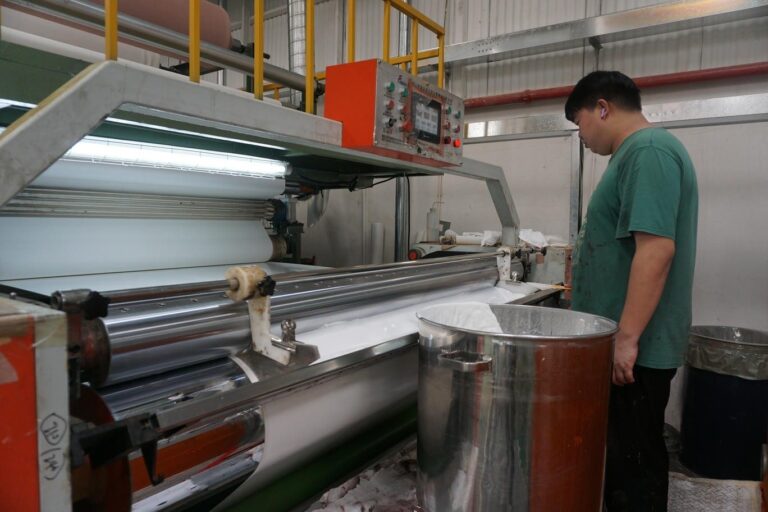
The coating line is where every line item on your quote becomes physical.
Thickness Is Not a Quality Score
Buyers often treat thickness as a proxy for quality. The measurement itself says otherwise. Thickness records depth in millimeters, while gsm records mass per square meter. A foamed sheet can read thick but feel light. A dense sheet can read thin but weigh heavy. Industry guides for bag makers place most handbags at 0.8 to 1.0 mm, and structured bags at 1.0 to 1.2 mm. Those bands describe intended use, not grade.
Gauge pressure matters too. Foam layers compress under a heavy gauge foot. The same roll can measure differently at two factories. Professional specs state the target, the tolerance, and the method together, so every side measures the same way.

Coating, foam, backing: total thickness alone tells you very little about this stack.
Two Questions That Expose a Weak Synthetic PU Supplier
Ask every candidate the same pair of questions. First: which standard did you use to measure this thickness? Second: may I see the abrasion and hydrolysis reports for this exact grade? Strong suppliers answer with document numbers. Weak ones answer with adjectives. We publish our build details openly on the silicone leather introduction page. Our full versus semi silicone comparison shows how we present trade-offs in writing.

Water-cooling section: the kind of process detail a complete quote will disclose.
About TOPSUN Silicone Leather
TOPSUN manufactures silicone and PU-coated fabrics in a dedicated coating plant. Our lines run 500,000 meters per month, with MOQs from 500 meters and lead times of 7 to 15 days. Every grade ships with test data, because a spec you cannot verify is a spec you cannot trust. Request swatches through our samples center and compare them against any quote in your hand.
Frequently Asked Questions
Is thicker synthetic PU always better quality?
No. Quality comes from how the coating, foam, and base fabric are engineered together. A well-built 1.0 mm sheet will outlast a poorly bonded 1.4 mm one in almost any service.
Which lines must every synthetic PU quote include?
Thickness with tolerance, weight in gsm, base fabric type, coating process, and topcoat details. A missing line is a fair reason to walk away.
The 60-Second Quote Check
Run this check on your next quote. Confirm all five line items are present. Ask the two questions above. Compare gsm against thickness instead of reading one alone. Then order swatches and test them against your real use case. Synthetic PU rewards buyers who read the paper before they judge the price, and it quietly punishes everyone else.
References
- https://pubagfactory.com/the-complete-guide-to-… — PU leather thickness bands by use: 0.8-1.0 mm for most handbags, 1.0-1.2 mm for structured bags; grade labels vary between suppliers; spec language matters in OEM orders
- https://taiteleather.com/pt/synthetic-leather-t… — thickness (mm) vs weight (gsm) are related but not interchangeable; layered build of coating, foam, and base fabric; gauge pressure and measurement method change readings