Who actually runs the coating line behind your next order? On sourcing platforms the label says “manufacturer” in every profile. In reality, a large share of listings belong to trading companies that resell from someone else’s production floor. Telling real synthetic leather manufacturers from resellers is the highest-leverage check a procurement team can run. It controls price, QC depth, and who answers the phone when a batch goes wrong.
This article uses market data to frame the stakes, then narrows to the paperwork. Three documents, verified in order, will answer the factory question before you spend a dollar on samples.
| Market segment | 2026 size | 2034 forecast | CAGR |
|---|---|---|---|
| Synthetic leather, all types | $50.78B | $79.29B | 5.7% |
| Asia Pacific share (2025) | 59.13% | — | — |
The Market Behind Synthetic Leather Manufacturers
A $50 billion market attracts every kind of middleman. Industry analysts project the global synthetic leather market to grow from $50.78 billion in 2026 to $79.29 billion by 2034. Asia Pacific alone holds nearly 60% of the share. Growth at that pace pulls thousands of new sellers into export channels each year. Most of them present themselves with the same factory photos and the same vocabulary.
The money at stake is not abstract. Studies of procurement failures suggest sourcing errors can add 12 to 15% to total acquisition costs. On a container program, that premium alone can exceed the price gap between a reseller quote and a factory quote.
Growth also changes how wholesale synthetic leather suppliers compete. Ten years ago, catalogs differentiated on price alone. Today the winners differentiate on verification: open audit policies, batch-level test data, and production transparency. Buyers who build those three checks into their RFQ template filter out most resellers before the first phone call, which is exactly where the filtering belongs.

Real inspection happens beside the production line, not in a stock photo library.
Factory or Trading Company: Reading the Business License
Start with the business license, and read the scope line, not the logo. A genuine manufacturer lists coating, lamination, or synthetic leather production under its registered business scope. A reseller’s license typically lists trading, import-export, or commerce. Neither is illegal, but the mismatch matters: you deserve to know which one is quoting you.
Then ask for proof tied to physical assets, because paper alone is easy to fake:
- A live video walk of the coating line, recorded during production hours, not on a weekend.
- Base fabric roll inventory on site. Factories that stock substrate are stable; factories that buy per order are brokers with a warehouse.
- Export records to your region, with at least two reference customers willing to answer one email.
One more tell costs nothing: cross-check the registered address. A production address sits in an industrial zone and shows up on satellite maps with loading bays. A reseller address sits in an office tower. We have watched buyers waste entire quarters on suppliers whose “factory” was a shared co-working desk with a good website.
Six Documents That Predict Quality Before the Deposit
Our QC team hosts buyer audits almost every month. The same pattern repeats: buyers who review documents before sampling almost never meet us at the claim stage. Six documents do most of the predictive work:
- 1. Curing-tunnel temperature logs from the last 30 days. Real lines log automatically; fake ones scramble.
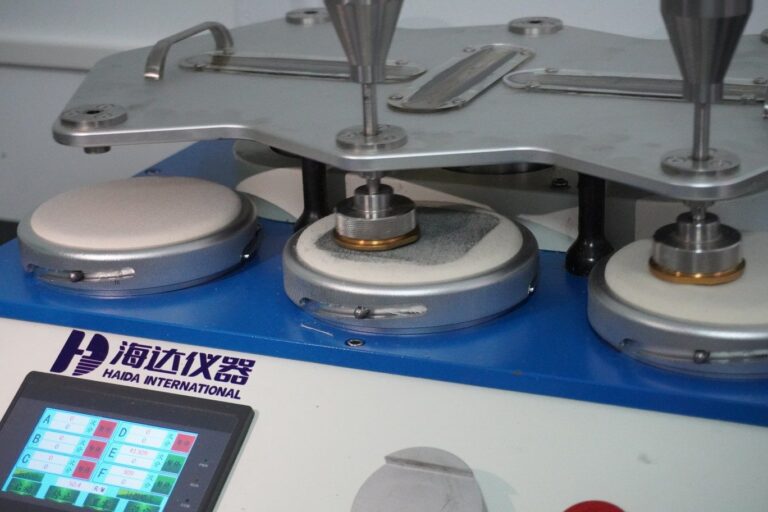
- 2. QC lab calibration certificates for the Martindale tester, tensile frames, and color spectrophotometer.
- 3. A recent FQC report listing roll-by-roll results. A single “PASS” stamp for a 500-roll shipment is a red flag.
- 4. Third-party lab reports (SGS, BV, or TÜV) dated within the year, on the exact product family you are buying.
- 5. ISO 9001 certificate with a scope that covers coating production, verified against the issuing body’s registry.
- 6. Substrate traceability records linking a finished roll back to a base fabric batch and a coating formula.
A factory that produces these in 48 hours is a factory. A supplier that stalls, blames the holiday calendar, or sends stock images is telling you something too. Want to see a production walkthrough first? Our factory production process page documents each stage from substrate to finished roll.

Coating rollers never lie: the line is either running or it does not exist.
Request Synthetic Leather Samples
Certifications That Actually Predict Consistency
Not all certificates deserve equal weight. ISO 9001 is the baseline for any serious supplier; it proves a management system exists, nothing more. For automotive work, the bar rises sharply. Buyers restrict sourcing to facilities certified under IATF 16949. That standard enforces continuous improvement and targets defect rates below 500 parts per million.
End-use dictates the checklist. Medical programs need ISO 10993 biocompatibility files. Furniture headed to Europe needs REACH documentation with PAH screening. Marine and outdoor programs lean on salt-spray and UV data rather than paper certificates. Matching the certificate to the application is where generalist resellers stumble. They hold one generic ISO file and offer it for every use case.
We publish our own compliance stack on our silicone leather supplier profile, including FDA food-contact and EN 13773 flame ratings. Every order ships with SGS test reports. For automotive programs specifically, our automotive interior applications page lists the FMVSS 302 and low-fogging data OEM buyers request first.
Is a trading company always a bad sign?
No. Good trading companies add value in consolidation, communication, and small-order flexibility. The problem is opacity. If a reseller discloses its partner factory, arranges your audit there, and marks up transparently, the model works. What fails programs is a reseller posing as the factory.
Do I need IATF 16949 for non-automotive orders?
Not strictly, but treat it as a proxy. A factory that maintains IATF-level process discipline applies the same habit to furniture or medical rolls. Few certificates predict batch-to-batch consistency that well.

Substrate inspection before coating: a habit only real production floors maintain.
Inside our QC line: the checks your documents should describe, on camera.
MOQ, Lead Time, and the Questions Resellers Dodge
Capacity questions expose middlemen faster than any certificate. Ask a real factory for its monthly output and it answers with a number and a floor plan: ours runs 500,000 meters per month across multiple coating lines. Ask for standard lead time and it quotes a window with confidence. Our own programs ship in 7 to 15 days depending on finish and volume.
Then probe the awkward edges. What happens to your order when a larger buyer takes the line? Resellers discover schedule conflicts after the deposit. Factories know their booking pipeline and quote honestly against it. What is the true MOQ, and why? We set ours at 500 meters because that is one full production changeover, not an arbitrary gate.
Finally, ask who owns the formula. A factory holds its coating recipes, substrate sources, and release-paper library in house. That ownership is why the same texture reproduces identically two years later. When a reseller “reorders” your custom grain, the message travels through someone else’s production planner, and variance creeps in.
A Case From Our Claim Files: The Sample Matched, the Shipment Did Not
One furniture importer we work with learned this lesson before it cost them. They had approved a sample from a new supplier and ordered a 3,000-meter production run. The shipment arrived, and the surface grain looked right. Within a month of upholstering, however, their factory reported coating separation at the seams during high-speed sewing.
Our lab ran the comparison they never got from the original seller. The approved sample measured 22 N/cm peel strength. The production rolls measured between 9 and 11 N/cm, under the ISO 2411 general-use minimum of 15 N/cm. Same catalog number, same color, different production run, and no document trail connecting the two.
The importer recovered partially through a chargeback, but the season was lost. The fix they adopted is the one this article recommends: batch-level test reports before shipment, and a named factory contact who can explain any deviation. Samples certify themselves. Only documents certify shipments. One batch report would have caught the mismatch in a single email.
Choose the Coating Line, Not the Brochure
Every claim in this guide reduces to one habit: verify documents that only a production floor can generate. Market growth will keep flooding the channel with new sellers. The difference between real synthetic leather manufacturers and resellers stays invisible until a batch fails, unless you ask for the paperwork first. Business license, temperature logs, third-party reports: three documents, forty-eight hours, and the middleman question is closed.
None of this requires suspicion, only sequence. Verification before sampling, sampling before deposit, and batch documents before shipment. Buyers who run that order sleep well; the rest fund the reseller margin.
About TOPSUN
TOPSUN operates its own coating and lamination lines for silicone leather, producing 500,000 meters monthly for buyers in 30+ countries. Buyer audits and third-party inspections are welcome on site.
In-line coating thickness monitoring, curing temperature verification, and spectrophotometer Delta E control run on every production batch.
References
1. https://www.fortunebusinessinsights.com/synthet… — global synthetic leather market $50.78B (2026) to $79.29B (2034), CAGR 5.7%; APAC 59.13% share (2025)
2. https://www.hh-mf.com/5-sourcing-pitfalls-plagu… — sourcing errors add 12-15% to acquisition costs; IATF 16949 targets defect rates below 500 PPM