Steam rises off the washing lines at 5:40 in the morning. At a garment finishing mill in northern Portugal, the water draining from an industrial washer no longer heads for the sewer. It enters a treatment loop, and it comes back clean enough for the next load. The same water has now made that trip hundreds of times. This is not a pilot project. It is a running production line with numbers attached. This article breaks down what sustainable textile production means at line level, using three working cases and one decision tree. The ledgers to watch are water, process, and chemistry.
What Sustainable Textile Production Actually Means
Strip away the marketing language, and the phrase describes three measurable things. First, inputs: how much water, energy, and chemistry each meter of fabric consumes. Second, process: how much of each input is recovered and reused instead of discharged. Third, outputs: what leaves the factory as waste, emission, or product, and how long that product lasts in service.
The market has already moved. The global sustainable textiles market was valued at USD 66.19 billion in 2025 and is projected to reach USD 180.46 billion by 2035, a 10.55% CAGR. Europe holds the largest revenue share at 36%. For buyers, that growth means suppliers now compete on production claims. The rest of this article shows which claims survive contact with a factory floor.
The Water Ledger: Where Textile Production Loses Most
Textile production is a water business. The industry consumes about 93 billion cubic meters of water per year, roughly 4% of global freshwater withdrawal. Dyeing and finishing are the hungriest steps, and they are also the most polluting ones. A single conventional finishing cycle can push 100 liters of water through one garment. Most of that water leaves the plant once, carrying dye, chemicals, and heat with it.

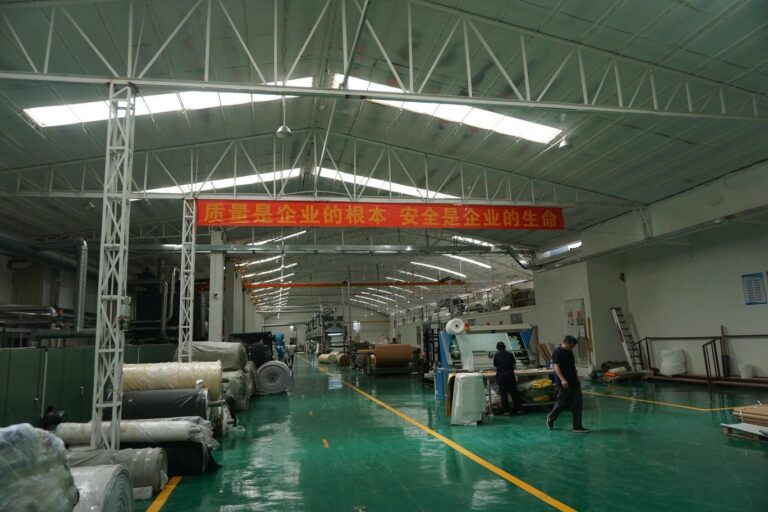
Coating line panorama: the stage where water, energy, and chemistry decisions concentrate.
The table below compares the conventional baseline with the practices that verified cases now report.
| Ledger | Conventional baseline | Sustainable practice | Verified result |
|---|---|---|---|
| Water | Single-pass wash, then discharge | Closed-loop treatment and reuse | 98% reuse |
| Finishing | About 100 L water per garment | Laser and ozone-based techniques | Down to 1 L |
| Chemistry | Solvent-based coating with plasticizers | Solvent-free silicone coating | Non-detect VOC (ISO 16000-6) |
Case: From 100 Liters to 1 at a Portuguese Mill
The mill belongs to Pizarro, a Portuguese garment finishing company. Jeanologia coordinates the project, and AITEX, the Spanish textile research institute, validates the results. Together they run LIFE ANHIDRA, a demonstration project funded by the EU LIFE programme.
The core is an H2Zero water treatment system. It treats wastewater in a closed loop and returns it to the washing machines without additional chemical dosing. The reported results are specific. Water use dropped 92%. Water reuse reached 98%. One facility saves 123,408 cubic meters per year, about 21,000 cubic meters over 60 operating days. The system also recovers textile fiber from the wastewater and valorizes it instead of shipping it to landfill.
The replication plan matters for buyers. The project targets 36 EU facilities within three years and at least 100 systems worldwide within five. That scale corresponds to potential savings up to 12.34 million cubic meters of water per year.
Inside a controlled coating line: why process discipline, not slogans, produces the numbers.
Process Innovation: 20 Techniques, 3 Billion Liters
Hardware is not the only lever. Levi Strauss & Co. has run its Water<Less program since 2011 with more than 20 manufacturing techniques. One technique replaces the fabric-softener wash with tumbling denim alongside bottle caps and golf balls. That single change saved 96% of the water in that finishing step. Across the program, the company reports more than 3 billion liters saved and another 5 billion recycled.
The lesson for procurement teams is plain. Sustainable textile production is a set of process decisions, not one machine purchase. Ask a supplier which steps changed. Then ask for the per-unit number.
The Chemistry Ledger: Solvent-Free Coating and Near-zero VOC
The third ledger is the least visible and the easiest to audit. Conventional coated fabrics often rely on solvent-based PU systems. Solvents carry VOC into the workshop air, and plasticizers migrate out of the film over time. That migration is one reason PU upholstery cracks within 3 to 5 years.
Our own line answers this at the source. TOPSUN coating runs a 100% solvent-free silicone system with zero plasticizers. VOC testing per ISO 16000-6 returns non-detect results. Curing temperature is verified at each station, and coating thickness is monitored in line, so the chemistry you approve is the chemistry that ships. The full station-by-station walkthrough is on our factory production page. The flow below shows where each control point sits.

Process flow: each station carries its own control point, from substrate to final cure.
Verification: Numbers That Travel With the Roll
Claims multiply. Documents decide. A credible sustainable production claim comes with three artifacts. First, a named test standard, such as ISO 16000-6 for VOC or ISO 12947 for abrasion. Second, a report from an accredited third party. SGS reports travel with every TOPSUN order, and inspection through SGS, BV or TÜV at the factory is welcome. Third, a batch number that ties the report to the roll you receive.
Energy belongs on the same audit list. Curing ovens are the energy center of a coating line. That is why curing temperature verification matters twice: once for product quality and once for energy discipline. The certification stack behind our eco-friendly silicone leather process is documented page by page.

Curing oven: the energy center of the line, where verified temperature settings pay off twice.

Final inspection: reports and batch numbers travel with every roll.
A Decision Tree for Your Next Supplier Audit
Use this sequence before your next order.
- If a supplier claims sustainable production, ask which ledger it improves: water, process, or chemistry.
- If water: request the reuse rate in percent and the saved volume in cubic meters per year.
- If process: ask which step changed and what the per-unit resource figure is now, versus before.
- If chemistry: request the VOC result per ISO 16000-6 and written confirmation of zero plasticizers.
- If a number does not come back within a week, treat the claim as marketing.
- If the numbers arrive and hold, move to samples with test reports attached.
One more threshold worth setting. A supplier who volunteers batch numbers and third-party inspection options has already passed a test many never attempt.
About TOPSUN
TOPSUN is a silicone leather manufacturer focused on B2B custom production for automotive, furniture, medical, and marine programs across 30+ countries.
100% solvent-free coating with non-detect VOC (ISO 16000-6), multi-stage QC from raw materials to final roll, SGS reports on every order, 500,000 m monthly capacity with a 500 m MOQ.
Request Samples With Test Reports
References
- https://www.towardschemandmaterials.com/insight… — Sustainable textiles market USD 66.19B (2025) to USD 180.46B (2035), CAGR 10.55%; Europe 36% revenue share
- https://environment.ec.europa.eu/topics/circula… — Textile industry uses 93 billion m3 of water yearly (4% of global); LIFE ANHIDRA: 92% water cut, 98% reuse, 123,408 m3 saved per facility yearly
- https://www.levi.com/CA/en_CA/features/waterles… — Water<Less program: 20+ techniques since 2011, 3 billion liters saved plus 5 billion recycled, 96% finishing water cut