I’ve audited over 50 leather suppliers in the last three years — and I can tell you that the gap between a supplier’s pitch and their actual delivery performance is where most procurement budgets die. The suppliers who look best on paper aren’t always the ones who ship on time, pass batch QC, and maintain color consistency across reorders. If you supply leather to manufacturing lines that can’t tolerate delays or material substitution, you need a qualification process that catches problems before the first invoice.
Request Supplier Qualification Kit
The 8 Checks Every Supply Leather Partner Must Pass
Before you place a single order, run these eight qualification checks. I’ve seen buyers skip three or four of these and pay for it in warranty claims, production delays, and emergency sourcing at 2x the normal price. Here are the five most critical checks — the remaining three I’ll cover in the audit checklist section.
| # | Qualification Area | What to Verify | Pass Criteria | Red Flag |
|---|---|---|---|---|
| 1 | Certifications | REACH, ISO 9001, ISO 10993 (if applicable) | Current, third-party verified | Expired or self-issued certs |
| 2 | Production capacity | Monthly output vs your peak demand | ≥2x your max order volume | Capacity equals your order only |
| 3 | Batch consistency | Delta E color matching across batches | Delta E ≤ 1.0 | “Close enough” without data |
| 4 | Lead time reliability | On-time delivery rate over 6 months | ≥95% on-time, documented | Vague estimates, no tracking |
| 5 | Compliance documentation | Batch-level test reports from accredited labs | SGS or Intertek reports per shipment | One-time certificate only |

Quality inspection in progress — the kind of verification your supplier should perform before every shipment
A supplier who can’t produce batch-level test reports from accredited labs is a supplier who can’t guarantee what’s in the box. One-time certificates prove a single sample passed — not that your production run will.
Why Traditional Leather Supply Chains Are Breaking in 2026
The traditional leather supply chain — hide sourcing, tanning, finishing, distribution — was never designed for the transparency and compliance demands that B2B buyers face today. When I evaluate whether to source natural leather vs synthetic leather for B2B manufacturing, the supply chain risk profile is often the deciding factor, not the material properties.
Natural leather supply chains carry compounding risks: cattle hide quality varies with climate and feed conditions, tannery capacity is concentrated in regions with increasing environmental regulation, and post-Brexit customs friction has extended lead times for UK and EU buyers. Chrome tanning faces regulatory pressure from REACH chemical restrictions administered by ECHA. Vegetable tanning is cleaner but slower and produces inconsistent results across batches.

Quality and safety standards displayed on the factory floor — visible commitment to compliance
For buyers evaluating potential supply partners, the question isn’t just “can they deliver?” — it’s “can they deliver consistently, compliantly, and transparently for the next five years?” Traditional leather supply chains struggle with all three.
How Silicone Leather Supply Eliminates Procurement Risk
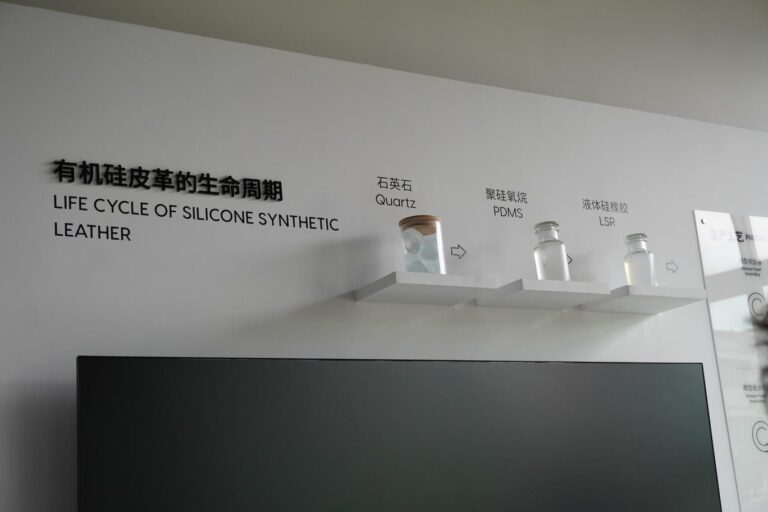
Silicone leather replaces supply chain volatility with manufacturing predictability. Instead of sourcing raw hides from abattoirs and tanneries, silicone leather is produced from controlled raw materials on automated coating lines. The factory-direct supply model means you’re buying from the manufacturer — not through three layers of distributors who each add lead time and margin.
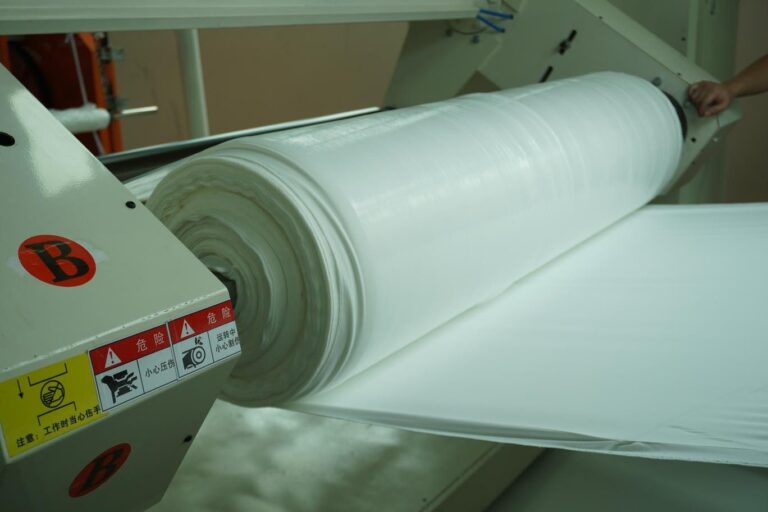
Inside TOPSUN’s factory quality control process — batch-level testing and verification before shipment
From a procurement perspective, this changes the math. Factory direct leather supplier wholesale MOQ at 500 meters with 7–15 day lead times means you can order closer to production demand — less inventory, less working capital tied up, less risk of material obsolescence. Monthly capacity of 500,000+ meters means even peak-season demand doesn’t strain the supply line. And every batch ships with test reports from our factory production process — Martindale, UV, flex, and color fastness data from SGS or Intertek.

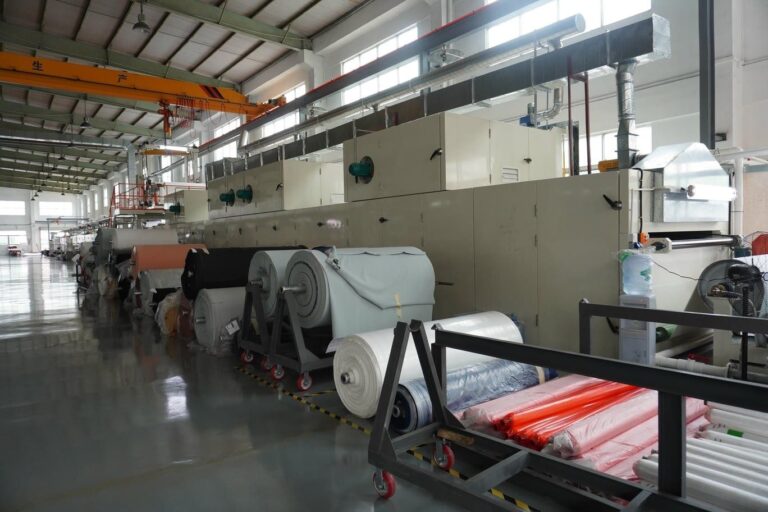
Finished rolls ready for shipment — factory-direct supply eliminates intermediary delays and cost layers
We’ve onboarded clients who previously spent 4–6 weeks waiting for tannery deliveries. After switching to silicone leather supply, their material lead time dropped to under two weeks. One automotive interior manufacturer reduced their safety stock by 35% because the supply rhythm became predictable enough to trust just-in-time ordering.
Building a Supply Leather Audit Checklist for Your Team
Here are the remaining three checks (6–8) to complete your supplier qualification framework. Together with the five above, these form the audit checklist I use when evaluating any new supply leather partner:
- Check 6 — Sample approval process: Does the supplier provide free A4 swatches via DHL/FedEx within 3 business days? If sample turnaround is slow, production turnaround will be worse.
- Check 7 — Customization capability: Can they produce custom embossing rollers in 7–10 days? Can they match Pantone colors at Delta E ≤ 1.0? If not, your design flexibility is limited by their capability.
- Check 8 — Financial stability: How long have they been operating? Do they serve 100+ brands? A supplier with 5 years of operation and a diversified client base is less likely to disappear mid-contract.

Quality inspection at the manufacturing facility — a standard step in supplier audit and qualification
For a structured approach to supplier auditing, our fabric supplier China audit guide walks through the on-site evaluation process. And for compliance documentation standards, the textile manufacturing compliance reference outlines the regulatory framework you should require your supplier to meet.
Whether you’re sourcing genuine leather, synthetic alternatives, or silicone leather, the qualification framework is the same. What changes is how easily a supplier can pass each check — and silicone leather manufacturers, with their controlled production lines and batch-level documentation, typically pass all eight without the caveats that traditional tannery supply requires. Explore our application-specific supply capabilities to see how this works in practice.
Frequently Asked Questions
What certifications should a supply leather partner have for B2B manufacturing?
At minimum: ISO 9001 for quality management, REACH compliance for chemical safety, and RoHS for heavy metals. For medical or child-contact applications, add ISO 10993 biocompatibility and EN 71 toy safety. For automotive interiors, add FMVSS 302 flame retardancy and ELV Directive compliance. For aviation, FAR 25.853 is required. A qualified supplier should provide current, third-party-verified certificates — not expired or self-issued documents. Require batch-level test reports from SGS or Intertek for ongoing shipments, not just a one-time certificate.
How do I verify a leather supplier’s production capacity before placing a bulk order?
Request three data points: monthly production output in meters, number of automated production lines, and current capacity utilization rate. A supplier producing 500,000+ meters per month across 10+ automated lines with sub-80% utilization can absorb your peak demand without disrupting other clients. If capacity utilization exceeds 90%, the supplier is running at peak and your orders may face delays during high-demand periods. Ask for production scheduling documentation and verify with a factory audit if the order value justifies it.
Qualify First, Order Second
The cost of qualifying a supply leather partner properly is a fraction of the cost of discovering they can’t deliver after you’ve committed. Eight checks, one factory audit, and a sample order — that’s the investment that separates procurement teams who supply leather reliably from those who fight fires every quarter. In 2026, the suppliers who pass all eight checks are increasingly the ones who control their production from raw materials to finished rolls. That’s the supply chain model that silicone leather manufacturers have built — and it’s the model that traditional leather sourcing is struggling to match.
About TOPSUN
TOPSUN supplies leather materials to B2B manufacturers worldwide, combining 500,000+ meters of monthly silicone leather capacity with 7–15 day lead times and batch-level test documentation.
Our REACH-compliant, ISO 10993-certified production lines serve 100+ brands across automotive, furniture, medical, and consumer electronics — every shipment arrives with the compliance paperwork your incoming QC team needs.