Analyzing 300+ B2B procurement specifications each quarter, I see silicone leather future trends converging into five forces that will redefine what “premium synthetic leather” means by 2030. The material that sat in the eco-niche corner in 2023 — valued at $217 million globally — is now projected to reach $536 million at a 14.0% compound annual growth rate. Yet most procurement teams I speak with are still specifying materials based on 2020-era compliance frameworks. The gap between where regulations, automotive OEMs, and circular economy mandates are heading — and what buyers actually have on spec sheets today — is where competitive advantage will be won or lost over the next four years.
Get Trend Briefing with Samples
Market Trajectory: 14% CAGR Signals Mainstream by 2028
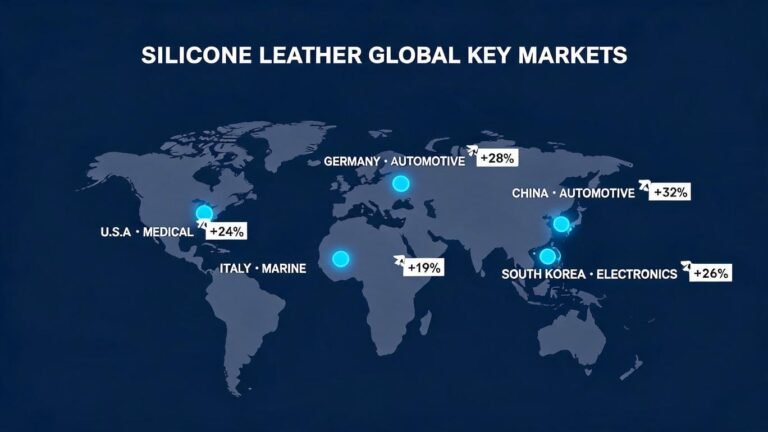
The global silicone leather market is expanding from $217 million in 2023 to a projected $536 million by 2030 — a 14.0% CAGR that dwarfs traditional leather’s approximate 3% annual growth and outpaces the broader synthetic leather sector’s 7.8% rate. Automotive interiors command 42% of downstream demand, driven by EV manufacturers who need lightweight, zero-VOC cabin materials. China holds 34% of global production capacity, meaning supply chain due diligence on Chinese silicone leather manufacturers is becoming a procurement-critical skill. For a detailed breakdown of market segments and growth drivers, see our silicone leather market forecast analysis.

The inflection point arrives around 2028. At current CAGR, silicone leather crosses the $400 million threshold — large enough that Tier 1 automotive suppliers and major furniture manufacturers can no longer treat it as a specialty material. It becomes a specified standard, appearing in RFQs alongside PU and PVC as a default option, not an upgrade.
Regulatory Pressure: EU PFAS Ban Hits Leather October 2026
On October 10, 2026, EU Regulation 2024/2462 takes effect — banning textiles, leather, fur, and footwear containing more than 25 ppb of PFHxA (a perfluorinated substance used in water and stain repellent coatings). Any product exceeding that threshold cannot enter the EU market, regardless of where it was manufactured. The broader PFAS restriction proposal is tracked through ECHA’s PFAS evaluation program. This is one of the most aggressive silicone leather future trends reshaping supplier qualification: PU and PVC coatings that rely on fluorinated water repellents face forced reformulation or market exclusion.
The broader PFAS restriction proposal — covering 10,000+ substances across 14 sectors — is moving through ECHA’s scientific evaluation phase, with EU legislation expected in early 2027. Five member states (Denmark, Germany, Netherlands, Norway, Sweden) submitted the proposal. Silicone leather requires no fluorinated coatings for water resistance — its hydrophobicity is intrinsic to the silicone polymer itself. That means zero reformulation cost when PFAS restrictions tighten. For materials already meeting upcoming standards, our sustainability compliance report documents the regulatory alignment.
EV Interior Revolution: Lightweight and Zero-VOC Become Non-Negotiable
Electric vehicle platforms are driving silicone leather future trends harder than any other application. EV designers strip weight obsessively — every kilogram saved extends range. Silicone leather at 0.7–1.2 mm thickness weighs 15–20% less than equivalent-grade genuine leather while matching or exceeding Martindale abrasion performance at 200,000+ cycles. More critically, EV cabins are sealed environments where volatile organic compounds accumulate. PU coatings emit plasticizers and solvents for months after installation; silicone leather’s platinum-cured formulation emits zero VOCs throughout its lifecycle.

Automotive OEMs including BMW and Mercedes-Benz have already piloted silicone leather in production interiors, and the material’s alignment with VDA 278 VOC testing standards makes specification straightforward. For a sector-by-sector breakdown of how EV interior material requirements are evolving, our automotive interior trends guide covers the testing protocols and OEM expectations.
Smart Surfaces: When Leather Becomes a Sensor Platform
Among silicone leather future trends, smart surface integration is the one most likely to surprise procurement teams. Research programs across Germany and South Korea are embedding capacitive touch sensors directly into silicone leather substrates — turning door panels, armrests, and dashboard surfaces into control interfaces without visible buttons. Silicone’s dielectric stability and thermal resistance (operating range -40°C to 200°C) make it an ideal substrate for printed electronics that would degrade in PU or PVC.

Antimicrobial variants are already commercial — silver-ion-infused silicone leather achieves 99.9% bacterial reduction per ISO 22196 without surface coatings that wear off. For specifiers evaluating next-generation material capabilities, our smart leather technology overview covers current and near-commercial innovations.
Circular Economy: Recyclability Moves from Aspiration to Mandate
The EU Circular Economy Action Plan is phasing in end-of-life recyclability requirements that directly impact material selection. PU and PVC synthetic leather are thermoset-adjacent materials — their crosslinked polymer coatings cannot be cleanly separated from base fabrics, making closed-loop recycling technically impractical at scale. Silicone leather’s polymer architecture allows mechanical recycling: post-consumer material can be ground, re-compounded, and re-coated onto new substrates without chemical degradation.
Several automotive OEMs have set 2030 carbon-neutral targets that require demonstrable end-of-life pathways for every interior material. Materials without a recycling pathway will be disqualified from specification. For buyers assessing material circularity, our leather recycling process analysis compares end-of-life pathways across synthetic leather types.
Silicone Leather Future Trends: 5 Forces Comparison
| Trend Force | Current Status (2026) | 2028 Projection | 2030 Impact | B2B Buyer Action |
|---|---|---|---|---|
| Market Growth | $217M → $536M, 14% CAGR | Crosses $400M; enters Tier 1 RFQs | Default spec option alongside PU/PVC | Qualify 2–3 silicone suppliers now |
| EU PFAS Ban | Reg. 2024/2462 effective Oct 2026 | Broader PFAS law (10,000+ substances) | Fluorinated coatings eliminated market-wide | Audit current materials for PFAS content |
| EV Interiors | 42% automotive share; BMW/Mercedes piloting | EV production volumes require scale | Zero-VOC mandatory for all EV cabins | Request VDA 278 VOC test data |
| Smart Surfaces | R&D phase; antimicrobial commercial | Touch-sensor leather in premium models | Standard for autonomous cabin interfaces | Track OEM smart surface roadmaps |
| Circular Economy | EU Action Plan phasing in | Recyclability required for OEM specs | Non-recyclable materials disqualified | Verify recycling pathway documentation |
For a visual overview of where silicone leather is heading next, watch our market outlook briefing:
Market outlook briefing — where silicone leather is heading next
FAQ: Silicone Leather Future Trends
What is the projected market size for silicone leather by 2030?
The global silicone leather market is projected to reach $536 million by 2030, growing from $217 million in 2023 at a 14.0% CAGR. Automotive interiors account for 42% of demand, with China holding 34% of global production capacity.
How will EU PFAS restrictions affect synthetic leather suppliers after October 2026?
EU Regulation 2024/2462 limits PFHxA to 25 ppb in leather, textiles, and footwear starting October 10, 2026. PU and PVC coatings that use fluorinated water repellents require reformulation. Silicone leather needs no reformulation — its water resistance is intrinsic to the polymer structure. A broader PFAS restriction covering 10,000+ substances is expected to become EU law in early 2027.
Can silicone leather be recycled at end of life?
Yes. Unlike PU and PVC synthetic leather, where crosslinked polymer coatings cannot be cleanly separated from base fabrics, silicone leather can be mechanically recycled — post-consumer material is ground, re-compounded, and re-coated onto new substrates without chemical degradation. This aligns with EU Circular Economy Action Plan requirements phasing in through 2030.
About TOPSUN
TOPSUN develops silicone leather engineered for silicone leather future trends through 2030 — with zero-VOC solvent-free production, PFAS-free REACH-compliant formulation, and recyclable material architecture serving automotive, medical, and consumer electronics markets. Our platinum-catalyzed coating line produces 16,000 meters daily across three production configurations, and our materials meet FDA 21 CFR 177.2600, ISO 10993-5 biocompatibility, and VDA 278 VOC emission standards.
The five forces driving silicone leather future trends — market growth, PFAS regulation, EV interiors, smart surfaces, and circular economy — are not speculative. They have dates, thresholds, and legislative backing. Buyers who wait until 2028 to qualify silicone leather suppliers will face capacity constraints as Tier 1 automotive and furniture manufacturers lock in supply agreements. The window to build supplier relationships, complete material testing, and update spec sheets is now.