Last spring, a bag manufacturer sent us two silicone panels stitched on the same day by the same operator. One seam held through every fold test we ran. The other split along the stitch line inside fifty bends. The fabric was never the problem. The sewable silicone in both panels was identical; the four machine settings were not.
That failure taught our team more about sewing silicone than any datasheet could. Silicone leather behaves differently from PU or PVC under a needle, and the reasons sit in the polymer itself. Below is the diagnosis we ran and the setup that fixed the line.
Where Sewable Silicone Seams Fail First
Three failure modes show up again and again when silicone panels reach the sewing floor. Skipped stitches come first, because a needle at the wrong angle deflects against a dense elastomer and the hook misses the thread loop. Frayed thread follows close behind. Friction against the slick silicone face heats the needle eye and shreds untreated yarn. The third mode is seam grin, where the panel stretches and the stitch line does not.
Our datasheet lists elongation at break above 300% (ISO 3376), so the material moves under load and an ordinary seam cannot follow. The failed client panel told the same story: 2.0 mm stock, a universal needle, and a short 2.5 mm stitch. Every one of those choices made sense for PU. None made sense for silicone.

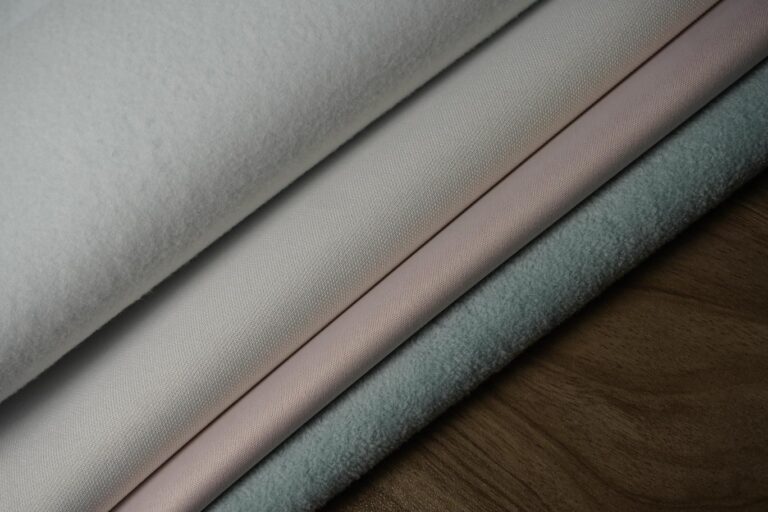
A 1.2 mm off-white panel folded flat. The same drape that makes silicone pleasant to touch also feeds unevenly under a standard presser foot.
Machine Setup: Walking Foot, Needle Size 90/14, Stitch Length
Start with the walking foot. Both faces of silicone leather are slick, and a standard presser foot lets the top layer creep ahead of the bottom one. A walking foot grips and feeds both layers together, which alone removes most skipped stitches. Teams that ask us about the best walking foot for silicone are usually solving the right problem.
Next, the needle. A sharp Microtex in size 90/14 pierces cleanly and deflects less than a ballpoint. Move up to 110/18 for panels at 2.0 mm. Stitch length matters just as much, because short stitches perforate the seam line. Our production baseline sits at 3.5 to 4 mm, and thin stock can stretch to 4.5-6 mm.
| Setting | Baseline | Why It Matters |
|---|---|---|
| Walking foot | Required for two-layer work | Stops the slick top layer from creeping |
| Needle | Microtex 90/14 (110/18 at 2.0 mm) | Sharp point, less deflection, fewer skipped stitches |
| Stitch length | 3.5-4 mm (4.5-6 mm on thin stock) | Dense perforation weakens the seam line |
| Machine speed | Reduced from top speed | Lower friction keeps the thread intact |
Talk to Our Engineers About Sewing Parameters
Thread, Tension, and Sewable Silicone vs Bonded Alternatives
Thread choice decides whether a seam survives the needle heat. Bonded polyester or bonded nylon is the safe answer, since the bonded coating shrugs off the friction that shreds soft yarn. Cotton is out entirely on abrasion and moisture grounds. Keep top tension slightly loose, because silicone compresses less under the foot than foam-backed PU does.
Adhesives look like the easier route until low surface energy enters the picture. Ordinary contact cement peels off untreated silicone. Dedicated systems rely on a silicone adhesive primer to bond at all, and every primer step adds cure time plus one more failure point. Sewing keeps the joint mechanical. This is also where the sewable silicone vs solid silicone sheet question settles: the fabric backing gives the needle something to lock into, and unsupported sheet offers nothing.

Fabric backing on a lychee-grain panel. The backing is what a needle locks into, which is why backed sheet outperforms unsupported film at the seam.
The Result: 100,000 Flex Cycles With Seam Integrity
We rebuilt the client’s setup around four changes: walking foot, 90/14 needle, 4 mm stitches, bonded polyester thread. Sewn assemblies then ran on our flexing rig beside bare material rated at 100,000 cycles or more under ISO 5402. The seams held the full program with no grin and no splits. Every panel is cut and sewn in our own workshop, and the in-house production process page shows the lines behind that result.
Watch a silicone leather sample run through our flexing rig, cycle after cycle.
Buyers who search how to sew silicone leather usually expect some exotic technique. The honest answer is a short settings list and a sharp needle. The same recipe now ships in finished goods for fashion and sports brands, where seams take repeated flexing and abuse.
Medical buyers have a simpler reason to care. Sewn seams leave no adhesive residue, so wipe-down schedules stay predictable. Our medical and healthcare applications page covers the certification path for sewn covers in clinical settings.

Finished small goods sewn from silicone panels. When the four settings are right, the seam disappears into the design.
Sewable Silicone Rewards the Right Setup
Sewable silicone is not hard to sew. It is unforgiving of the wrong settings, and a walking foot with a sharp 90/14 needle turns it into the most predictable high-performance material on your sewing floor. Dial in those four settings once, and the seam stops being a variable in your quotes.
Request Sewable Silicone Samples
Can you sew silicone leather on a home sewing machine?
Yes, on thin stock. Panels at or below 1.2 mm sew well on domestic machines with a walking foot, a 90/14 needle, and a longer stitch. Production loads above 1.5 mm need an industrial machine with enough presser-foot lift and clearance.
What thread works best for sewable silicone?
Bonded polyester or bonded nylon, sized to match the needle. The bonded coating resists the friction that shreds softer yarns. Avoid cotton entirely, and keep top tension slightly loose so the elastic face does not pucker between stitches.
About TOPSUN
TOPSUN engineers sewable silicone leather for medical covers, sports gear, and small leather goods where the seam has to outlast the panel itself.
In-house base-fabric coating, 0.8-2.0 mm thickness customization, flex-tested sample panels, and sewing parameter guidance shipped with every sample order.
References
1. https://wandaoleather.com/blog/what-is-silicone… — Stitch length 3-4 mm, sharper needle advice, and primer-based adhesive systems for low surface energy silicone.
2. https://fabricfunhouse.com/pages/sileather — Walking foot recommendation, 90/14 to 110/18 needle range, and 4.5-6 mm stitch length guidance.