The roll arrived at our lab with a complaint file, not a welcome note. Two thousand meters of automotive PVC leather, bought against a one-line RFQ: 1.0 mm, embossed grain, black. The order named the material, never the manufacturing process behind it. By week three of sewing, three defects had surfaced. The grain washed out around every seam. Thickness drift jammed the feed dogs. The cabin odor panel flagged the lot twice.
The buyer asked us the question the RFQ never did: which line made this roll? PVC leather leaves one of two production routes, a calendering melt line or a knife-coating paste line. The route was not on the quote. It never is. This article walks both routes the way we walked that complaint file, window by window.

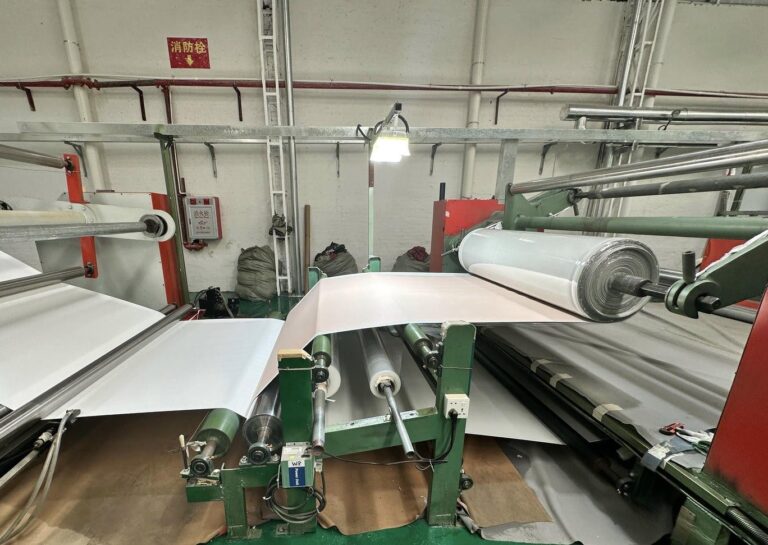
The grain of a coated roll starts here: texture printed on paper, not pressed by a roll.
The Case: Three Defects, One Missing Spec Line
Each defect pointed to a process, not a material. Grain loss at the seams points to how the surface got its texture, embossed after fusion or transferred from release paper. Thickness scatter points to how the film was formed, rolled to a gap between steel rolls or doctored wet and fused in ovens. Odor points to the final ovens, the fusion window and the topcoat chemistry. Read together, the three defects describe one production line.
The two routes do not just differ in equipment. They set different failure modes, different thickness tolerances, and different defect signatures into every roll. A buyer who cannot name the route cannot arbitrate a claim. The same test report, the same price, and the same spec sheet can hide two different products.
Route One: The Calendering Melt Line
Calendering forms PVC dry. The route runs five windows, and each one is on record in published process data. The compound is high-speed mixed for 5 to 12 minutes, then plasticated in a Banbury internal mixer for 2 to 4 minutes. The hot mass passes an open mill into an extruder with a die window of 120 to 150°C. A four-roll calender then presses skin and foam into continuous film at roll temperatures of 160 to 185°C, set roll by roll.
Lamination and foaming close the melt route. The layered laminate enters a foaming oven at 170 to 180°C for 2 to 3 minutes. Softness routes add a milling step at 60 to 85°C for 20 to 40 minutes. Thickness lives in the roll gap. In one published production trial, closed-loop gap feedback held a skin layer to plus or minus 0.05 mm across a 1.4 m width. Open-loop control drifted to plus or minus 0.12 mm. That scatter is the number a sewing line feels first.

Melt route or paste route: the difference is invisible on a swatch and obvious on a line.
Route Two: The Knife-Coating Paste Line
Knife-coating forms PVC wet. Emulsion-grade paste resin disperses in plasticizer into a plastisol, de-aerated under vacuum before it meets a blade. Published automotive work meters a 0.3 mm wet skin layer onto embossed release paper. Plasticizer runs at 60 to 80 phr, with blowing agent at 10 to 30 phr. Grain here is bought, not pressed. The paper carries the texture, and the PVC takes it during gelation.
The oven sequence is the second half of the route. Skin gel runs at 180°C for 30 seconds. The foam layer then coats the reverse and pre-gels at the same window. Final fusion and foaming runs 200 to 210°C for about 60 seconds. Wider industry lines stage the foaming furnace from 110 to 195°C at 15 to 25 meters per minute.
Surface finishing closes the line. Three water-borne PU topcoats follow fusion, each dried at 90°C for 10 seconds. A final dry runs at 140°C for 40 seconds, then embossing at 200°C. Count the windows as we do in the lab: five on the calender line, nine on the coating line. Fourteen process windows, and not one of them appears on a standard quotation.

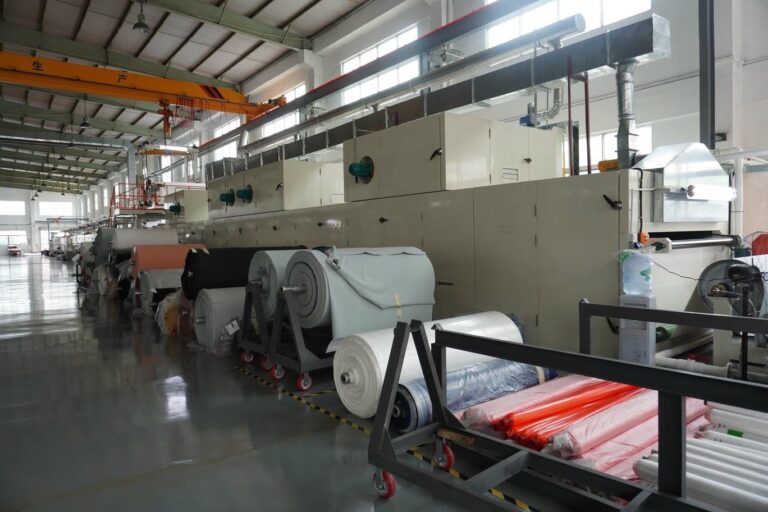
Ovens are the shared clock of both routes: the window, not the polymer, decides the defect.
The Diagnosis Table: Read Your Roll Backwards
Here is the comparison we sent back with the complaint file. Each row is a question you can ask a roll, and the answer names the line it came from.
| Question at the dock | Calendering melt line | Knife-coating paste line |
|---|---|---|
| Where did the grain come from? | Embossed into the fused surface by an engraving roll | Transferred from textured release paper |
| What controls thickness? | Roll gap, roll temperature, tension, line speed | Blade gap, coat weight, paste rheology, oven history |
| Which defects are native? | Thermal degradation, roll sticking, thickness variation | Pinholes, cratering, incomplete fusion, transfer defects |
| Where does odor originate? | Bulk compound and foaming history | Fusion window and topcoat chemistry |
| What drives the MOQ? | Run length on heavy calender trains | Release-paper batches and line setup |
Our complaint roll answered all five questions one way. The grain washed out because release-paper texture sits shallower than embossed grain and abrades at folded seams. Thickness jammed the feed dogs because blade-gap coating drifts unless every coat weight is logged. The odor panel flagged the lot because the fusion window ran hot enough to survive customs. It then leached in the cabin. One route, three signatures.
One row also matters at order time: machinery sets PVC leather minimums near 500 to 1,000 meters on both routes. Buyers comparing PVC against other coated families usually ask the material question first and the route question never. Both matter. Where silicone constructions differ from both PVC routes, our silicone versus PU comparison separates the families by chemistry and service life. When a European RFQ uses a word that spans all of them, the simili leather notes in this series can help. They pin the quote to one material before price talk starts.

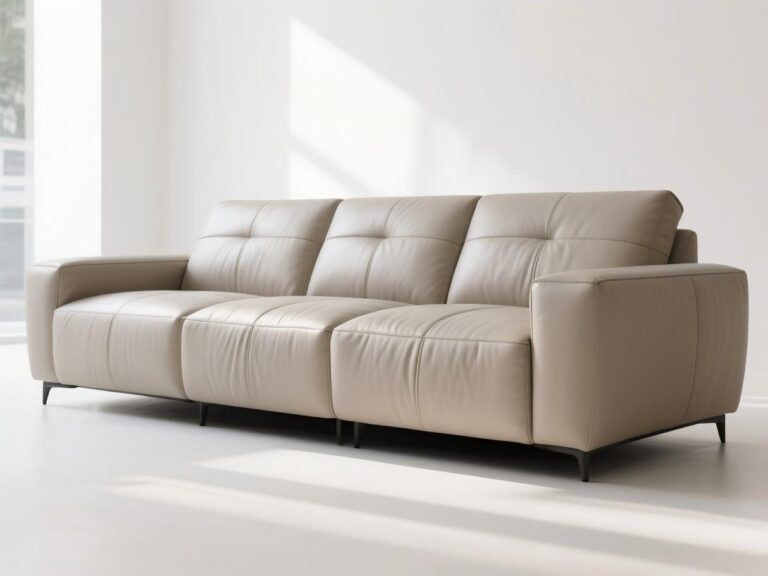
Same polymer family, different process histories: the application sees the difference first.
Before You Sign: The Six-Point List
The case closed when the supplier re-ran the order on an emboss-calendered construction. Tolerance tightened to plus or minus 0.05 mm, and the sewing line ran clean. It could have closed at the RFQ stage for free. Six spec lines do that work.
First, name the production route in the purchase order: calendering or knife-coating, in writing. Second, require the process-flow diagram with the temperature and residence-time windows for the quoted construction, not a generic one. Third, lock the layer stack: skin thickness, foam thickness, fabric type and weight, and topcoat chemistry, not one total thickness.
Fourth, ask for the roll-temperature profile and the foaming-oven residence time actually used on your construction. Fifth, specify the release-paper grain code and the topcoat system where the coating route applies. Sixth, tie every defect tolerance in the contract to a named process window. A supplier who answers all six is quoting a process. A supplier who answers none is quoting a price.
If seeing a line run helps more than reading one, start with our own floor. The video below walks the production line end to end. The factory production notes explain what each control node checks before a roll ships.
Watch the Line Run: Production Floor End to End
Talk to Our Process Engineers
Request Route-Spec Samples
References
1. https://wandaoleather.com/blog/how-is-automotiv… — Calendering and knife-coating process windows from patent examples: mix and Banbury times, die 120–150°C, roll 160–185°C, gel 180°C/30 s, fusion 200–210°C/60 s, plus the ±0.05 mm vs ±0.12 mm gap-control trial
2. https://www.qiansin.com/news/what-is-pvc-leathe… — Mainstream coating line stages: surface slurry dried at 170–190°C, foaming furnace staged 110–195°C at 15–25 m/min