What does the word “plant” actually guarantee when it appears on a leather label? The honest answer: only the feedstock. It says nothing about flex life, coating chemistry or water footprint of the finished sheet. Plant leather is a system claim, and the system is what you must benchmark. This article gives buyers four material families, one comparison table and a shortlist framework built on verified numbers.
Plant Leather Is a Feedstock Label, Not a Performance Spec
The category is growing fast enough to attract label inflation. The global plant-based leather market is projected to nearly double from $649.6 million in 2026 to $1,436.1 million by 2033, a 12.0% compound rate. Money like that draws in hybrids that lean on the word plant while hiding a thick PU layer. Lab data backs the caution. Bovine leather reaches 39.5 N/mm² in tensile strength and over 200,000 flex cycles in a direct comparison, while several plant-filled coated textiles stop far earlier.

The Benchmark Table: Four Materials, Key Metrics
Judge every candidate on the same columns. Flex cycles predict how a strap, seat or handle ages. Carbon and water per square meter come from cradle-to-gate assessments. Read the table as a whole, because no single column crowns a winner.
| Material | Flex Cycles | GHG (kg CO2e/m²) | Water (m³/m²) | Best Fit |
|---|---|---|---|---|
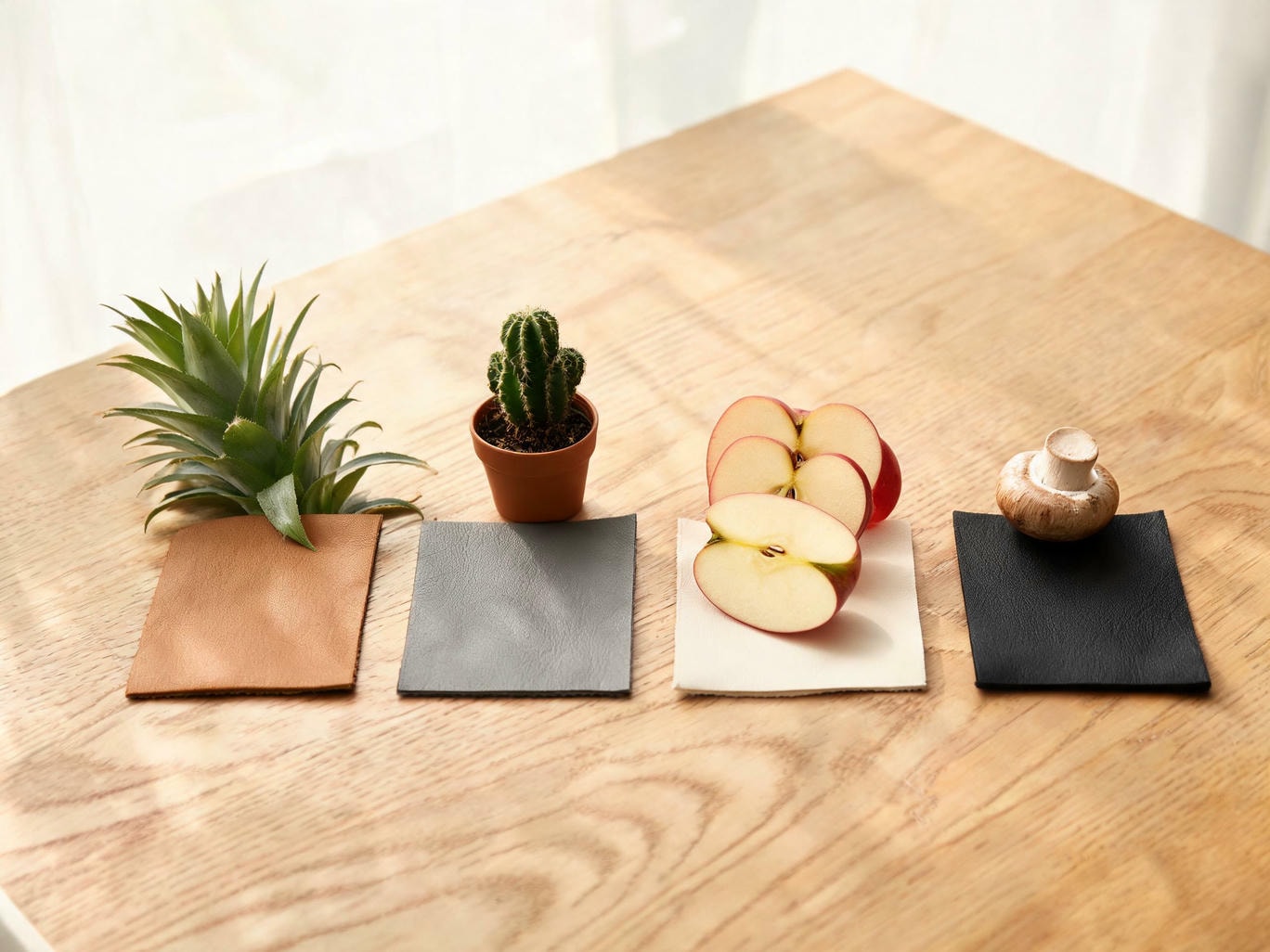
| Cactus (Desserto) | 30,000 | 1.39 | 0.02 | Wallets, belts, accessories |
| Pineapple (Piñatex) | 150,000 | Not disclosed | Not disclosed | Fashion goods with drape |
| Mycelium | 20,000+ bends | Varies by finish | ~99% less than bovine | Structured premium goods |
| Bovine leather (baseline) | 200,000+ | 27.30 | 32.95 | Heavy-duty applications |
Where Plant Leather Wins and Where It Fails
The environmental case is real where third-party data exists. Cactus-based material reports 34.33 MJ of energy demand per square meter against 335.84 for animal leather and 92.93 for PU. Water use sits at 0.02 cubic meters per square meter, roughly a 1,600-fold gap to bovine. Mycelium grows in about two weeks on farm waste and saves around 90% of the land.
Mechanics decide the rest. Cactus flexes 30,000 cycles, one seventh of the bovine baseline, so it suits accessories rather than seating. Piñatex reaches 150,000 cycles but needs hydrophobic laminates for outdoor exposure. Mycelium holds structure well while staying moisture sensitive. None of these sheets is a drop-in replacement. Each one earns a specific slot in a line, and the slot is narrower than the marketing suggests.
Next-generation material walkthrough: surface, flex behavior and finish options.
A Buyer’s Shortlist for Plant Leather Programs
Run five checks before signing. First, demand an ISO 14040/44-aligned LCA with third-party verification. Second, match flex and abrasion data to the real application, not the brochure. Third, require disclosure of the polymer share, because the coating decides the footprint. Fourth, confirm an end-of-life route such as EN 13432 compostability. Fifth, check regulatory fit for 2027 digital product passports. For baby and kids products, add migration and skin-contact reports to the file. For marine and outdoor exposure, plan a moisture and UV screen, since most plant sheets need protection there. Where a program demands 200,000-cycle flex life with zero solvent input, TOPSUN silicone leather documents both in writing.
TOPSUN manufactures silicone leather with zero solvent input, non-detect VOC results and multi-stage QC. Certificates cover salt spray, abrasion and hydrolysis aging, with SGS batch reports on request.
Monthly capacity runs at 500,000 meters with a 500-meter MOQ, supplying 30+ countries for eight years.
Discuss Plant-Based Blends With Our Team
Request a Bio-Based Comparison Swatch
References
- https://www.fabulive.com/blogs/news/the-bio-bas… — System benchmarks: bovine 39.5 N/mm² tensile and 200,000+ flex cycles; cactus 30,000 cycles, 1.39 kg CO2e and 0.02 m³ water per square meter; Piñatex 150,000 cycles.
- https://www.greencycle8.com/blog/comparing-eco-… — Mycelium saves ~99% water and ~90% land, grows in two weeks; buyer framework spans LCA, specs, transparency, end-of-life and ESPR 2027 alignment.
- https://www.persistencemarketresearch.com/marke… — Plant-based leather market: $649.6 million (2026) to $1,436.1 million (2033) at a 12.0% CAGR.