Which plant based leather manufacturers can actually ship in volume this year? Directory pages list dozens of names. Audited capacity numbers support a handful. And one of the most-quoted names in the category stopped shipping entirely before restarting on a partner’s line.
If you are a sourcing manager comparing plant based leather manufacturers, the marketing copy is not the problem. The missing numbers are. This article puts five names on one table, shows what each one actually produces, and ends with the five checks we run before signing any new material supplier.
| Name | Feedstock Claim | What Actually Ships | Verified Scale | Buyer Risk Flag |
|---|---|---|---|---|
| Ananas Anam (Piñatex) | Pineapple leaf fiber, Spain | Non-woven fiber mat, usually PU-finished | Serving global brand programs since 2014 | Binder chemistry varies by grade; ask for the datasheet |
| Desserto (cactus) | Nopal cactus, Zacatecas, Mexico | Cactus-fiber coated material | Licensed into Fossil, Adidas, Mercedes programs | Most buyers receive it through converters, not direct |
| Frumat (apple) | Apple pomace, Florence, Italy | Pomace powder mixed with binder, spread on canvas | Niche; small batch runs | Capacity is limited; long lead times on repeat orders |
| MycoWorks (Reishi) | Mycelium, grown in the US | Fine mycelium sheets | ~1.5M sq ft annual capacity reported for 2026 | 60% of output sent to third-party tanneries for finishing |
| Bolt Threads (Mylo) | Mycelium, branded 2020 onward | Restarted Q4 2025 via contract manufacturing | Under 500k sq ft/year, constrained | Line stopped 2023, restarted 2025 – continuity is the risk |
The Plant Based Leather Manufacturers Map: Who Ships What
Start with a fact that surprises most first-time buyers. The plant based leather manufacturers you can actually buy from are fewer than the brand announcements suggest. A large share of the companies selling “apple leather” or “cactus leather” goods are converters. They import the coated roll from one feedstock producer and cut, emboss, or stitch it locally.
One Guangzhou bag maker states it plainly in its own supplier disclosure. All Piñatex it uses is imported from Ananas Anam in Spain. Cactus leather is imported from Desserto in Mexico. The factory is a customer of the brand, not a manufacturer of the material.
The concentration is real. Piñatex is manufactured and distributed exclusively by one company, Ananas Anam, which reported 2025 revenue of $48 million. That distinction between brand and converter matters for three reasons. First, your price includes at least one import margin. Second, your lead time follows the feedstock producer’s queue, not your converter’s. Third, if the producer changes its binder formula, your converter cannot stop the change from reaching your goods.

Most plant based leather fashion goods trace back to a small set of feedstock producers
Why Some Plant Based Leather Manufacturers Stopped Shipping
In 2021, mycelium leather was the safest bet in the category. Several plant based leather manufacturers announced luxury partnerships within months of each other. Buyers wrote Mylo into specs with confidence.
Then Bolt Threads stopped shipping Mylo in 2023. It restarted in Q4 2025 through a contract-manufacturing partnership, but at under 500,000 square feet a year. The specification did not fail a wear test. It outlived its supplier’s line for two years. We have watched the same pattern hit smaller bio-material start-ups: a pilot line, a press release, and no commercial-scale coating hall.
Here’s the thing. A material supplier’s survival is a spec question, not just a business-news question. If your product program runs three years and your leather supplier’s line runs eighteen months, you will reformulate mid-program at your own cost.
Lesson from the graveyard: treat every plant based leather manufacturer as live until proven. Ask for a dated production photo, a current export record, and the name of one brand that shipped a full collection on the material last season.
If your team is weighing plant based options against a coating line you can audit, our sourcing engineers will walk the comparison with your volumes in hand. Audit Your Supplier List With Our Team
Feedstock, Binder, and Capacity: The Numbers Behind Every Name
Strip away the sustainability narrative and every credible plant based leather manufacturer answers to three numbers.
Feedstock. Pineapple leaves, nopal cactus, apple pomace, mycelium. The source decides your supply seasonality and your geography. Cactus harvests follow nopal cycles. Apple pomace depends on juice season. Mycelium is grown, so it is the least seasonal of the group.
Binder. This is the number buyers skip. Plant fibers do not hold together on their own. Frumat’s process, for example, dries apples into powder, mixes it with pigments and a binder, and spreads the slurry onto a canvas. The apple layer is a minimum of 50% fiber, finished with a polyurethane top layer. Industry assessments put most commercial bio-leathers in the same boat: a 60-80% bio-base with a 20-40% polymer binder. The “plant based” label describes the filler, not the film.
Capacity. MycoWorks reports about 1.5 million square feet of annual Reishi capacity at its US facility, with a second, smaller Netherlands plant planned for 2027. That is real scale, but it is still a rounding error next to a single coated-fabric hall running millions of meters a year. And roughly 60% of current Reishi output goes to third-party tanneries for dyeing and finishing, which adds a processing hop to every order.

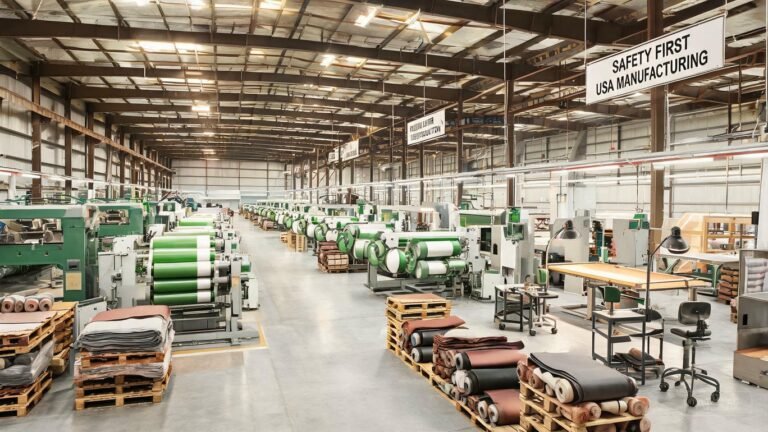
Capacity claims should end at a warehouse you can see, count, and audit
For context on where the category is heading, the plant based leather market was valued near $649.6 million in 2026 and is projected to reach $1,436.1 million by 2033, a 12.0% CAGR per Persistence Market Research. Growing, but from a small base. Most of that growth concentrates in fashion accessories, not contract seating.
What a Supplier Audit Should Cover Before You Sign
When we evaluate any new material line, including alternatives we do not sell, we run the same five checks. They apply directly to plant based leather manufacturers.
- Dated production evidence. Photos, export records, or a live video call from the hall. Not a press kit.
- Binder chemistry disclosure. What polymer coats the plant fiber, and does it pass your VOC protocol? ISO 16000-6 data, not a marketing claim.
- Aging data, not just new-sample feel. Martindale cycles, flex counts, and hydrolysis behavior under your climate conditions.
- Batch traceability. Can the supplier tie a delivered roll to a harvest lot or a fermentation batch?
- Second-source clause. If the line stops, what happens to your program? Write the exit before you need it.
Check three deserves a hard look. Industry benchmarking now sets a minimum of 150,000 Martindale cycles for bio-based leathers in serious programs. Several plant based materials feel excellent as a sample, yet we have seen uncoated bio-mats soften and crack once a PU binder hydrolyzes in humid coastal service. If your product ships to those markets, demand the aging numbers before the hand-feel conversation.
Regulation is tightening the audit, too. The EU Green Claims Directive became enforceable in July 2025, so any biodegradable or bio-based claim on goods sold into Europe now needs third-party certification behind it. And ISO 23206:2026, published this year, is the first international standard for characterizing bio-based textile materials. Luxury groups already cite it in RFPs. Ask which of the two your plant based leather manufacturers can document today.
One reason buyers cross-check plant based options against silicone coatings is the audit trail. Our silicone versus PU comparison documents exactly which binder and carrier ship on every roll, which is the disclosure most bio-material converters cannot match.

On a coating line, the binder is a visible process step – auditable, not a supplier’s word
What audited capacity looks like: three bases, six million meters a year, one traceable coating line. Watch before you accept a supplier’s “capacity” slide.
Five Checks for Choosing Plant Based Leather Manufacturers
The plant based leather manufacturers worth signing are the ones that survive your audit, not the ones with the best launch story. Before your next purchase order, run this list:
- Confirm the company still ships the material it announced. A 2021 press release is not a 2026 supply contract.
- Identify the feedstock producer behind the converter, and price the import chain honestly.
- Get the binder chemistry and a VOC report under ISO 16000-6 or your local equivalent.
- Demand aging data matched to your climate, not a new-sample demo.
- Write a second-source or exit clause into the contract before the first shipment.
If your shortlist is thin after those checks, compare it against a hide-free alternative you can audit end to end. Our eco-friendly silicone leather line is documented with the same numbers we ask of any supplier, and you can see how they are made on our factory production page.
Ready to put the five checks to work on a real material? Request Capacity-Verified Silicone Leather Samples
About TOPSUN
TOPSUN supplies capacity-audited silicone leather to brand teams comparing plant based leather manufacturers with coating lines they can actually visit.
Three production bases with 6 million meters of annual output, 200,000-cycle Martindale abrasion (ISO 12947-2), non-detect VOC emission (ISO 16000-6), EN71 and FDA food-contact documentation, and OEM color and grain matching.
References
1. https://www.persistencemarketresearch.com/marke… — Plant based leather market valued at US$649.6 million in 2026, projected to reach US$1,436.1 million by 2033 at a 12.0% CAGR
2. https://www.mushmycel.com/blogs/eco-friendly/bi… — MycoWorks Reishi capacity of ~1.5M sq ft annually with 60% finished by third-party tanneries; Mylo restart under 500k sq ft/year; Piñatex 2025 revenue of $48M; 150k Martindale industry minimum; EU Green Claims Directive enforceable July 2025; ISO 23206:2026 published (2026)
3. https://www.fashionindex.com/blog/plant-based-l… — Frumat’s Florence process: apples dried to powder, mixed with binder onto canvas; minimum 50% apple fiber with a PU top layer