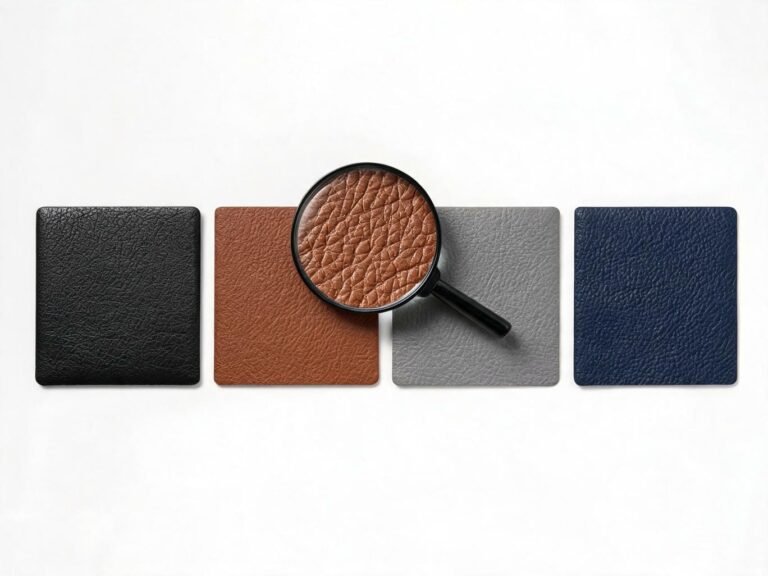
Why does one patterned seat look tired after a season while another carries its design for a decade? The difference rarely comes from the pattern itself. In pattern fabrics, it comes from how the surface was built.
That is the conclusion the wear data keeps confirming. It changes how buyers should read a pattern fabrics catalog. Three processes dominate the market: embossing, printing, and jacquard weaving. The table below compares them on process, durability, cost, and fit. The sections after it explain where each method wins and where it quietly loses.
| Dimension | Embossed | Printed | Jacquard-Woven |
|---|---|---|---|
| Pattern source | Heat-pressed texture from roller or release paper | Ink or dye on the surface | Woven into the structure |
| Pattern durability | 50,000-100,000+ cycles | Visible wear at 15,000-20,000 cycles | Structural, cannot peel |
| Design range | Geometric and textured | Photo-realistic, full color | Complex woven motifs |
| Cost profile | High tooling, low unit cost at scale | Low setup, ink costs climb with volume | High yarn and loom time |
| Best fit | Automotive, heavy upholstery | Fashion graphics, short runs | Premium decorative seating |

Same catalog, three different ways of putting a pattern on a surface.
How Each Pattern Gets Made
Embossing starts before the coating does. In coated-fabric production, liquid resin is cast against an embossed release paper, then cured and peeled away. The paper’s grain transfers directly into the surface. Natural grain, lychee, pebble, and matte-flat are the four textures that dominate catalogs. Engraved rollers also press texture into base fabric directly, under heat and calibrated pressure.
Printing applies ink where the design sits, and digital lines switch artwork with almost no tooling. Jacquard weaving builds the motif into the cloth itself, trading loom time for permanence. Our silicone leather introduction covers how the casting step defines the final grain.
Grain depth is a controlled number, not a look. Release paper masters wear out. A shop that re-runs an exhausted paper ships batches where the lychee peak flattens by the tenth roll. Line operators track casting viscosity, oven temperature, and peel angle on every run. Each one shifts how sharply the pattern transfers. Ask how often a supplier retires a release paper master. The answer predicts how your third order will match your first.
Watch release paper turn a paper texture into a production grain.
The Wear Gap: 15,000 Versus 50,000 Cycles
Independent wear testing puts numbers on the gap. Standard printed fabric shows significant pattern wear at 15,000 to 20,000 abrasion cycles. Durability embossed fabric commonly reaches 50,000 to over 100,000 cycles before the pattern loses its tactile definition. The ratio holds because one pattern is a topography and the other is a color.
Market behavior follows the test bench. Automotive dashboards and door panels specify embossed textures almost exclusively, because ink cannot survive that duty cycle. Fashion graphics run the opposite way: the artwork outlives the season anyway, so printing wins on speed and range. The same structural logic separates full-silicone from semi-silicone builds, where the coating share changes what the surface tolerates.
One caution before quoting those cycle numbers: test conditions decide the result. The same surface can score 25,000 cycles under one abrasion protocol and 60,000 under another. Head load, stroke length, and grit differ between rigs. When a catalog claims a wear number, ask which machine produced it and at what pressure. A number without a test method is a mood, not a spec.
Request Pattern Swatches and Wear Data
Pattern Fabrics and the Cost Curve
Tooling drives the economics. Every embossed design needs an engineered roller or a release-paper master, so the first meter carries that mold cost. Spread across a 500-meter minimum order or a 50,000-meter program, the per-unit number flattens fast. Digital printing works the other way: almost no setup, but ink and curing costs climb with every meter.
The crossover point decides the method. Short, graphics-heavy runs favor printing. Long, signature-texture programs favor embossing. Buyers who match the method to the order size stop paying twice. Either they fund tooling they never amortize, or they fund ink that erases the unit savings.
Real volumes make the curve concrete. Suppose a pattern roller costs the equivalent of 1,200 meters before the first saleable meter runs. On a 500-meter minimum order, tooling adds 2.4 meters of cost to every meter bought. On a 30,000-meter program, it adds four centimeters. The fabric is identical; the decision that matters is whether your volume can amortize the mold.

Tooling cost per design falls with every meter that runs after it.
When the Pattern Meets the Cleaning Crew
Maintenance separates the survivors further. An embossed texture hides soil in its valleys and releases it with a wipe. The pattern also survives disinfectants, because no ink layer exists to attack. Printed patterns fade first where hands land hardest: armrests, headrests, and seat edges that take a daily wipe-down.
Jacquard sits in the middle. The woven motif never peels or fades, but a snag pulls yarn, and repairs stay visible. For program buyers, that trade matters more than the upfront look. A pattern that survives year three without a patch kit beats one that photographs better on launch day.
Chemistry does what friction starts. Quaternary ammonium disinfectants, alcohol wipes, and chlorine bleaches attack dye bonds and ink binders first. A printed pattern thins exactly where the cleaning schedule is most aggressive. Embossed silicone surfaces take the same chemistry without losing texture, because no color layer sits on top to strip. For clinics, transit, and food service, that difference settles the pattern question on its own.

Small goods show pattern choices at their most personal scale.
Where Silicone Coating Changes the Pattern Math
Coating chemistry feeds back into every point above. Silicone resin carries no plasticizers to migrate. An embossed grain therefore stays crisp instead of slowly relaxing the way plasticized PVC peaks do. Hydrolysis resistance keeps a deep pattern’s valleys from turning into micro-crack starters. That matters after a few humid seasons, which is where coated patterns usually fail first. Freeze a coupon to minus 40 degrees and flex it. A surface that powders at the peaks fails the winter-warehouse test before installation starts.
The casting route also keeps pattern options open at production scale. Grain comes from the release paper rather than an engraved metal roller. A new texture therefore enters the line as a paper change, not a machining job. That is how a mid-volume buyer reaches 50,000-cycle pattern life without the tooling bill a metal mold implies.
What a Pattern Swatch Tells You Before It Ships
A swatch hides as much as it shows. A palm-sized sample proves color and hand feel. It cannot prove pattern longevity, because abrasion failure starts at edges, seams, and high-load zones a swatch never simulates. Ask for a wear-tested coupon instead. Request the same pattern run through the rig that produced the cycle counts above, with photos at 10,000-cycle intervals. Suppliers who keep cycle-interval photos on file can send them the same day. The ones who cannot have usually never run the test.
Then run the wipe test yourself. Clean the coupon five times with the strongest agent your facilities actually use. Ignore the mild soap printed on a care card. If the embossed peak softens or the printed area loses saturation by wipe three, you have your answer. It arrives before the order, not after season one.
One more check belongs on the same call: colorfastness. Rub the pattern against a white cotton cloth, wet and dry. Printed surfaces shed dye within a dozen strokes when fixation is weak. Embossed textures transfer nothing, because their pattern has no dye to give.
Matching Pattern Fabrics to the Program
Three questions decide: what wears the surface, how long the design must live, and how large the order runs. Add a fourth whenever the decision is close. Ask what chemistry the surface will meet in service, and whether the supplier can prove the pattern survives it. The table settles the common cases.
| If the program is… | Pick | Because |
|---|---|---|
| Automotive or heavy contract seating | Embossed | 50,000+ cycles, and no ink ever enters the spec |
| Photo-real graphics on short runs | Printed | Low setup and full color; season-length life is enough |
| Signature premium seating | Jacquard or embossed-print hybrid | Structure plus artwork at the highest perceived value |
Pattern fabrics earn their place in a spec when the process behind the pattern matches the duty behind the seat. Process, cycle counts with named test methods, tooling amortization, and cleaning chemistry cover most of the decisions buyers regret. Read those first, then read the price, and the catalog starts telling the truth.
Compare Patterns with Our Engineers
References
1. https://www.climbingtex.com/news/industry-news/… – Durability Special Embossing Sofa Fabric: printed fabrics show pattern wear at 15,000-20,000 cycles; embossed fabric reaches 50,000-100,000+ cycles.
2. https://es.fanxitex.com/news/industry-news/embo… – Embossing on Fabric vs Printing: embossed textures report 2-3x longer pattern retention; tooling-heavy embossing amortizes at scale while digital printing suits short runs.
3. https://www.honghuanpaper.com/news/industry-new… – Leather Release Paper Buying Guide: casting resin against embossed release paper transfers grain patterns; natural grain, lychee, pebble, and matte-flat dominate catalogs.