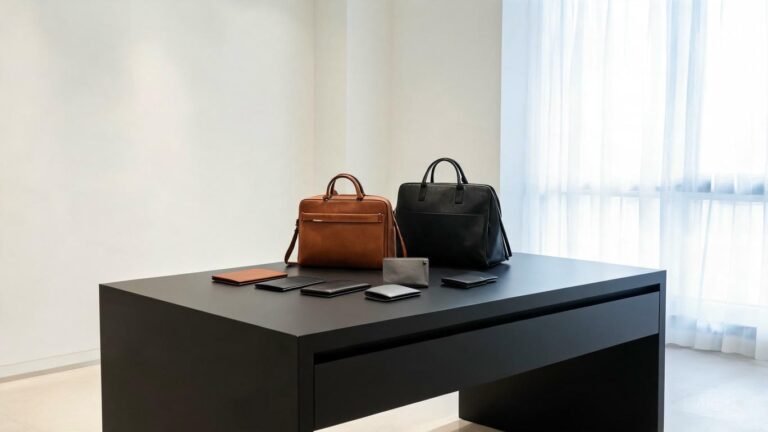
On demand leather manufacturing has gone from niche to mainstream faster than almost anyone in the industry expected. Five years ago, if you wanted custom leather goods, you were looking at 500+ piece minimums and 12-week lead times. Today, manufacturers advertise MOQs as low as 50 pieces, sample turnaround in 7 days, and bulk production in 3–4 weeks.
For procurement teams, this is both exciting and dangerous. The promise of low-risk, fast-turn custom production lets brands test designs without committing to huge inventory buys. But the economics of on-demand manufacturing work differently than traditional bulk sourcing — and if you don’t account for the differences, you can end up paying far more per unit than you expect.
This guide breaks down how on-demand leather manufacturing actually works, what it really costs, and when it makes sense — or doesn’t — for your sourcing strategy.
Explore Custom OEM/ODM Capabilities
What On-Demand Leather Manufacturing Actually Means
Let’s start with definitions, because “on demand” means different things to different suppliers. Here’s what the term generally covers in the leather goods industry:

On-demand manufacturing relies on pre-stocked materials and flexible production lines to enable fast turnaround
| Model | Typical MOQ | Lead Time | Customization Level |
|---|---|---|---|
| White Label | 50–200 pcs | 2–4 weeks | Logo only — factory owns the design |
| Private Label (Semi-Custom) | 100–300 pcs | 4–8 weeks | Color, material, logo, minor tweaks |
| Full Custom OEM | 300–500+ pcs | 8–12 weeks | Complete design from scratch, brand-owned IP |
| Micro-OEM (On-Demand) | 50–200 pcs | 3–5 weeks | Custom design with pre-approved material library |
The “micro-OEM” model is what most people mean when they say on-demand leather manufacturing in 2026. It works by combining pre-stocked materials (leather, hardware, lining) with flexible production lines that can switch between small-batch designs quickly. Instead of tooling up a dedicated line for one 5,000-piece order, the factory runs multiple 200–500 piece orders through the same line in a single week.
This model exploded in popularity for a simple reason: DTC brands and Amazon sellers can now test 3–5 designs simultaneously with minimal financial risk. If one design sells, they reorder at higher volume. If it doesn’t, they’re out a few hundred dollars, not a $50,000 production commitment.
The Real Cost of On-Demand vs. Bulk Manufacturing
Here’s what most on-demand manufacturing marketing doesn’t tell you: unit cost is significantly higher than bulk production. The question is whether the flexibility justifies the premium. Let’s look at the numbers for a typical leather accessory — let’s say a wallet or small bag.
Procurement principle: On-demand manufacturing trades unit cost for inventory risk reduction. The premium pays for itself only if you would have otherwise had unsold inventory or missed sales from long lead times.
| Cost Component | Bulk (2,000 pcs) | On-Demand (200 pcs) | Difference |
|---|---|---|---|
| Material cost (per unit) | $4.50 | $6.00 | +33% |
| Labor cost (per unit) | $3.00 | $5.50 | +83% |
| Setup / tooling (amortized per unit) | $0.25 | $2.50 | +900% |
| Overhead / factory margin | $1.25 | $3.00 | +140% |
| Total unit cost | $9.00 | $17.00 | +89% |
That 89% premium is the sticker shock that catches many new brands off guard. But here’s the other side of the equation — the total cost of a failed bulk order. If you order 2,000 units at $9 each and only sell 800, your effective cost per sold unit is $22.50 — which is worse than the on-demand price. Plus you’re sitting on 1,200 units of dead inventory taking up warehouse space.
The math works in on-demand’s favor when your sell-through is uncertain. It works against you once you know a design is a winner and you can forecast volume reliably. The smartest brands use both models — on-demand for testing and initial launches, bulk production for proven SKUs.
The Hidden Costs That Surprise First-Time Buyers
The per-unit price you see in a supplier’s listing isn’t the total cost. These are the additional expenses that show up on your invoice — and if you don’t budget for them, they can blow up your margin:

Custom materials and colors add cost — standard in-stock options are the key to keeping on-demand pricing low
- Sample fees — $50–$200 per sample design, often credited toward your first bulk order. Budget for at least 2–3 rounds of samples.
- Mold / tooling charges — Custom hardware, unique embossing dies, and specialized cutting molds cost $200–$2,000+ and aren’t included in per-unit pricing.
- Custom material surcharges — Want a specific leather color or texture that’s not in the supplier’s standard library? Expect a 20–40% material premium and higher MOQ.
- Quality inspection fees — Third-party QC adds $100–$300 per shipment, but it’s worth every penny to avoid receiving defective goods.
- Shipping and duties — Express air freight for small batches can add $3–$8 per unit. Sea freight is cheaper but takes 4–6 weeks, defeating the speed advantage.
- Revision costs — Changes after production starts cost time and money. A single design revision can add 1–2 weeks and 10–20% to the order total.
Silicone Leather and On-Demand Manufacturing: A Natural Fit
Here’s a trend that’s accelerating in 2026: on-demand manufacturers are increasingly adding silicone leather to their standard material libraries, and for good reason. Silicone leather solves several of the pain points that make on-demand genuine leather manufacturing expensive and slow.

Manufactured materials like silicone leather offer batch-to-batch consistency that genuine leather can’t match
Why silicone leather works so well for on-demand production:
- Consistent quality — Every roll is identical, so there’s no selection waste or quality variance between batches. This is huge for repeat orders.
- Wide color availability — Standard colors are kept in stock, enabling fast turnaround. Custom colors are reproducible with exact color matching.
- Lower defect rates — 1–2% vs 5–8% for genuine leather, which means fewer rejected units and more predictable yield.
- Vegan positioning — Allows brands to market to the fast-growing vegan and sustainable consumer segments without switching manufacturers.
- Easier customization — Embossing, debossing, printing, and laser engraving all work cleanly and consistently on silicone leather.
In our experience working with on-demand manufacturing partners, brands that switch product lines from genuine leather to silicone leather typically see a 25–35% reduction in per-unit cost at the same MOQ level, combined with faster turnaround and lower return rates. It’s not the right choice for heritage brands that sell the “genuine leather” story — but for performance-focused, design-forward brands, it’s often a better fit.
See Our Production Capabilities
Learn about TOPSUN’s factory production capacity and flexible OEM capabilities
When On-Demand Makes Sense (and When It Doesn’t)
On-demand leather manufacturing isn’t better or worse than traditional bulk sourcing — it’s a different tool for a different job. Here’s how to decide which model fits each situation:
| Scenario | Best Model | Why |
|---|---|---|
| New brand, first product launch | On-demand (100–300 pcs) | Low risk, fast to market, test market response |
| Proven SKU, stable demand | Bulk production (1,000+ pcs) | Lowest unit cost, economies of scale |
| Seasonal / limited edition drops | On-demand (200–500 pcs) | Fast turnaround, no leftover inventory |
| Corporate gifting programs | On-demand (50–500 pcs) | Custom branding, variable quantities per order |
| Private label retail line | Hybrid: on-demand test → bulk scale | Validate with low volume, then optimize cost |
| High-volume mass market | Bulk (5,000+ pcs) | On-demand premium doesn’t justify itself |
Building the Right Manufacturing Mix
On demand leather manufacturing has permanently changed how brands source leather goods. The ability to launch new designs with minimal financial risk, test multiple variations simultaneously, and scale up only what works — these were impossible just five years ago.
But on-demand isn’t a replacement for bulk manufacturing. It’s a complement. The brands winning in 2026 aren’t choosing one or the other — they’re building a hybrid sourcing strategy where on-demand handles the front end (testing, launches, small runs) and bulk production handles the back end (proven SKUs, high-volume replenishment).
If you’re evaluating on-demand manufacturing for your leather goods line, the fastest way to assess a supplier’s quality and reliability is to order samples first. Pay for prototypes, test the materials, put the finished product through real-world use. The savings from avoiding one bad production run will pay for dozens of sample orders.
About TOPSUN
TOPSUN offers flexible on-demand silicone leather manufacturing for brands and OEM partners who need low-MOQ custom production with fast turnaround and consistent quality across every order.
MOQs from 300 yards · 4-week sample turnaround · Custom embossing & colors · Full OEM/ODM capability · Consistent batch-to-batch quality · Zero VOC certified