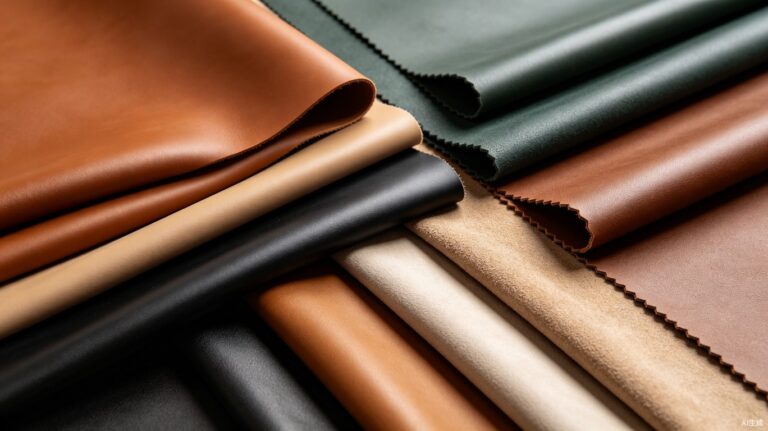
Why should a buyer trust a data sheet? Because somewhere behind it stands a machine that does not care about marketing. Our lab bench answers that question every day. Machine fabric quality, in our vocabulary, is quality a physical instrument has already measured, repeated, and signed. This article introduces the four machines behind the numbers, and the verdict each one delivers.
What Machine Fabric Means in Our Lab
The phrase is simple. A fabric claim is only as good as the instrument behind it. Our lab runs every batch through the same gauntlet, and each machine answers one question with a number. No adjectives survive the bench. What follows is the short tour we give procurement teams who visit our factory.

The first verdict: will the material tear under load?
Four Machines, Four Verdicts
Four machines do most of the talking. Their methods are public standards, which means any laboratory in the world can re-run the verdict.
| Machine | Question It Answers | The Number We Print | Standard Behind It |
|---|---|---|---|
| Tensile tester | Will it tear under load? | Tensile 15+ N/mm; tear 20+ N | ISO tensile methods |
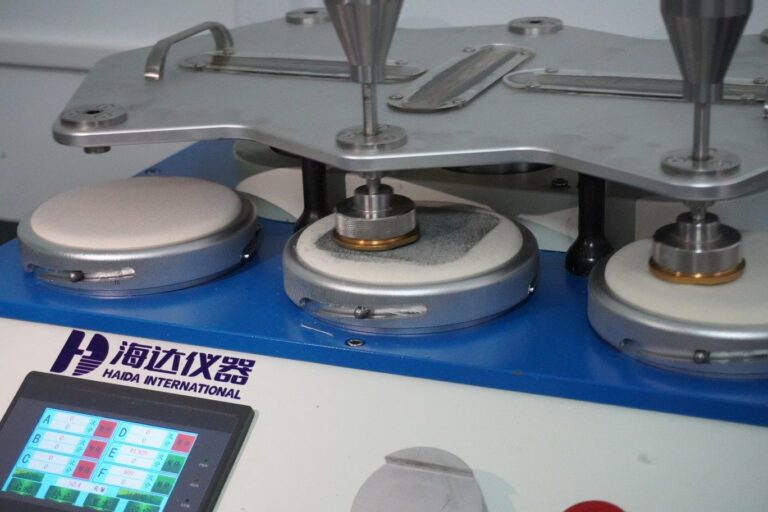
| Martindale tester | How long will the surface survive friction? | 200,000+ cycles | ISO 12947 / ASTM D4966 |
| Bally flexing tester | Will it crack at the crease? | Flex cycles to first crack | SATRA TM55 / ISO 17694 |
| Calendering and coating line | Is thickness and texture uniform? | 0.23-3.0 mm; 100+ textures | In-process QC gauges |
The Martindale bench explains the most quoted number in the industry. One rub is one revolution of the instrument’s outer drives. A full cycle traces a Lissajous figure of sixteen rubs stretching over three meters. A common test endpoint is 20,000 rubs. Our upholstery specification runs ten times that figure and keeps going, because commercial seating never sees a gentle life.

Coating rolls: where thickness uniformity is won or lost.
Creases are crueler than friction. The Bally flexing tester folds a specimen in half, clamps it, and bends it back and forth at 22.5 degrees. The cycle rate is one hundred per minute, and the counter runs to 999,999. Coatings that look flawless on a roll fail here first, which is exactly why we run it on every construction. Our factory production page shows the bench in place.
Flexing endurance test: the coating must survive thousands of crease cycles.

Calendering: the step that turns chemistry into a grain you can touch.
Downstream, production machines defend the lab’s verdict. Calendering rolls set the surface texture, from lychee grain to silk finish, across more than one hundred options. Coating heads hold thickness across 0.23 to 3.0 millimeters. In-process gauges check every roll so batch twelve matches batch one. Machine fabric quality is not one machine. It is a relay from lab bench to line, and the baton never drops.

Every roll passes the same gauges; batch twelve must match batch one.
Machine Fabric Specs You Can Verify
Here is the recap worth keeping. Two hundred thousand Martindale cycles. Flex testing at 22.5 degrees and 100 cycles per minute. Thickness held across 0.23 to 3.0 millimeters. Tensile strength above 15 N/mm. Every figure traces back to an instrument and a public standard, and our silicone leather overview lists them with each product line. Ask any supplier to show the machine behind the number. If the answer is a brochure, you have learned something too.
Ask Our Engineers About Test Data
Request Samples with Lab Reports
About TOPSUN
TOPSUN manufactures full-silicone coated fabrics for cinema seating, marine upholstery, healthcare furniture, and public transport interiors across 30+ countries, backed by an in-house physical testing laboratory.
MOQ 500 m, delivery in 7-15 days, SGS reports with every order, and thickness options from 0.23 to 3.0 mm across six product lines.
References
- https://www.jamesheal.com/pt-pt/essentials-mart… — Martindale mechanics: one cycle equals sixteen rubs tracing a 3.02 m Lissajous figure; 20,000 rubs is a common endpoint.
- https://www.utstesters.com/blog/what-is-a-fabri… — Abrasion and pilling tester endpoints: yarn breakage, predefined color change grades, and other defined surface changes.
- https://www.directindustry.com/prod/gester/prod… — Bally flexing tester specs: 22.5 degree flexing angle, 100 cycles per minute, counter to 999,999; standards SATRA TM55 and ISO 17694.