200,000 abrasion cycles. Fourteen weeks in an 85°C, 85% humidity chamber. One thousand hours of salt spray. These are the numbers behind a genuinely long lasting fabric. Most product catalogs never print a single one of them. Instead, buyers get adjectives: durable, premium, heavy-duty. In B2B sourcing, adjectives are not evidence. This article walks through the test numbers that actually predict service life. It explains what each one measures, and the values worth insisting on before you sign a purchase order.
What the Martindale Test Actually Measures
Ask three suppliers how they test abrasion and you may get three different answers. That confusion is exactly why ISO 12947 exists. The Martindale method rubs a fabric sample against a standard abradant in a Lissajous figure under 12 kPa pressure. It counts cycles until the surface shows unacceptable wear. Because the motion is multi-directional, the result reflects real seating stress better than a straight-line rub.
The martindale rub count fabric spec is the closest thing our industry has to a common language. Residential upholstery typically targets 15,000 to 30,000 double rubs. Wool hospitality fabrics reach 30,000 to 50,000, and performance microfiber is quoted above 100,000. In our lab, every production batch goes through Martindale sampling. Our High Performance collection is certified to 200,000+ cycles under ISO 12947, roughly ten times the residential baseline.

Martindale sampling on every batch: abrasion cycles are verified, not promised.
One caution before you lean on this number. A rub count predicts surface wear only. It says nothing about the coating peeling off the base fabric two summers from now. That delamination is the failure mode that actually ends most upholstery contracts early.
Long Lasting Fabric Starts With the Coating, Not the Catalog Photo
Durability is engineered into the material stack long before a test machine touches the sample. A coated fabric is a system of four layers: base fabric, primer, polymer coating, and surface finish. Change any one of them and the lifespan changes with it. That is why two fabrics with identical rub counts can age completely differently in the field.
This is where silicone chemistry separates itself from polyurethane. PU coatings depend on plasticizers that slowly migrate out over time, which is why aged PU hardens and then cracks. A full-silicone coating cures into a stable Si-O-Si polymer network, the same backbone used in medical-grade tubing. There are no plasticizers to lose. The material stays flexible for its entire service life instead of just its first year.
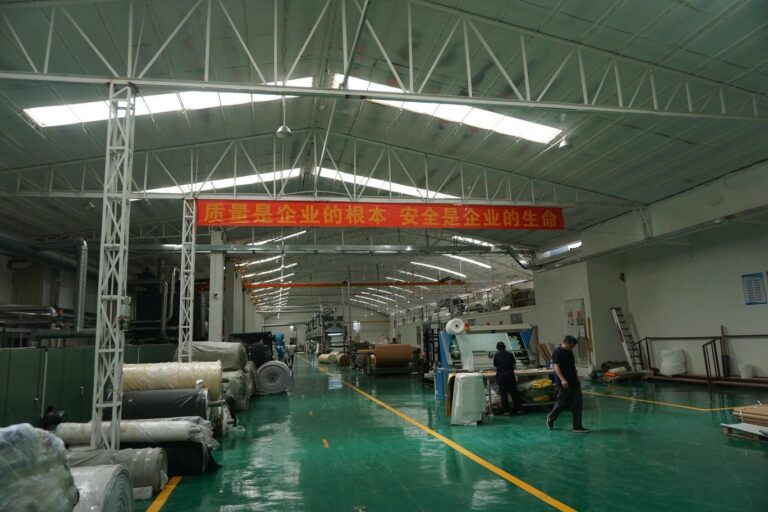
Our production floor runs multi-stage QC for exactly this reason. The line monitors coating thickness in real time, verifies curing temperature, and checks Delta E color on every roll. Want to see how a coating line is organized in practice? Our factory production overview walks through each step from base fabric unwinding to final inspection.
Hydrolysis: The Failure Mode a Rub Count Never Catches
Here is the failure that surprises buyers most. A PU sofa can pass every abrasion test at the factory, then start flaking within three years. Not from wear, but from hydrolysis. Water vapor in the air attacks the polyurethane ester bonds, and the coating slowly reverts to a sticky, peeling film. Industry material guides put low-grade upholstery at 3 to 5 years of service life. Quality materials reach 8 to 15 years, and hydrolysis is the main reason for that gap.
A fabric durability test that skips hydrolysis is measuring the wrong risk. The standard approach is a climate chamber at 85°C and 85% relative humidity. It compresses years of moisture aging into weeks. Our hydrolysis-resistant silicone leather survives 14 weeks in that chamber with no delamination, no strength loss, and no surface degradation. That result supports a 10-to-15-year service life against the 3-to-5-year PU baseline. It is also why we treat the chamber as a standard gate, not an occasional audit.

Moisture is the silent killer of coated fabrics. The droplet test is the visible half of a 14-week hydrolysis program.
We saw this gap firsthand with a client’s PU booth seating. It passed 50,000 double rubs at intake, then shed its coating within two years in a humid coastal venue. The rub count was accurate. It simply was not testing the failure that actually happened. For a deeper chemistry comparison, our silicone vs PU breakdown covers the molecular details behind this case.
Talk to Our Engineers About Test Data
How to Match a Long Lasting Fabric to the Application
A 200,000-cycle spec on a decorative headboard is wasted money. A 20,000-cycle fabric on an airport bench is a warranty claim waiting to happen. The table below maps each test number to what it predicts, using baselines drawn from published material guides.
| Test Metric | What It Predicts | Published Baseline | TOPSUN Silicone Leather |
|---|---|---|---|
| Abrasion cycles (ISO 12947) | Surface wear life | 15,000–30,000 cotton; 30,000–50,000 wool; 100,000+ performance microfiber | 200,000+ (High Performance) |
| Hydrolysis (85°C / 85% RH) | Coating delamination in humid service | PU fails in 3–5 years | 14 weeks, no delamination |
| Service lifespan | Replacement cycle | 3–5 years low-grade; 8–15 years quality | 10–15 years |
| VOC emissions (ISO 16000-6) | Indoor air and compliance | Varies; solvent-borne systems off-gas | Non-detect, 100% solvent-free |
Application math follows directly. For a family sofa, a long lasting fabric for sofa projects should clear 100,000 cycles with kids and pets in the room. For marine or coastal work, add the salt spray column. Our marine grade is tested to ASTM B117 for 1,000+ hours, a figure most treated textiles never approach. Bending endurance matters too, which is why we also run flex testing on seams and thin-gauge material.

Flex testing catches cracking that flat abrasion tests miss, especially on thin-gauge and seam-heavy designs.
Watch the full performance test run: abrasion, waterproofing, and stain resistance in one session.
Is a higher Martindale count always better?
No. Beyond roughly 100,000 cycles, extra abrasion capacity rarely changes outcomes in residential settings. Match the number to the application instead. Use 25,000 for bedroom furniture, 100,000+ for contract seating, and 200,000 where 24/7 use is the norm. Paying for cycles the application will never use is budget taken away from hydrolysis and UV specs that actually matter.
Does durable fabric mean stiff or hard to clean?
Not with silicone coating. Our material rates Level 5 stain resistance and tolerates alcohol-based disinfection, so hospital-grade cleaning does not degrade the surface. Hand stays soft from day one because flexibility comes from the polymer structure, not from additives that wash out.
The Bottom Line: Demand Numbers, Not Adjectives
A long lasting fabric is not a feeling. It is a set of verifiable results. Ask for a rub count tied to ISO 12947 and a hydrolysis pass measured in weeks at 85°C. Add salt spray hours for coastal air, plus VOC data for enclosed interiors. Suppliers who volunteer these numbers have usually done the testing. Suppliers who answer with adjectives usually have not. Ask for the test report with the sample. The replacement cycle you avoid five years from now will be the cheapest part of the deal.
Request Silicone Leather Samples with Full Test Reports
About TOPSUN
TOPSUN manufactures full-silicone coated fabrics for cinema seating, marine upholstery, healthcare furniture, and public transport interiors across 30+ countries.
In-house coating lines with 500,000 m monthly capacity, Martindale and hydrolysis verification on every order, SGS reports shipped with each batch, and custom textures or Pantone-matched colors from 500 m MOQ.
References
- https://www.haoyeahtex.com/news/industry-news/h… — Martindale test per ISO 12947 runs at 12 kPa for upholstery fabrics
- https://fenmicasa.com/custom-upholstered-furnit… — upholstery lifespan 3–5 years (low-grade) vs 8–15 years (quality), double-rub ranges by material
- https://www.fortunebusinessinsights.com/synthet… — synthetic leather market USD 50.78B in 2026, 5.7% CAGR to 2034