Leather on leather construction is everywhere in manufactured goods — upholstered furniture with leather-wrapped cushions sliding over leather frames, automotive seats where leather panels rub against leather bolsters, handbags with leather overlays bonded to leather bodies. Yet this common construction method introduces a set of engineering problems that most product developers underestimate until they show up as warranty claims: squeaking, accelerated wear, adhesive failure, and dimensional instability. Understanding these challenges through the lens of material standards and testing protocols is essential for any B2B manufacturer specifying layered leather assemblies.
From a compliance and testing perspective, leather on leather interfaces create failure modes that single-layer constructions do not encounter. The interaction between two leather surfaces — whether bonded, stitched, or in sliding contact — must be evaluated against specific ISO and ASTM standards that measure friction coefficient, adhesive bond strength, and accelerated wear. This article examines the engineering challenges, the testing protocols that reveal them, and how modern material alternatives like silicone leather can eliminate the problems that plague traditional leather-on-leather assemblies.
Request Layered Material Samples
What Is Leather on Leather Construction?
Leather on leather construction refers to any product assembly where two or more leather surfaces are in direct contact — either permanently bonded or in dynamic sliding contact. The most common applications include automotive seating (where leather bolster panels slide against the seat base during entry and exit), reclining furniture (where leather-covered moving parts articulate against leather-upholstered stationary surfaces), and fashion accessories (where leather overlays are laminated to leather substrates for structural reinforcement or aesthetic layering).
The construction method takes several forms. In bonded assemblies, adhesive layers join two leather sheets to create a thicker, stiffer composite — often used in belt manufacturing, luggage bases, and structural handbag panels. In stitched assemblies, leather layers are sewn together with or without adhesive reinforcement, creating seams that must withstand both static and dynamic loads. In sliding assemblies, two leather surfaces are designed to move against each other, such as in recliner mechanisms or adjustable headrests. Each form presents distinct engineering challenges that require different testing approaches.
The common thread across all forms is that leather’s natural surface properties — its porosity, its variable friction coefficient, its moisture sensitivity — create unpredictable behavior when two leather surfaces interact. A single leather surface against fabric or foam behaves predictably. Two leather surfaces against each other introduce a variable that standard material specifications often do not account for.

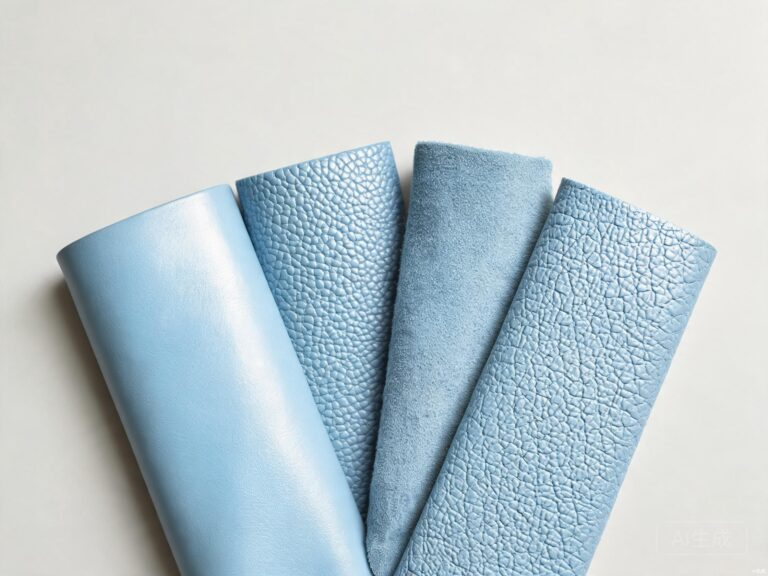
Layered leather samples — the interface between layers is where engineering challenges concentrate
The Friction Problem: When Leather on Leather Surfaces Slide
Friction between two leather surfaces is the single most problematic aspect of leather on leather construction. Unlike leather against fabric (which slides smoothly due to fabric’s low-friction fiber orientation) or leather against metal (which can be lubricated), leather against leather generates high and variable friction coefficients that change with humidity, temperature, surface treatment, and wear history. This variability makes it nearly impossible to predict long-term behavior from short-term testing alone.
The practical consequences are well-documented in automotive warranty data. Leather-on-leather contact points in car seats — particularly at the bolster-to-cushion interface — are among the most frequent sources of squeaking and creaking complaints. The sound is generated by stick-slip friction: two surfaces alternately gripping and releasing as they slide, producing audible vibrations. In furniture, the same phenomenon manifests as recliner mechanisms that squeak louder over time as surface treatments wear off and friction coefficients increase.
From a testing standpoint, the relevant standard is ISO 15113, which measures the coefficient of friction between two material surfaces. For leather-on-leather pairs, typical static friction coefficients range from 0.6 to 1.2 depending on the leather type and surface treatment — values that are 2-4 times higher than leather-against-fabric pairs. This high friction translates directly into accelerated wear at contact points, as the stuck-slip cycle abrades both surfaces simultaneously. Accelerated wear testing per ISO 5470 (Martindale) with leather-on-leather abradant pairs typically shows 30-50% faster surface degradation compared to standard abradant testing.

Abrasion resistance testing — critical for evaluating leather-on-leather wear performance
Adhesion Methods for Bonding Leather Layers
When leather on leather construction requires permanent bonding rather than sliding contact, the adhesive system becomes the critical engineering decision. The challenge is that leather is a porous, flexible, and dimensionally unstable substrate — it absorbs moisture, expands and contracts with humidity changes, and has a surface that adhesives penetrate rather than sit on top of. These properties make achieving a durable bond significantly harder than bonding synthetic materials.
The table below compares the primary bonding methods used in leather on leather construction, evaluated against the criteria that determine long-term bond integrity:
| Method | Bond Strength | Flexibility | Heat Resistance | Best Application |
|---|---|---|---|---|
| Solvent contact adhesive | High (initial) | Moderate | Poor (softens >60°C) | Handbag panels, belts |
| Water-based PU adhesive | Moderate | Good | Fair | Furniture upholstery |
| Hot-melt adhesive film | Moderate-High | Good | Good | Automotive interiors |
| Stitching (no adhesive) | Depends on pattern | Excellent | Excellent | Dynamic load areas |
| Silicone adhesive (for silicone leather) | High | Excellent | Excellent (>200°C) | All layered applications |
The vulnerability of solvent and water-based adhesives is heat and humidity. In automotive interiors, dashboard and door panel temperatures can exceed 80°C in parked vehicles — well above the softening point of most contact adhesives. Bond failure at these temperatures leads to delamination, bubbling, and visible separation of leather layers. Hot-melt films perform better but still degrade over thermal cycling. Stitching avoids adhesive failure entirely but introduces perforation points that weaken the leather and can cause tear propagation.
View Silicone Leather Specifications
Leather on Leather Durability: What Testing Reveals
Standardized testing exposes the durability gaps in leather on leather construction with uncomfortable clarity. When we run layered leather assemblies through accelerated life testing, the failure patterns are remarkably consistent across product categories — whether the test subject is a car seat, a recliner, or a handbag. The dominant failure modes are surface abrasion at sliding interfaces, adhesive delamination at bonded interfaces, and dimensional mismatch caused by differential moisture absorption between leather layers of different grades or tanning methods.
Consider the results from a test series we conducted comparing leather-on-leather assemblies with leather-on-silicone and silicone-on-silicone alternatives. After 50,000 Martindale cycles with a leather abradant (simulating leather-on-leather contact), the real leather surface showed visible grain damage and color loss. The same test with silicone leather as the contact surface showed minimal wear — silicone’s low friction coefficient (0.2-0.4 versus leather’s 0.6-1.2) meant the abradant simply slid across the surface without gripping and tearing.

Flexibility and bending endurance testing — simulates dynamic stress at leather-on-leather interfaces
The bending endurance test (ISO 7854) reveals another critical difference. Leather-on-leather bonded assemblies failed at an average of 15,000-20,000 flex cycles before adhesive delamination appeared at the bond line. Silicone-on-silicone assemblies using silicone adhesive showed no delamination after 50,000 cycles — the flexible, heat-stable silicone adhesive maintained bond integrity through repeated flexing that destroyed organic adhesive bonds. This is why silicone leather is increasingly specified for applications requiring layered construction — it eliminates the failure modes that plague traditional leather assemblies.
Why Silicone Leather Solves the Layering Problem
Silicone leather addresses every failure mode that makes leather on leather construction problematic. Its inherently low friction coefficient eliminates the stick-slip squeaking that drives automotive and furniture warranty claims. Its chemical inertness means it does not absorb moisture, so layered silicone assemblies maintain dimensional stability across humidity changes that would cause leather layers to expand, contract, and delaminate. And because silicone adhesives cure through addition reactions rather than solvent evaporation, the bond between silicone layers is as thermally stable as the material itself — rated for continuous use above 200°C.
For B2B manufacturers, the practical implications are significant. Automotive interiors specified with silicone leather eliminate the squeaking complaints that account for a meaningful percentage of warranty visits. Furniture manufacturers can build reclining mechanisms with silicone-on-silicone sliding surfaces that remain quiet through years of use. And handbag producers can bond silicone leather layers without worrying about the adhesive softening in hot shipping containers or retail display windows. For more on how silicone leather compares to traditional alternatives, see our analysis of real leather upholstery fabric and our guide to faux leather supplier evaluation.
Why does leather on leather squeak?
Leather on leather squeaking is caused by stick-slip friction — a phenomenon where two surfaces alternately grip and release as they slide against each other. Leather’s porous, textured surface creates high static friction (the surfaces grip), and when the force exceeds the static threshold, the surfaces suddenly slip, producing a vibration that registers as sound. The problem worsens over time as surface treatments wear off and the leather’s natural tackiness increases. Humidity changes also affect friction: dry leather grips harder, while slightly moist leather may slide more freely before drying out and gripping again. Silicone leather’s low, stable friction coefficient (0.2-0.4) eliminates stick-slip behavior entirely.
Can you glue leather to leather permanently?
Yes, but “permanently” requires careful adhesive selection and surface preparation. Solvent-based contact adhesives provide strong initial bonds but degrade with heat and humidity. Water-based PU adhesives offer better environmental profiles but lower bond strength. For truly permanent bonds in demanding applications, hot-melt adhesive films or — in the case of silicone leather — silicone-based adhesives provide the best long-term performance. The key variables are the adhesive’s glass transition temperature (must be above the product’s maximum service temperature), its flexibility (must match the leather’s flexing without cracking), and its moisture resistance (must not soften when the leather absorbs ambient humidity).
Leather on leather construction is not going away — layered assemblies are fundamental to how upholstered products are built. But the engineering problems it creates are well understood, well documented by testing standards, and increasingly solvable through material substitution. By specifying silicone leather for layered applications, B2B manufacturers can eliminate squeaking, prevent adhesive delamination, and achieve durability performance that traditional leather-on-leather construction simply cannot deliver. The testing data is clear; the standards are established; the alternative materials exist. The question is whether your next product specification will account for the lessons that warranty data has already taught the industry.
About TOPSUN
TOPSUN engineers silicone leather with a stable friction coefficient of 0.2-0.4 and full compatibility with silicone adhesives, enabling layered constructions that eliminate the squeaking, delamination, and wear problems inherent in traditional leather-on-leather assemblies for automotive, furniture, and accessories applications.
Low-friction surface (0.2-0.4 COF) · Silicone adhesive compatible · 50,000+ flex cycles · ISO 7854 tested · Heat-stable above 200°C