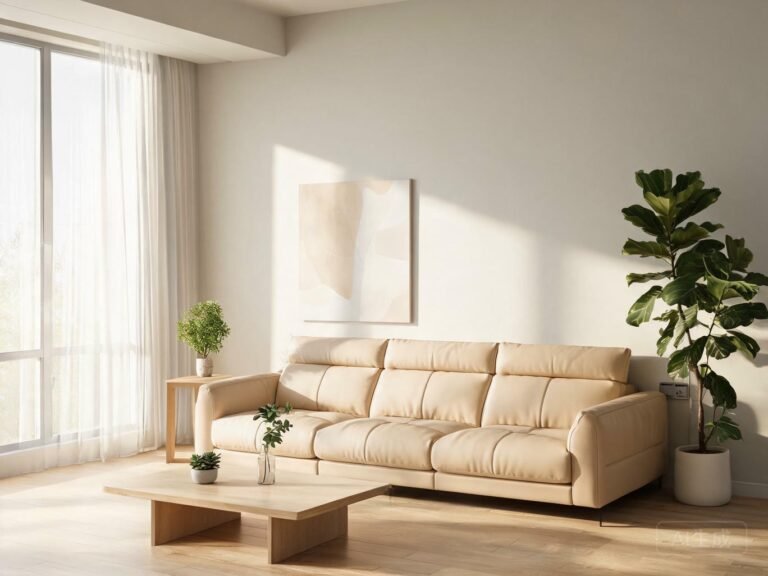
Why Sofa Upholstery Construction Determines Product Lifespan
A furniture manufacturer ships 2,000 sofa units to a retail chain. Within six months, 15% come back with seam failures, stretched seat panels, and delaminated armrest covers. The root cause isn’t the leather material itself — it’s the mismatch between material properties and upholstery construction techniques. When designers specify leather and upholstery sofa materials without understanding how the material behaves during cutting, stitching, stretching, and framing, the construction process introduces failure points that no amount of material quality can overcome.
In our work with furniture manufacturers, we’ve seen the same pattern repeatedly: a premium leather that performs flawlessly in material testing fails within months of sofa deployment because the upholstery construction wasn’t engineered for that material’s specific properties. Stretch tolerance, seam slippage behavior, foam bonding compatibility, and pattern matching precision — these construction factors determine whether a sofa looks tailored and tight after three years or saggy and loose after six months. This guide breaks down the construction decisions that matter most.
Leather and Upholstery Sofa: 5 Construction Failure Points
Most sofa upholstery failures trace back to five construction-specific issues. None of them show up in standard material testing — they only appear when the leather meets the upholstery process. Understanding these failure points is the first step in preventing them:
- Seam slippage — When stitching holes are too close to the edge, the leather pulls through the thread under tension. Materials with low tear strength are particularly vulnerable. The result: seams that gap open under seating load, exposing foam and framing beneath.
- Panel stretching and distortion — Leather stretched too tightly during upholstery application continues to relax over time, creating sagging seat surfaces and wrinkled back panels. Materials with high elongation rates (how much they stretch under load) are more prone to this failure.
- Foam delamination — When leather is bonded directly to foam cushions, the adhesive bond must survive the same flexing cycles as the material itself. Materials with low surface energy (like silicone) require specific adhesive formulations; using standard contact cement causes the bond to fail within months.
- Pattern mismatch at seams — Textured and patterned leathers require precise alignment at every seam junction. Materials with directional grain or repeating patterns that shift during stretching produce visible misalignment that reads as poor craftsmanship to the end customer.
- Edge fraying at cut lines — Leather cut for upholstery panels exposes the substrate edge. Materials with loose substrate weave or poorly bonded coating layers fray at cut edges, creating fuzzy seams and progressive edge deterioration.
Each of these failures is preventable — but only when the material specification accounts for how the leather will be processed during upholstery construction, not just how it performs in isolation.

Coating and leveling process — the substrate-to-coating bond quality directly determines edge fraying resistance during upholstery cutting.
Material Selection: Matching Leather Properties to Sofa Design
Different sofa design elements place different demands on the leather material. A tight-back sofa with tufting requires different material properties than a loose-cushion modular with zippered covers. Matching material properties to design requirements prevents construction failures before they occur:
| Construction Factor | What Goes Wrong | Genuine Leather | PU Leather | Silicone Leather |
|---|---|---|---|---|
| Seam allowance behavior | Seam slippage under load | Good — dense fiber holds stitches | Moderate — coating can delaminate at stitch holes | Excellent — ≥25 N/mm tensile holds stitches securely |
| Panel stretching | Sagging and distortion over time | Stretches permanently under load | Moderate elongation, recovers partially | Low permanent set — maintains shape |
| Foam bonding | Delamination of bonded cushions | Good — porous surface bonds well | Good — standard adhesives work | Requires silicone-compatible adhesive |
| Edge fraying at cuts | Fuzzy seams, progressive edge wear | Good — solid hide edges stay clean | Poor — substrate weave frays at cut lines | Excellent — tightly bonded coating prevents fraying |
Table: Construction factor comparison based on TOPSUN’s upholstery manufacturing experience and material testing data. Actual performance varies by material grade and construction technique.
The table reveals an important nuance: silicone leather excels at seam holding, shape retention, and edge integrity — but requires specific adhesive formulations for foam bonding. This isn’t a weakness; it’s a material characteristic that must be accounted for in the construction specification. Furniture manufacturers transitioning from PU to silicone leather upholstery need to update their adhesive protocol — the same contact cement that works for PU will fail on silicone within months.

Color-matched leather rolls for sofa upholstery — consistent color across production batches is essential for multi-panel pattern matching.
Seam Engineering in Leather and Upholstery Sofa Manufacturing
Seams are where sofa upholstery lives or dies. Every seam is a concentration point for tension, flexing, and wear — and the leather material’s behavior at the stitch line determines whether that seam holds for ten years or fails in ten months. Three seam engineering decisions matter most:
Stitch hole tear resistance — When a needle punctures leather, it creates a perforation that concentrates stress. Under seating load, the thread pulls against these holes. Materials with high tear strength (measured in N/mm) resist this pulling force. TOPSUN’s furniture-grade silicone leather achieves ≥25 N/mm tensile strength, meaning stitch holes maintain their integrity under repeated load cycles. PU leather, at 10-18 N/mm, is more prone to progressive hole elongation that leads to seam gapping.
Seam allowance and edge distance — The distance from the stitch line to the material edge determines how much material is available to resist tear propagation. For upholstery applications, maintain a minimum 10mm seam allowance — tighter allowances risk seam slippage, especially with materials that have lower tear strength. Silicone leather’s high tear strength allows slightly tighter seam allowances without failure, giving designers more flexibility in tight-radius upholstery curves.
Thread and material compatibility — The thread must be compatible with the leather’s surface energy and chemical resistance. Bonded nylon thread works well with most materials, but silicone leather’s chemical inertness means it won’t degrade thread over time — unlike PU leather, which can off-gas residual solvents that weaken synthetic threads. For decorative topstitching visible on the sofa surface, use UV-stable thread to match the leather’s UV resistance grade.

Water droplet test — stain-resistant upholstery leather prevents liquid penetration at seam lines where the substrate is exposed.
From Frame to Finish: Quality Control Checkpoints
A well-constructed sofa passes through seven quality control checkpoints between the raw leather roll and the finished product. Each checkpoint catches a different class of construction failure — and skipping any one of them shifts the failure from the factory floor to the customer’s living room:
- 1. Incoming material inspection — Verify thickness tolerance (±0.05mm), color consistency (Delta E ≤2.0 against master sample), and substrate integrity before cutting begins. Reject rolls with visible coating defects or substrate irregularities.
- 2. Cutting stage — Check pattern alignment on textured materials, verify cutting direction for directional grains, and inspect cut edges for fraying. Materials with poor edge integrity should be flagged for seam tape reinforcement.
- 3. Pre-sewing inspection — Confirm panel dimensions match the pattern template within tolerance. Panels that are too large will stretch during framing; panels that are too small will create tension concentrations at attachment points.
- 4. Seam inspection — Verify stitch density (typically 8-12 stitches per inch for upholstery), seam allowance consistency, and thread tension. Pull-test random seams to verify they meet the minimum seam strength specification.
- 5. Foam bonding — For bonded cushion constructions, verify adhesive coverage and cure before assembly. Test bond strength on sample coupons — a proper bond should resist hand-peeling without separation.
- 6. Framing and stretching — Monitor tension uniformity across panels. Over-tensioning causes panel distortion; under-tensioning creates wrinkles. Use tension gauges for consistent application across production runs.
- 7. Final assembly — Inspect seam alignment at junctions, verify cushion fit, and check for any visible construction defects. Clean the surface with the recommended cleaning agent to verify chemical resistance.
In our production facility, we’ve found that checkpoint 4 (seam inspection) catches the highest percentage of construction failures — approximately 60% of all defects. The remaining checkpoints each catch 5-10% of issues. This means that investing in seam quality control delivers the highest return on inspection effort for furniture manufacturers.

Texture and fold behavior — upholstery leather must maintain pattern integrity through cutting, folding, and stretching without distortion.
FAQ: Leather and Upholstery Sofa Construction
What thickness of leather works best for sofa upholstery?
For sofa upholstery, the optimal thickness range is 0.8–1.2mm for seating surfaces and 0.6–0.9mm for decorative panels and backrests. Thicker materials (1.2–1.5mm) work for high-wear areas like armrests but require more force during stretching and framing, which can stress seam lines. Thinner materials (below 0.6mm) are suitable for decorative accents but lack the tear strength for load-bearing upholstery panels. TOPSUN offers custom thickness from 0.3–2.5mm, allowing furniture manufacturers to specify different thicknesses for different sofa components within a single design. Always verify thickness tolerance — a ±0.1mm variation across a roll can cause panel dimension inconsistencies during cutting.
How does silicone leather perform in sofa upholstery stitching?
Silicone leather performs exceptionally well in upholstery stitching due to its high tear strength (≥25 N/mm) and tightly bonded coating structure. Stitch holes maintain their integrity under repeated seating load, resisting the elongation and gapping that plague PU leather seams. The material’s low permanent set means panels don’t stretch and distort over time, maintaining tailored appearance through years of use. The one consideration: silicone leather’s low surface energy requires silicone-compatible adhesive for foam bonding applications. Standard upholstery contact cement won’t bond properly — use a silicone-based adhesive primer or a manufacturer-recommended bonding system. For more on eco-friendly sofa leather options, our sustainability page covers the full material profile.
About TOPSUN
TOPSUN supplies upholstery-grade silicone leather engineered specifically for sofa manufacturing — with thickness tolerances, tear strength, and seam-friendly formulations validated through real-world furniture production. Our custom thickness range of 0.3–2.5mm supports upholstery panel optimization across different sofa components, with 100+ texture and color options for pattern matching. We provide ≥25 N/mm tensile strength for seam-load applications, technical support for furniture manufacturers transitioning from PU to silicone leather upholstery, and full construction documentation including adhesive compatibility guides and stitching recommendations. Learn more about TOPSUN.
Build Better Sofas. Start With Better Specifications.
The difference between a sofa that looks tailored after five years and one that sags after six months isn’t just the leather — it’s how the leather was specified for the upholstery construction process. If your current material specification doesn’t account for seam behavior, panel stretching, foam bonding, and pattern matching, you’re leaving product lifespan to chance. Request our upholstery sample kit, test the materials in your actual construction process, and build sofas that stay tight, tailored, and trouble-free for years.
Related reading: furniture and sofa applications and upholstery cleaning and maintenance guide.