Two rolls of coated fabric can look identical on the dock and age three years apart in service. Why? The answer sits inside fabrics, in the layers a quote sheet never mentions. Our inspection team cuts a square from every lot and reads the cross-section like a chart.
Three layers do the work: the base cloth, the polymer layer, and the topcoat. The bond between them decides whether the roll stays intact or delaminates in the field. Here is what each layer contributes, and the one test that judges all three.
| Layer | The Job It Does | Spec to Demand | Where It Fails |
|---|---|---|---|
| Base cloth | Carries the tensile and tear strength of the sheet | Woven polyester, dimensionally stable through heat curing | Uneven tension telegraphs through thin skins |
| Polymer layer | Waterproofing, chemical resistance, flex life | 0.1-2.0mm build, cure quality verified | Under-cure causes immediate delamination |
| Topcoat | Gloss, stain release, UV and blocking barrier | Matte to gloss finish, blocking-resistant | Yellowing outdoors, sticking in hot storage |
| The bond | Holds all three layers together | Peel 50N/5cm or better under ISO 2411 | Bubbles, peels, lifts at edges and folds |
What the Base Cloth Carries Inside Fabrics
The base fabric is the skeleton. It holds the tensile and tear numbers of the finished sheet, so a coating cannot rescue a weak weave. Most lines run woven polyester in the 150D to 1000D range because it barely moves during heat curing.
Weave density then sets the bonding logic. A looser weave lets resin sink in and lock mechanically. A tight weave stays smooth but leans on chemistry for grip.
Visitors who join our factory production line tour see this directly. The base roll is checked at the unwinder before any polymer touches it.

Base fabric inspection at the coater: layer one is judged before layer two exists.
The Polymer Layer Where Performance Lives
The middle layer is the functional core. It turns a textile into something waterproof, chemical-resistant, and flex-tolerant. Film builds run 0.1 to 2.0mm depending on the program. The layer adds 50 to 500 GSM to the finished sheet.
Cure quality decides everything here. Insufficient heat or pressure during curing produces immediate delamination, not a slow failure. The polymer must interlock with the fibers rather than sit on top of them. This is also where full silicone differs from hybrid builds, as our full vs semi-silicone comparison explains.

Two material structures side by side: the middle layer chemistry separates a full build from a hybrid one.
The Topcoat Buyers Judge First
Buyers judge a fabric by its surface, and the topcoat earns that judgment. It sets gloss, touch, stain release, and UV holdout. Without a UV package, the polymer beneath yellows and turns brittle outdoors. A blocking-resistant finish also keeps rolls from sticking to themselves in hot warehouses.

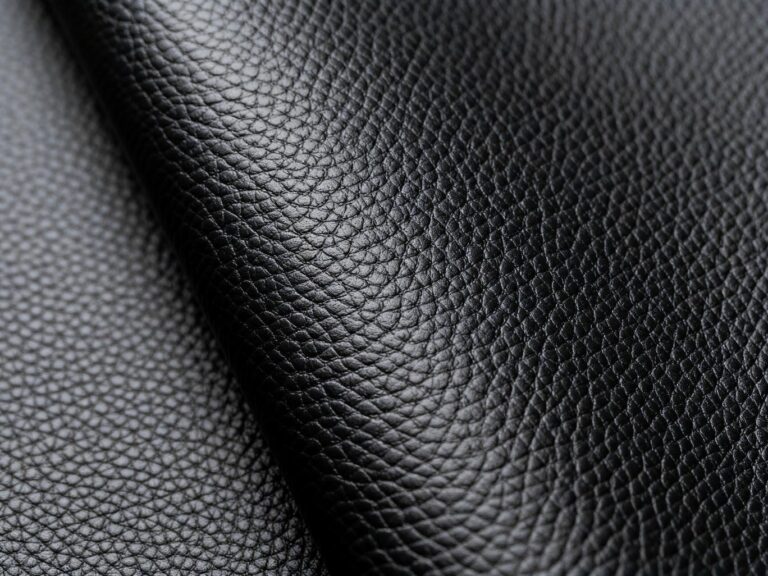
Litchi grain in silver grey: the surface layer carries both the texture and the UV package.
See how surface texture is decided at the release-paper stage, one of the inside variables a quote sheet never shows.
Texture choice is one more inside decision. It is engraved on release paper and transferred to the coating. That is why the same grain repeats identically across every roll.
Reading the Peel Test Like an Inspector
The bond gets one number: peel strength, measured under ISO 2411 or ASTM D751. For durable goods, 50N per 5cm is the common benchmark, and flexed products should sit at the upper end. But a bare number is not a verdict. A useful requirement states the method, direction, units, conditioning, and acceptance limit.
Failure mode tells the rest of the story. Clean separation at the interface points to weak bonding. A split inside the coating means the interface is stronger than the layer itself. Fiber pull-out shifts the blame to the substrate. Residual weaving oils on the base cloth are a classic hidden cause.
Lot discipline closes the loop. Delamination almost never shows on a fresh sample. Condition the specimen and test the production lot, not just the development roll. Approve bulk only after the same construction passes the same method.
Book a Layer-by-Layer Sample Review
The Verdict: What to Demand From the Inside
Match the inside build to the program before comparing surface swatches. The verdict table below condenses our inspection files.
| Your Program | Demand From the Inside | Why It Decides |
|---|---|---|
| High-fold goods: bags, upholstery seams | Peel at 50N/5cm or higher, plus flex-aged adhesion | Folding opens weak interfaces at creases first |
| Outdoor long-exposure covers | Topcoat UV package and conditioned peel after weathering | UV and heat age the bond, not just the surface |
| Skin-contact or medical seating | Solvent-free polymer layer with a wipeable topcoat | Chemistry can migrate from the middle layer |
| Heavy industrial covers | Base cloth tear strength plus a weld-seam trial | The base carries load; adhesion alone is not strength |
Some programs need a base that flexes and breathes. Our silicone microfiber leather pairs a dense nonwoven core with a full-silicone skin. It is the construction we recommend when the inside matters as much as the face.

Calender rollers set layer thickness in pass after pass: inside consistency is a machine setting before it is a promise.
Open the next quote and ask for the inside picture. Inside fabrics, the layer stack and its peel number predict service life better than any hand-feel comment ever will.
Request Rolls With Full Layer Data
About TOPSUN
TOPSUN builds silicone-coated fabrics as three-layer systems, from base cloth selection to full-silicone polymer and protective topcoat, inspected layer by layer.
Every lot ships with SGS files covering peel adhesion, Martindale, and hydrolysis, alongside Pantone and RAL matching across 100+ textures.
References
1. https://mfgmerch.com/coated-fabric/ — Coated fabric is a three-layer system: base textile, a 0.1-2.0mm polymer layer adding 50 to 500 GSM, and a topcoat, with 50N/5cm as the common peel benchmark for durable goods.(2026)
2. https://www.hzwincome.com/news/jacket-fabric-co… — Three-layer laminates resist delamination better than two-layer builds, and delamination almost never shows on a fresh sample, so wash-test swatches before bulk.(2026)
3. https://www.derflex.com/m/articledetail.asp?id=… — A coating-adhesion requirement must state method, direction, unit, conditioning, acceptance limit and failure mode, and the failure position tells more than the number alone.