Picture a Tuesday lunch. Your toddler’s strawberry puree has been smeared across the high chair leather seat for 15 minutes while you answer the door. On PU leather, that acidic residue is already reacting with the surface coating. On vinyl, plasticizers are migrating into the food residue. On silicone leather, you wipe it clean with a damp cloth — no chemical reaction, no stain, no degradation. The material under your baby’s food matters more than most product spec sheets acknowledge. Here’s what B2B buyers need to know about high chair leather safety, food contact compliance, and why material chemistry determines whether a product passes or fails real-world use.
Request Food-Safe High Chair Leather Samples
What Happens When Acidic Food Sits on High Chair Leather
Baby food is chemically aggressive. Tomato sauce, citrus juices, berry purees, and even milk formula have pH levels between 3.0 and 4.5. When these acidic substances sit on a synthetic leather surface, they don’t just stain — they react. The severity of that reaction depends entirely on the coating chemistry.
PU leather uses a polyurethane coating that’s stabilized with additives. Under prolonged acidic exposure, the PU surface begins to hydrolyze — the ester bonds in the polyurethane break down, causing the coating to become tacky, then brittle, then cracked. This isn’t immediate; it’s cumulative. Each feeding session adds a thin layer of chemical damage until, after 6–12 months of daily use, the surface texture changes and staining becomes permanent.

Soft pastel silicone leather layers: food-safe, stain-resistant material for baby and children’s products
Silicone leather behaves completely differently. The silicone polymer is inherently acid-resistant — it doesn’t hydrolyze, doesn’t break down under acidic exposure, and doesn’t absorb food residues. In our stain resistance testing, we applied ketchup, orange juice, and strawberry puree to silicone leather surfaces and left them for 24 hours. All three wiped clean with water alone. The same test on PU leather left permanent discoloration on two of three samples. High chair leather stain resistance isn’t a feature — it’s a direct consequence of the coating chemistry.
The Plasticizer Problem in Baby High Chair Materials
Here’s the thing that keeps materials scientists up at night: most high chair leather on the market today is either PU or PVC — and both contain plasticizers. Vinyl (PVC) typically contains 30–50% plasticizers by weight, including compounds like DEHP and DINP that have been restricted or banned in children’s products across the EU and multiple US states.
The problem isn’t just that plasticizers exist — it’s that they migrate. When a baby’s food sits on a plasticized surface, or when the surface is warmed by a heated meal or body heat, plasticizer molecules can transfer into the food residue. This is why baby and children’s product applications demand materials that are plasticizer-free at the chemical level, not just “low-phthalate” at the marketing level.

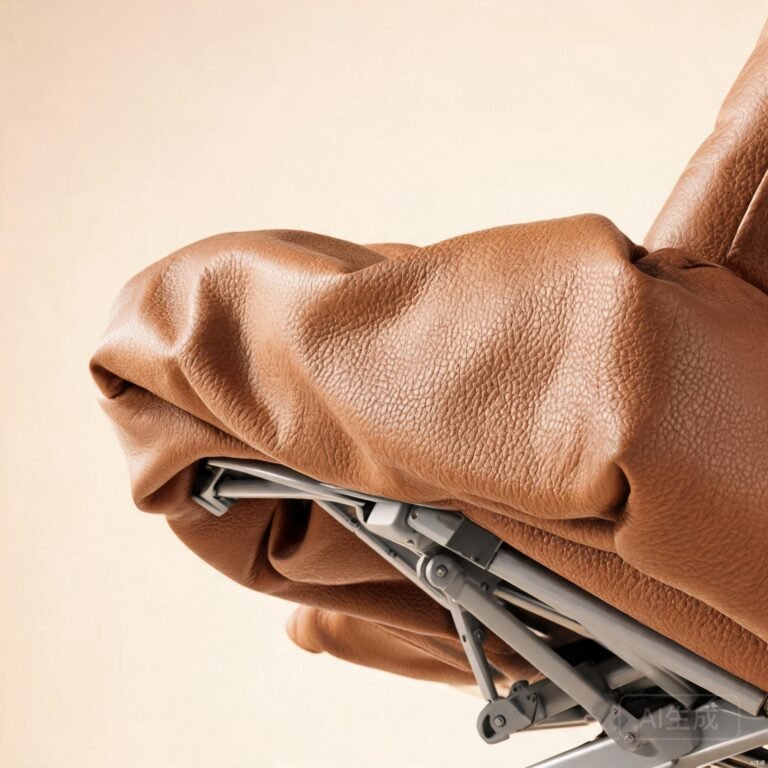
Flexibility bending test: ensuring high chair leather maintains softness without plasticizer additives
The silent failure: Silicone leather contains zero plasticizers — its flexibility comes from the inherent elasticity of the silicone polymer. No DEHP, no DINP, no migration. This is the baseline safety standard for any material that contacts a baby’s food.
FDA Food-Contact Certification: Why It Matters for High Chair Leather
FDA food-contact certification under 21 CFR 177.2600 confirms that a material doesn’t leach harmful substances into food that contacts its surface. For a high chair tray or seat cushion where food directly touches the material, this isn’t a nice-to-have. It’s the difference between a product that passes safety review and one that gets recalled.
Here’s how the three common high chair leather materials compare on the safety metrics that matter most:
| Material | Food Acid Resistance | Plasticizer Content | FDA Food Contact | Cleanability After 1 Year |
|---|---|---|---|---|
| Silicone Leather | Excellent (no hydrolysis) | Zero | Compliant (21 CFR 177.2600) | Unchanged — wipes clean |
| PU Leather | Moderate (hydrolyzes over time) | Low–moderate (varies) | Not typically certified | Surface degrades, staining increases |
| Vinyl / PVC | Poor (plasticizer leaching) | High (DEHP/DINP) | Not certified for food contact | Cracks, absorbs stains |
Beyond FDA compliance, silicone leather also passes EN 71-3 toy safety standards (heavy metal migration limits) and ISO 10993 biocompatibility testing — meaning it’s certified safe for prolonged skin contact. For a baby who touches, licks, and chews on the high chair surface during every meal, that’s the certification tier that matters.
How B2B Buyers Should Specify High Chair Leather
If you’re sourcing high chair leather for a baby product line, your purchase order needs to go beyond color and thickness. Here’s the specification checklist we recommend:
- FDA food-contact certification: Require 21 CFR 177.2600 test reports — not a generic “food safe” claim. Ask for the actual lab report with extraction data.
- EN 71-3 toy safety: Heavy metal migration testing specific to children’s products. This is mandatory for CE marking in the EU.
- Plasticizer-free verification: Request a chemical composition analysis confirming zero DEHP, DINP, and other restricted phthalates. Don’t accept “phthalate-free” without the test data.
- Acidic food stain resistance: Require stain testing with tomato sauce, orange juice, and berry puree at 24-hour exposure. Specify that results must show no permanent discoloration.
- Cleanability cycle data: Ask for results from 1,000 wipe cycles with common household cleaners. The surface should show no degradation or texture change.
For buyers evaluating high chair cover materials, the pattern is consistent: PU and vinyl pass on price but fail on food safety. Silicone leather is the only material that passes both.
Our silicone leather introduction covers the full chemistry behind why this material class is inherently food-safe — from cross-linked polymer structure to zero-plasticizer formulation.
One more practical consideration: daily cleaning. Cleaning and maintenance protocols for silicone leather are simple — water and mild soap, no special conditioners, no pH-neutral-only products. For a product that gets wiped 3–5 times daily, that simplicity translates to real labor savings over the product’s life.

Fire retardant testing: silicone leather self-extinguishes, adding a safety margin for children’s furniture

Baby product applications: silicone leather provides food-safe, stain-resistant surfaces for high chairs and nursery furniture
Watch how TOPSUN’s silicone leather passes FDA food-contact, EN 71-3, and ISO 10993 testing for baby-safe applications.
Frequently Asked Questions
Is PU leather safe for baby high chair surfaces?
PU leather is widely used in baby high chairs, but its safety depends on the specific formulation and certification. Standard PU is not FDA food-contact certified and may contain additives that leach under acidic food exposure. If you’re specifying PU for a high chair, require EN 71-3 test reports and acidic food resistance data. For products marketed as food-safe, silicone leather is the only material with full FDA 21 CFR 177.2600 compliance.
What certifications should high chair leather have for food contact?
At minimum: FDA 21 CFR 177.2600 (US food contact), EN 71-3 (EU toy safety — heavy metal migration), and ISO 10993-5/-10 (biocompatibility for skin contact). If the product ships to California, add Prop 65 compliance. For products sold in markets with EN 71-3 requirements, the children’s furniture leather safety standards are non-negotiable — and they eliminate vinyl/PVC from the acceptable materials list.
The Surface Your Baby Eats On
High chair leather is the surface your baby’s food touches three times a day, every day, for years. The material chemistry determines whether that surface stays clean and inert — or degrades, stains, and leaches. PU leather hydrolyzes under acidic food exposure. Vinyl leaches plasticizers into food residue. Silicone leather is FDA food-contact certified, plasticizer-free, and resistant to every common baby food acid.
For B2B buyers sourcing high chair leather, the specification is straightforward: require FDA 21 CFR 177.2600 test reports, EN 71-3 compliance, and zero plasticizer verification. If a supplier can’t provide all three, the material isn’t safe for food contact — regardless of how it looks or feels.
Get FDA-Certified High Chair Leather Quote
About TOPSUN
TOPSUN manufactures high chair leather with FDA food-contact certified silicone coating for baby feeding products, children’s furniture, and nursery equipment — with full batch-level safety documentation for every production run.
21 CFR 177.2600 FDA food-contact compliant | EN 71-3 toy safety certified | Zero plasticizers, phthalates, or heavy metals | ISO 10993 biocompatibility for direct skin contact | REACH SVHC 181 and RoHS 2.0 compliant