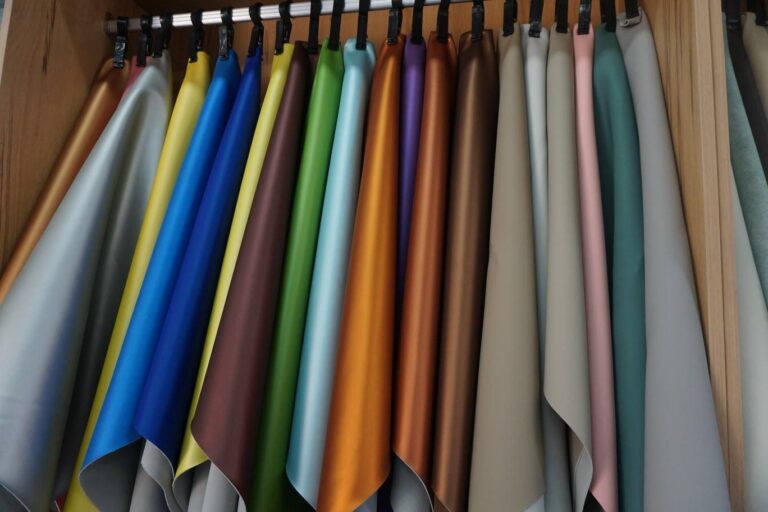
Two suppliers quote the same waterproof sheet. One calls it film fabric. The other calls it coated fabric. The prices sit apart, the datasheets look similar, and the word waterproof appears on both. Which one belongs on your PO?
Our answer, after years of quoting both sides of this question: they are not competitors, they are different constructions. The construction, not the polymer, decides how the material fails. This piece shows where the two split and what to verify before you commit.
Film Fabric Is a Bonded Layer, Not a Coating
A film fabric is a composite made by bonding a pre-formed polymer film to a base textile with heat, pressure, and sometimes adhesive. The base cloth, usually nylon or polyester, supplies tensile strength, tear resistance, and drape. The film supplies the function: a waterproof barrier, a weldable surface, or a bonding layer. Suppliers describe the pairing as fabric plus film, each doing its own job.
One detail catches many buyers. A film can be the functional face of the finished sheet, or it can be the adhesive that joins two layers. Those are different procurement requirements, and quoting them as one item is how specs drift. Name which one you are buying before the sample stage.

Film on rolls, waiting for a base cloth. The bond line is where the value sits.
Film vs Coated: Where the Constructions Split
A coated build applies liquid polymer directly onto the weave, where it penetrates the yarns and cures into one material. A film fabric keeps the layers separate, joined by a bond line. That single difference drives most of the behavior that follows.
| Aspect | Film fabric (laminated) | Coated build |
|---|---|---|
| Bonding | Pre-made film bonded with heat and pressure | Liquid polymer fused into the weave |
| Structure | Discrete layers joined by a bond line | One integrated layer |
| Typical failure | Film peels away unless peel bond is specified | Cracking from plasticizer loss over years |
| Weldability | Strong point, seams fuse by heat | Sew-and-seal, welding less reliable |
| Cost position | Lighter and lower cost for short-life duty | Higher upfront, longer service life |
Read the failure rows twice. Neither construction is weaker. Each fails in a different place, and your application decides which failure you can live with.

Lamination in progress. Temperature, pressure, and speed set the peel strength.
The Films Buyers Actually Meet
Three film families cover most quotes. TPU film is the volume leader, cast between roughly 0.02 and 2.0 mm and offered in hardness grades from about 70A to 95A Shore, with lamination widths reaching 2,400 mm at the larger converters. PVC film costs less and sews easily, but it carries plasticizers that can migrate out over years of flexing. Silicone film is the newer entry, priced higher, with no plasticizer to lose.
TPU wins on weldability and weight. PVC wins on price. Silicone wins where cleaning agents, skin contact, or long service life enter the spec. Most sourcing disputes are really arguments about which of those three matters most for the end use.
Substrate bonding on our line: the same bond line logic a film fabric lives or dies by.
Compare Film and Coated Builds With Our Engineers
Where the Bond Line Decides the Batch
Laminated constructions fail at the bond line, so peel strength is the number that matters. Ask for it on the test report, measured before and after a defined flex or wash cycle. A film fabric without a peel specification is a promise, not a product.
The reward for getting the bond right is welding. Medical goods show the pattern clearly: oxygen bags, blood pressure cuffs, and anti-bedsore mattresses all rely on thermoplastic films that fuse at the seam, holding air or fluid without stitch holes. Barrier gowns push the same logic further, with films engineered against synthetic blood and viral penetration under ASTM F1670 and F1671. For welded goods, see our medical and healthcare applications.
The Silicone Route: No Plasticizer to Migrate
Silicone builds attack the problem differently. Instead of managing plasticizer loss, they use a polymer that contains none, so the face cannot stiffen or crack from migration. Cleaning agents and alcohol wipes stop being a threat to the surface chemistry. Hydrolysis, the failure that quietly eats plasticized builds in humid storage, has no pathway either.
The trade is cost and weldability: silicone is not thermoplastic, so seams are sewn rather than heat-fused. Where the spec calls for long service under wiping and weather instead of airtight seams, a silicone build wins the lifecycle math. Our full versus semi comparison breaks down how far the silicone face needs to extend. Outdoor programs can start from our marine and outdoor applications.

Rolls staged for conversion. However the face is made, the base cloth carries the load.
What to Verify Before the PO
Whichever construction wins, four checks belong on the purchase order. Peel strength, with the test method named. Film or coating thickness, with tolerance. Width, matched to your cutting layout. And for welded goods, a welding window confirmed on your own seam equipment, not just the supplier’s.
On our silicone line, builds run 0.8 to 2.0 mm and 400 to 800 g/m², with tensile, flex, and abrasion reports shipped alongside the samples. That habit, numbers attached to every claim, matters more than which construction you pick.
The One-Line Decision
Choose film fabric when the product needs welded seams, low weight, or a short-life budget, and choose a coated build when the product needs to survive years of cleaning and flexing. Verify the peel bond either way, because in a laminate the bond line is the product.
Request Film and Coated Samples
Frequently Asked Questions
Is a laminated film fabric weaker than a coated one?
Not inherently. A coated build resists delamination because the polymer penetrates the yarns, while a film fabric holds up as long as the peel bond is specified and tested. Heavy-duty truck covers lean coated for life span, while inflatables and welded medical goods lean film for airtight seams. Match the failure mode to the duty, not the marketing.
Can film fabric be welded instead of sewn?
Yes, when the film is thermoplastic. TPU and PVC films fuse under heat or high frequency, which is why oxygen bags, blood pressure cuffs, and inflatable goods use them. Silicone film and silicone coatings are not thermoplastic, so products in that family are sewn and sealed instead.
About TOPSUN
TOPSUN manufactures silicone-coated fabrics on in-house lines, supplying furniture, automotive, marine, and medical programs from 0.8 to 2.0 mm. Every sample ships with tensile, flex, and abrasion reports attached, so film-versus-coated decisions can be argued from numbers.
Compliance documents cover REACH, PAHs, and ISO 10993-5 cytotoxicity, and the standard MOQ starts at 500 meters. Our engineers help buyers match construction to duty cycle before the first quote is issued.