A furniture OEM we work with switched their entire sofa line to faux leather textile three years ago. Their warranty claim rate dropped 60% — but not because they picked the cheapest roll on the market. They picked the right one. That distinction matters when you are sourcing faux leather textile at scale, because the gap between a 2-year material and a 10-year material is measured in cents per meter, not dollars.
This guide breaks down what B2B buyers actually need to evaluate: material composition, performance benchmarks, cost beyond the unit price, and supplier qualification criteria. Whether you are sourcing for automotive interiors, furniture upholstery, or medical seating, the framework here applies.

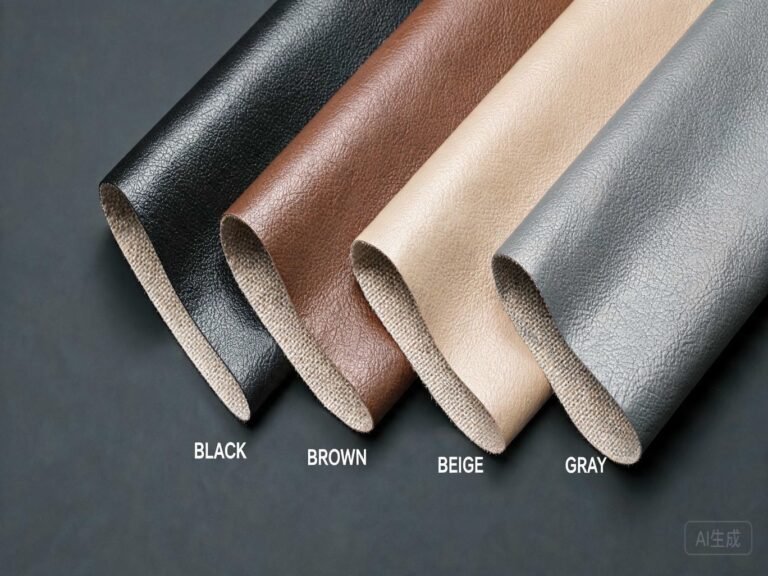
Faux leather textile swatches in production — color consistency is a key sourcing criterion.
What Defines a Faux Leather Textile?
Faux leather textile refers to any synthetic material engineered to replicate the look and feel of genuine leather while using a fabric backing — typically polyester, cotton, or a blended substrate — coated or laminated with a polymer surface. The result is a roll-good material that can be cut, sewn, and wrapped just like animal hide, but at a fraction of the cost and with far greater consistency.
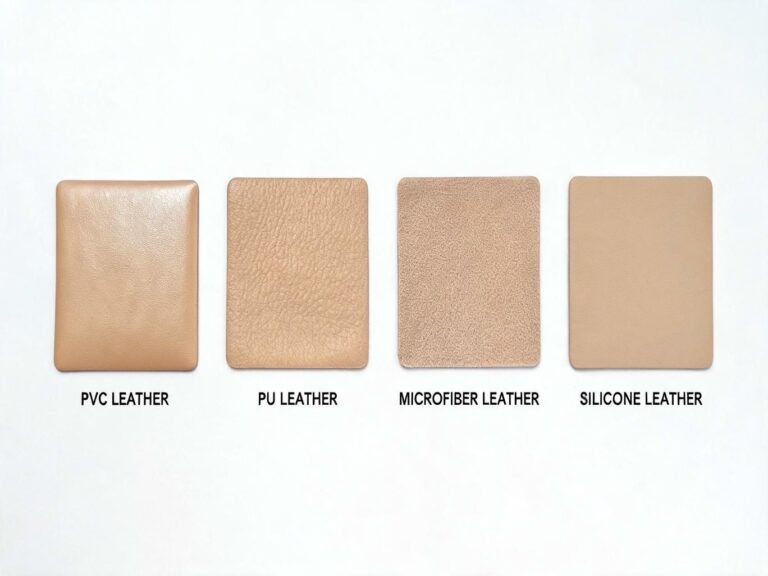
Four dominant types compete in the B2B market today, and they are not interchangeable:
- PVC faux leather textile — Polyvinyl chloride coating on woven backing. Inexpensive, waterproof, but contains plasticizers and phthalates that off-gas VOCs over time. Common in low-cost contract furniture.
- PU faux leather textile — Polyurethane surface layer. Softer hand feel than PVC, breathable, but hydrolyzes in humid environments within 2–5 years. Widely used in fashion and mid-range furniture.
- Silicone faux leather textile — 100% silicone polymer bonded to fabric. Zero VOC, inherent UV stability, 10–15+ year service life. The premium tier for automotive, medical, and marine applications.
- Microfiber faux leather textile — Ultra-fine fiber nonwoven base impregnated with PU. Closest to genuine leather in structure, good abrasion resistance, but limited color fastness under prolonged UV exposure.
Understanding which polymer sits on top of the fabric backing is the first step in any faux leather textile performance criteria evaluation. The backing fabric also matters — a tightly woven polyester provides better tear strength than a loosely knit alternative, which directly affects how the material performs on a specific application’s wear curve.

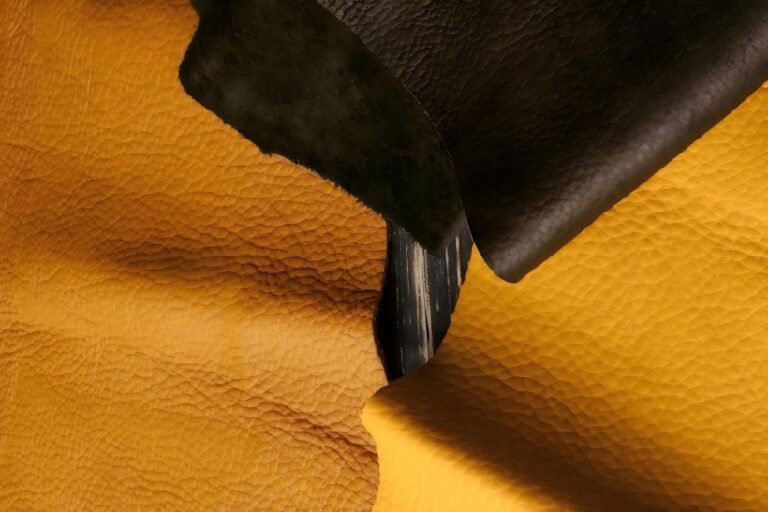
Raw material display showing the lifecycle stages of faux leather textile production.
Performance Criteria That Separate Winners from Losers
Here’s the thing — most sourcing teams stop at thickness and color match. That leaves four performance dimensions untested, and each one has caused costly field failures.
Abrasion resistance is the single most quoted metric, and for good reason. The Martindale test measures how many cycles a material survives before visible wear. PVC typically rates 15,000–30,000 cycles. PU reaches 25,000–50,000. Silicone-coated faux leather textile exceeds 200,000 cycles — a 4x to 13x advantage that translates directly to warranty cost reduction. In our testing lab, we have run Martindale on samples from competitors that failed at 8,000 cycles despite being labeled “commercial grade.”

Physical testing equipment used to verify faux leather textile durability claims.
Hydrolysis resistance determines whether your material will crack and peel in humid climates. PU faux leather textile is particularly vulnerable — the ester bonds in polyurethane break down when exposed to moisture and heat. We have seen PU upholstery in tropical markets fail within 18 months. Silicone, with its silicon-oxygen backbone, is inherently hydrolysis-resistant, which is why it dominates marine and high-humidity applications.
UV stability and VOC emissions round out the critical four. UV testing (QUV accelerated weathering) reveals whether colors will hold over 5 years of sun exposure. VOC testing matters for automotive interiors — where cabin air quality regulations like VDA 277 are tightening — and for indoor furniture in markets with strict indoor air quality laws.
Field data from a 3-year sofa line study: warranty claims dropped from 7.2% to 2.8% when the OEM upgraded from PU to silicone faux leather textile — a 60% reduction that recovered the material cost premium within 14 months.
For buyers evaluating faux leather textile durability testing, always request third-party test reports — not supplier self-declarations. The gap between lab-certified and field-real performance can be enormous.
| Property | PVC | PU | Silicone | Microfiber |
|---|---|---|---|---|
| Abrasion (Martindale cycles) | 15K–30K | 25K–50K | 200K+ | 30K–60K |
| Service Life (years) | 3–5 | 2–5 | 10–15+ | 5–8 |
| Temperature Range (°C) | -15 to 70 | -20 to 60 | -40 to 250 | -20 to 80 |
| VOC Emissions | High | Moderate | Zero | Low |
| Recyclable | Very difficult | Difficult | Yes | Limited |
Cost Factors Beyond the Price Per Meter
Procurement teams love unit price comparisons — and suppliers know it. But the real cost of faux leather fabric unfolds across the entire product lifecycle, and ignoring that is how you end up replacing 500 sofa covers in year three.
Here is a total-cost-of-ownership framework we use with buyers:
- Material cost — the per-meter price. PVC is cheapest ($2–5/m), PU mid-range ($4–10/m), silicone premium ($8–18/m), microfiber upper-mid ($6–14/m). These ranges vary by thickness, backing, and order volume.
- Warranty reserve — if your material lasts 3 years instead of 10, you will pay for replacements, labor, and logistics. A 5% warranty claim rate on a $200 product costs $10 per unit — more than the material price difference.
- Cleaning and maintenance — genuine leather needs conditioning every 6 months. PU requires special cleaners. Silicone wipes clean with a damp cloth. Over a 10-year furniture lifecycle, maintenance labor can exceed the original material cost.
- Regulatory compliance — REACH, PAHs, and increasingly strict VOC regulations mean that cheap PVC sourced today may be unsellable in the EU tomorrow. Compliance documentation is not optional — it is your market access.
- End-of-life disposal — incinerating PVC releases dioxins. PU is difficult to recycle. Silicone is recyclable. For brands targeting circular economy goals, this is no longer a footnote.
When you factor in faux leather textile cost factors holistically, the cheapest material per meter is rarely the cheapest over a product’s life. A silicone-based textile that costs 2x the PU alternative but lasts 3x longer and generates zero warranty claims is the lower TCO choice — and the math gets more favorable as labor and logistics costs rise.

Buyer evaluation in progress — quality assessment of faux leather textile samples.
B2B Sourcing Recommendations That Protect Your Bottom Line
After evaluating hundreds of synthetic leather suppliers, here are the qualification steps that consistently separate reliable partners from headaches:
- Request third-party test reports upfront — Martindale, UV (ISO 4892), hydrolysis (ISO 1419), and VOC (VDA 277 or equivalent). No reports, no order.
- Run a pilot batch before committing to volume — a 50-meter sample order lets you test cutting, sewing, and adhesion without risking a full container. We always encourage buyers to understand the material before scaling.
- Audit the factory’s QC process — does the supplier perform in-line testing during coating, or only batch-test finished rolls? Real-time QC catches defects before they reach your cutting table.
- Verify certification authenticity — ISO 10993, REACH, and FDA certificates should be traceable to the testing lab. Fake certificates are disturbingly common in this industry.
- Negotiate color consistency guarantees — Delta E tolerance should be specified in your contract. A Delta E > 2 between batches means visible color mismatch on assembled furniture.
For buyers comparing silicone versus PU, our silicone vs PU comparison page walks through the performance trade-offs in detail. The short version: if your product needs to survive more than 5 years in real-world conditions, silicone is the only faux leather textile that does not require caveats.
Watch how different faux leather textile materials compare in real-world performance testing.
Frequently Asked Questions
Is faux leather textile the same as PU leather?
No. PU leather is one specific type of faux leather textile — it uses a polyurethane surface coating. Faux leather textile is the broader category that also includes PVC, silicone, and microfiber variants. Each type has different performance characteristics, lifespans, and regulatory profiles. Confusing the two leads to incorrect durability expectations.
How long does faux leather textile last in commercial applications?
It depends entirely on the polymer type. PVC typically lasts 3–5 years. PU lasts 2–5 years but hydrolyzes faster in humid environments. Silicone-coated faux leather textile lasts 10–15+ years even under heavy commercial use. For contract furniture with 24/7 occupancy, we strongly recommend silicone for its Martindale rating above 200,000 cycles and inherent UV stability.
Making the Right Material Choice
According to Grand View Research, the global synthetic leather market is projected to exceed $85 billion by 2030, driven by automotive and furniture demand — but that growth is unevenly distributed across material types. The faux leather textile market is not short on options — it is short on honest performance data. The buyers who win are the ones who test before they trust, who calculate total cost instead of unit price, and who demand certification traceability from every supplier they evaluate. Whether you end up with PVC for a short-life product, silicone for a 15-year warranty, or something in between, the decision should be driven by data, not by a spec sheet.
If you are currently sourcing faux leather textile for a new product line, start by requesting physical samples and third-party test reports. Then run your own abrasion and hydrolysis testing on the samples before committing to volume. The cost of a few test meters is trivial compared to the cost of a warranty program on the wrong material.
About TOPSUN
TOPSUN manufactures silicone-based faux leather textile for furniture, automotive, and medical upholstery applications that demand hydrolysis resistance and 200,000+ cycle Martindale abrasion performance.
ISO 10993 biocompatibility certified · REACH compliant · Zero-VOC solvent-free production · Custom Pantone color matching with 100+ embossing patterns · 8+ years serving 30+ countries