The global synthetic leather market reached USD 45.5 billion in 2025, with polyurethane (PU) accounting for 57% of that share [$TRAE_REF](https://www.grandviewresearch.com/industry-analysis/synthetic-leather-market). That dominance makes sense on a cost-per-meter basis. But procurement teams managing multi-year furniture, automotive, or medical contracts know that upfront price tells only part of the story. When your specification sheet reads “faux leather polyurethane,” the real trade-offs hide in durability curves, VOC compliance exposure, and hydrolysis timelines that surface years after purchase orders close.
This guide breaks down what B2B buyers need to evaluate when sourcing faux leather polyurethane — from manufacturing fundamentals and performance benchmarks to regulatory pressure points and silicone leather as a next-generation alternative. For a broader material comparison, see our detailed silicone vs PU leather analysis.
Request PU vs Silicone Samples
What Is Faux Leather Polyurethane?
Faux leather polyurethane is a coated fabric where liquid polyurethane resin is applied over a textile backing — typically woven polyester, knit fabric, or non-woven base — to simulate the appearance and hand feel of genuine leather. The PU coating forms the visible surface layer, while the fabric substrate provides structural integrity and tear strength. Unlike PVC leather, which relies on plasticizers for flexibility, PU uses a polyurethane polymer that can be formulated for varying degrees of softness, breathability, and texture.
The manufacturing process matters for procurement because it directly determines VOC exposure. Traditional solvent-based PU production uses dimethylformamide (DMF) as a primary solvent. DMF is classified as a reproductive toxin under EU REACH regulations, and its emissions during curing require closed handling systems and exhaust treatment. Water-based PU systems reduce this risk but often trade away some abrasion resistance and surface durability. Understanding which production method your supplier uses is the first specification checkpoint.

Polyurethane coating line — the production method (solvent-based vs water-based) directly affects VOC compliance status
Faux Leather Polyurethane Performance Trade-Offs
In our experience testing materials for furniture and automotive clients, PU faux leather delivers clear advantages in initial cost and aesthetic range. The material offers 1,000+ color and texture options, a warm leather-like hand feel, and processing compatibility with standard cutting and sewing equipment. These attributes explain its 57% market share. But performance trade-offs become visible within the first 2-3 years of field deployment.
The most critical trade-off is lifespan. PU faux leather typically lasts 3-5 years before showing surface cracking, peeling, or color fading. In high-traffic commercial environments — hotel lobbies, restaurant booths, transit seating — that timeline compresses further. By contrast, silicone leather maintains structural integrity for 10-15+ years under identical conditions, backed by Martindale abrasion ratings of 100,000-200,000+ cycles versus PU’s 30,000-80,000 cycles.
Hydrolysis is the second silent cost. PU’s molecular chains break down when exposed to moisture over time — a process called hydrolysis. In tropical or high-humidity environments, PU degrades within 2-3 years, developing surface tackiness, blistering, and eventual delamination. This isn’t a defect; it’s an inherent material limitation. Silicone leather, by comparison, passes 1,000+ hour hydrolysis tests with zero degradation, making it the preferred specification for moisture-exposed applications.

Martindale abrasion tester — PU faux leather typically rates 30,000-80,000 cycles vs silicone leather’s 100,000-200,000+
VOC Regulations Reshaping PU Leather Sourcing
REACH restrictions on synthetic polymer microparticles and tightening VOC emission norms are reshaping how B2B buyers source PU faux leather [$TRAE_REF](https://www.grandviewresearch.com/industry-analysis/synthetic-leather-market). European and North American procurement teams now require emission test documentation that didn’t exist five years ago. For automotive interiors, VDA 277 and VDA 278 standards govern total VOC and semi-volatile organic compound emissions — and solvent-based PU formulations routinely struggle to meet these thresholds without additional post-processing.
The regulatory trajectory is clear: compliance costs for solvent-based PU will continue rising. Manufacturers are responding by shifting toward water-based PU systems and solvent-free coating technologies. However, these transitions require capital investment in new production lines, and not all suppliers have completed the shift. Procurement teams should audit whether their PU leather supplier operates solvent-based or water-based lines, and request current emission test certificates as part of supplier qualification.
“We’ve seen clients switch from PU to silicone leather mid-contract after VOC emission failures triggered product recalls. The cost of retroactive material replacement far exceeds the per-meter premium of specifying the right material upfront.”
PU vs Silicone Leather: A Procurement Comparison
When evaluating faux leather polyurethane against alternatives, the comparison should extend beyond price-per-meter to include lifecycle cost, compliance risk, and replacement frequency. The table below summarizes the key procurement-relevant differences:
| Property | PU Faux Leather | Silicone Leather |
|---|---|---|
| Martindale Abrasion | 30,000 – 80,000 cycles | 100,000 – 200,000+ cycles |
| Lifespan | 3 – 5 years | 10 – 15+ years |
| Temperature Range | -20°C to 80°C | -40°C to 250°C |
| VOC Emissions | Moderate to high (DMF in solvent-based) | Near zero (solvent-free process) |
| Hydrolysis Resistance | Poor (degrades in 2-3 yrs in humidity) | Excellent (1,000+ hrs tested) |
| Flame Retardancy | Requires chemical additives | Inherent (EN 13773 / FAR 25.853) |
| Upfront Material Cost | Economical ($) | Premium ($$$) |
| 10-Year TCO (incl. replacement) | Higher (2-3 replacement cycles) | Lower (single deployment) |

Color fastness testing — silicone leather maintains grade 4-5 ratings vs PU’s typical grade 2-3 under accelerated UV exposure
Specification Checklist for Faux Leather Polyurethane Buyers
Whether you ultimately specify PU or transition to eco-friendly silicone leather, the following checklist ensures your specification captures the data that matters for multi-year contracts:
- Production method confirmation: Solvent-based, water-based, or solvent-free? Request the supplier’s current production line certification and DMF usage documentation.
- Martindale abrasion rating: Specify minimum cycle requirements based on application — 25,000+ for residential furniture, 50,000+ for commercial seating, 100,000+ for automotive and marine.
- Hydrolysis test data: Request hours-to-failure data under ISO 1419 or equivalent accelerated aging. Anything below 500 hours signals risk for humid environments.
- VOC emission certificates: For automotive, require VDA 277/VDA 278 results. For furniture, request REACH SVHC compliance documentation and any applicable GREENGUARD or OEKO-TEX certifications.
- Color fastness grades: Specify minimum grade 4 for light fastness (ISO 105-B02) and grade 4-5 for rubbing fastness (ISO 105-X12).
- Batch consistency protocol: Confirm Delta E tolerance for color matching — ≤1.0 for premium applications, ≤2.0 for standard commercial use.
- Flame retardancy compliance: For public spaces, verify EN 1021-1/2 (furniture) or FAR 25.853 (aviation) certification. PU requires additive treatment; verify additive longevity.
- Replacement cost modeling: Calculate total cost over contract duration including material cost, replacement labor, downtime, and potential compliance retrofitting.
For buyers evaluating silicone leather as an alternative, our team at TOPSUN can provide side-by-side sample kits with matched specifications. The PU leather fundamentals guide and our environmental impact analysis of faux leather polyurethane provide additional context for internal specification reviews.

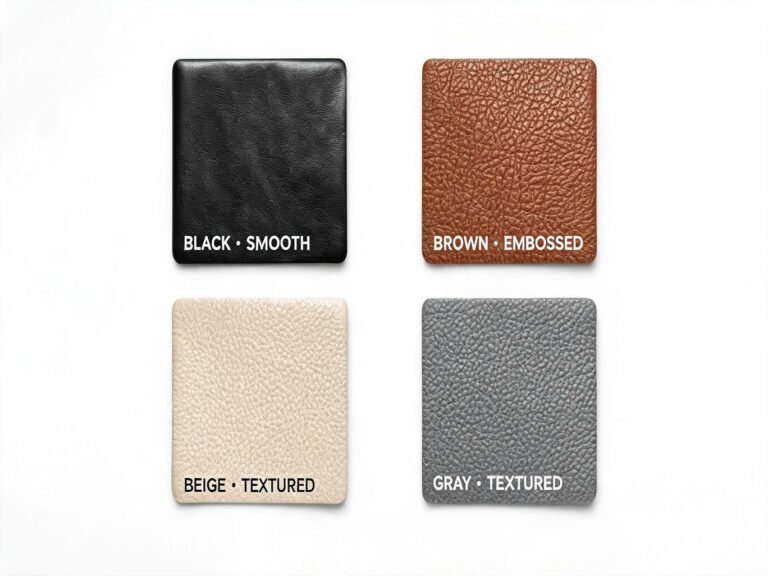
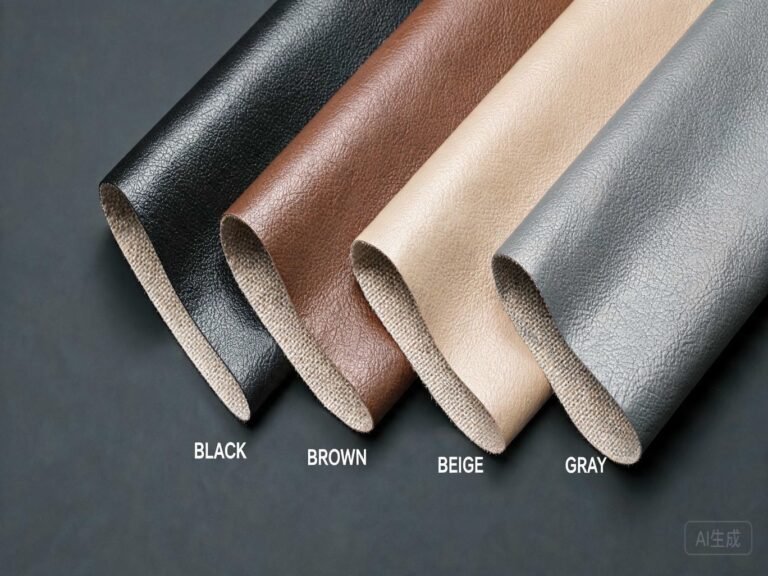
Color palette comparison — PU offers 1,000+ options while silicone leather covers 100+ textures with Pantone/RAL precision matching
Is faux leather polyurethane safe for automotive interiors?
PU faux leather can meet automotive interior standards, but solvent-based PU production emits DMF (dimethylformamide), a substance classified as a reproductive toxin in the EU. Water-based PU reduces VOC risk but may sacrifice abrasion performance. Buyers should request VDA 277 or VDA 278 emission test results from suppliers before approving PU for cabin interiors. Silicone leather inherently meets these thresholds without additional treatment, which is why EV manufacturers increasingly specify it for seat and panel surfaces.
How does faux leather polyurethane compare to silicone leather in total cost of ownership?
PU faux leather typically costs 40-60% less per meter upfront than silicone leather. However, with a 3-5 year lifespan versus 10-15 years for silicone, plus higher replacement labor and potential compliance retrofitting costs, the total cost of ownership often favors silicone leather over a 10-year furniture or automotive contract cycle. For high-traffic commercial applications, the break-even point typically falls around year 4-5, after which silicone’s single-deployment advantage compounds.
Get a Custom PU vs Silicone Quote
About TOPSUN
TOPSUN manufactures high-performance silicone leather as a direct alternative to faux leather polyurethane for B2B buyers across furniture, automotive, medical, and marine sectors. Our solvent-free coating lines produce materials with near-zero VOC emissions, Martindale abrasion ratings exceeding 200,000 cycles, and full compliance with REACH, ISO 10993-5, FDA 21 CFR Part 177.2600, and EN 13773 flame retardancy standards. We support Pantone and RAL color matching with Delta E ≤ 1.0 accuracy, offer 100+ texture options, and maintain batch-to-batch consistency through automated process control. Procurement teams can request matched specification samples — PU versus silicone — to conduct their own internal comparison testing before committing to long-term contracts.
Related reading: Full vs semi silicone leather · Silicone vs PU comparison · PU and faux leather sourcing guide