Faux leather pieces or full rolls: which one actually costs less for your program? Buyers ask us this weekly, and the honest answer depends on volume, color count, and how much offcut waste your cutting plan can absorb. Pre-cut pieces carry a higher price per square meter but slash waste for small runs. Rolls reward commitment with the lowest unit cost. This guide runs the numbers on both formats so you can order with confidence instead of guesswork.
| Factor | Pre-Cut Pieces | Full Rolls |
|---|---|---|
| Unit cost per m虏 | Higher (cutting labor) | Lowest |
| Offcut waste | Near zero | 10-25% typical |
| Entry volume | Dozens of pieces | 300-500 m |
| Color range per order | Many, small lots | Few, large lots |
| Dye-lot consistency | Varies by lot | Single lot per roll |
| Best for | Sampling, crafts, accessories | Mass production |
When Faux Leather Pieces Beat Full Rolls
Pieces win whenever volume is small and variety is large. Earring makers, hair-bow brands, and notebook cover studios order dozens of sheets across six or more colors in a single purchase. One roll would outlive their product cycle. The accessories segment is growing at a projected 7.12% CAGR through 2031. It sits inside a leather goods market worth $464.8 billion in 2026. Most of that growth comes from small, colorful, fast-turning product lines.
A hair-accessory brand we support switched from two rolls to pre-cut sheets last year. Their offcut waste dropped from roughly 20% to under 3%, which paid for the higher piece price within one season. If your cutting pattern cannot nest efficiently, the roll discount is an illusion.

Specialty textures like this glitter finish sell in small lots, not 500-meter rolls.
When a Full Roll Wins on Cost and Consistency
Rolls take over once a design proves itself. Unit cost drops, dye-lot consistency holds across the whole run, and your cutting team nests patterns freely. For sofa panels, automotive trim, or any product with large single-piece components, pre-cut formats rarely exist at the required size anyway. Consistency matters more than convenience at this stage: one roll is one dye lot, so piece number 4,000 matches piece number 4.
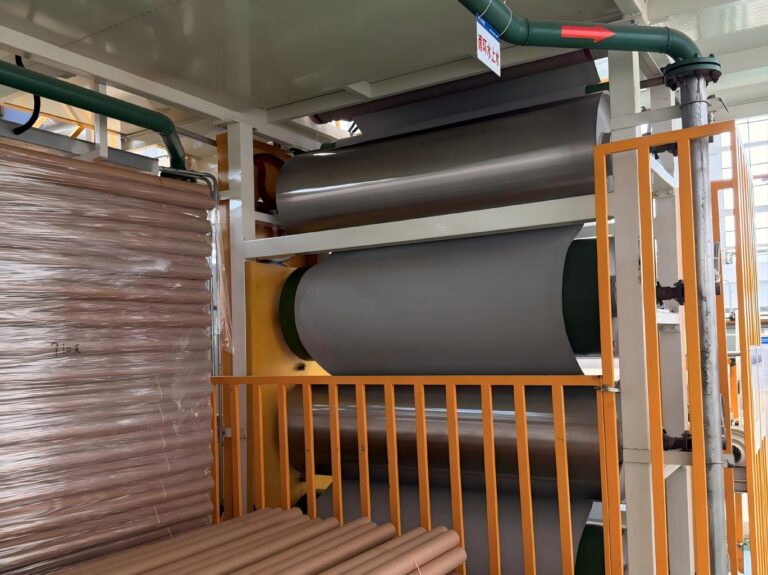
On our own slitting line, converting a roll into custom widths costs a fraction of die-cutting individual pieces. Buyers who need repeats of the same shape in volume should price silicone microfiber leather by the roll before assuming pieces are cheaper.

Slitting converts one roll into custom widths at a fraction of die-cut costs.
Custom Die-Cut Pieces: What to Send Your Supplier
Ordering custom faux leather pieces goes smoothly when the spec is complete. Suppliers need three things from you:
- A vector cutting file (AI, DXF, or PDF) with the true finished dimensions and corner radii.
- Backing requirements: self-adhesive, plain, or fabric backing for sewing.
- Annual volume estimate, since tooling and piece pricing both key off it.
Tolerance is the detail most first-time buyers miss. Die-cut parts hold 卤0.5 mm comfortably; tighter tolerances raise tooling cost. For electronics sleeves and 3C accessory coverings, state the tolerance on the drawing, not in an email thread.

Small leather goods turn pre-cut pieces into finished products with minimal waste.
Faux Leather Pieces or Rolls: The Quick Verdict
Both formats earn their keep in different programs. Match your situation to the verdict table below before the next purchase order:
| If you need… | Choose |
|---|---|
| 6+ colors, under 200 units each | Pre-cut faux leather pieces |
| Sampling before a production run | Pre-cut pieces |
| One color, 1,000+ units per year | Full roll |
| Large panels (sofa, boat, car seat) | Full roll |
Run the waste math against the unit price and the decision usually makes itself. For fashion-forward programs that mix many colors, faux leather pieces keep cash free and shelves varied.

Custom cuts start at the bench: a craftsman turns rolls into program-ready pieces.