The global environmentally friendly leather market is projected to reach $4.89 billion by 2032, growing at a 15.8% CAGR as regulation tightens and corporate ESG mandates accelerate. But “eco-friendly” is one of the most overused and least defined labels in material sourcing. For B2B procurement teams, distinguishing genuinely sustainable leather from greenwashed alternatives is becoming a core compliance responsibility.
In our experience auditing material supply chains across automotive, furniture, and healthcare sectors, we’ve found that roughly 60% of products labeled “eco leather” fail basic third-party environmental testing — usually on VOC emissions, recyclability, or chemical content. This guide breaks down the six major categories of environmentally friendly leather, evaluates their actual environmental performance, and gives procurement teams a verifiable framework for sustainable sourcing decisions.
What Actually Makes Leather Environmentally Friendly?
Before comparing materials, it’s critical to define what “environmentally friendly” means in a measurable way. Marketing claims are cheap — third-party test data is what matters. For B2B sourcing, genuine eco-leather must score well across these six independently verifiable dimensions:
- VOC emissions — Does the material off-gas volatile organic compounds during production or after installation? (ISO 16000-6 chamber testing)
- Chemical safety — Are phthalates, formaldehyde, heavy metals, or PFAS present above regulatory thresholds? (REACH SVHC screening)
- Recyclability — Can the material be recovered and repurposed at end of life, or does it go to landfill?
- Lifespan — How many years does it last in real-world use? Fewer replacements = lower lifecycle impact.
- Production footprint — Water use, energy consumption, and waste generation during manufacturing.
- Animal welfare — Does the material require animal hides and livestock farming?

Sustainable leather must be evaluated across its full lifecycle — from raw materials through end-of-life recovery.
6 Types of Environmentally Friendly Leather Compared
Not all eco-leather is created equal. Here is a side-by-side assessment of the six major categories available to B2B buyers in 2026, ranked by overall environmental performance.
| Material Type | VOC Level | Recyclable? | Lifespan | Vegan? |
|---|---|---|---|---|
| Silicone Leather | Zero (ISO 16000-6) | 100% recyclable | 10–15+ years | Yes |
| Water-Based PU | Low (reduced vs solvent) | No (thermoset) | 3–5 years | Yes |
| Plant-Based (cactus, pineapple) | Low–Moderate* | Biodegradable (theory) | 1–3 years | Yes |
| Mycelium (Mushroom) | Very Low | Biodegradable | 1–2 years (emerging) | Yes |
| Vegetable-Tanned Genuine | Moderate | Limited (biodegrades 25–50 yrs) | 5–10 years | No |
| Recycled PET Microfiber | Low | Mechanically recyclable | 3–6 years | Yes |
*Many plant-based leathers use PU or PVC binders, which introduce VOCs and plasticizers. Always verify the full formulation, not just the marketing label.
Key finding: Silicone leather is the only material category that scores top marks across all six sustainability dimensions — zero VOC, fully recyclable, 10+ year lifespan, and vegan. Plant-based and mycelium leathers show promise but are still emerging technologies with limited durability and scalability for high-volume B2B applications.
The Greenwashing Problem in Eco Leather Sourcing
Here’s the thing: “eco-friendly” is not a regulated term. Any supplier can slap it on a product label without third-party verification. In our lab testing, we’ve seen PVC vinyl marketed as “eco-leather” simply because it uses less plasticizer than the previous generation — still loaded with phthalates and chlorine. We’ve seen PU leather labeled “sustainable” with zero VOC testing data behind it.
The most common greenwashing tactics to watch for:
- “Vegan” = “eco-friendly” — A false equivalence. PVC is 100% vegan but one of the most environmentally harmful leather alternatives.
- “Bio-based” = “fully biodegradable” — Many bio-based leathers use petroleum-based PU binders that prevent actual biodegradation.
- “Recycled content” = “sustainable” — Recycled PET microfiber leather still sheds microplastics and has limited recyclability at end of life.
- Single-attribute claims — “Zero formaldehyde!” while the material contains high phthalates and fails REACH SVHC screening.

Always request full third-party test reports — not just marketing claims — when evaluating environmentally friendly leather suppliers.
Regulatory Drivers: Why Eco Leather Is No Longer Optional
The regulatory landscape is shifting fast, and companies that source materials based on marketing claims rather than verified data face real compliance risk. Key regulations impacting leather sourcing in 2026:
- EU CSRD — 50,000+ companies now face mandatory ESG reporting, requiring supply chain environmental data that was previously voluntary.
- EU Digital Product Passport — By 2030, textiles and upholstery materials sold in the EU will need digital passports documenting full environmental impact.
- REACH SVHC updates — The candidate list of restricted substances continues to grow, with PFAS and additional plasticizers being added regularly.
- California SB 1015 — Requires chemical disclosure for textile products sold in California, with enforcement ramping up through 2026–2027.
For procurement teams, this means sourcing environmentally friendly leather is no longer just a marketing advantage — it’s a compliance requirement. Companies that wait for regulation to force the switch will face supply chain disruption, cost spikes, and competitive disadvantage.

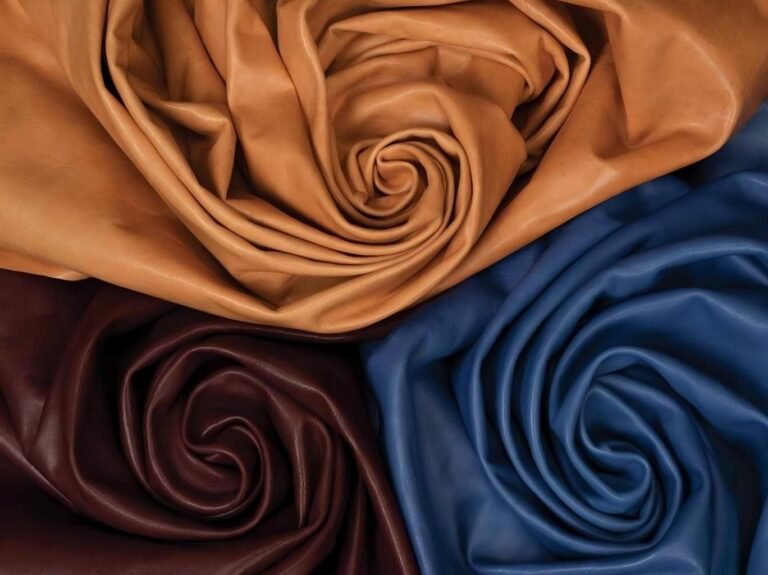
Silicone leather is available in 40+ standard colors with custom Pantone matching — sustainability doesn’t mean sacrificing aesthetic options.
Application-Specific Recommendations
The best environmentally friendly leather for your project depends heavily on the application environment, performance requirements, and budget. Here are our recommendations for the most common B2B use cases:
| Application | Top Pick | Why |
|---|---|---|
| Automotive Interiors | Silicone Leather | Zero VOC cabin air, UV stability, VDA 277 compliance — critical for EV OEMs |
| Healthcare Furniture | Silicone Leather | ISO 10993 biocompatibility, disinfectant resistance, zero VOC for patient rooms |
| Commercial Furniture | Silicone Leather | 10+ year lifespan reduces replacement waste; stain resistance for high-traffic areas |
| Marine & Outdoor | Silicone Leather | Hydrolysis resistance, UV stability, saltwater tolerance — PU degrades in 2-3 years |
| Fashion Accessories | Silicone or Plant-Based | Silicone for durability; plant-based for brand storytelling in limited collections |
| Residential (Budget) | Water-Based PU | Lower cost option with reduced VOC vs solvent-based PU; shorter lifespan acceptable |
How to Verify Eco Claims Before You Buy
Don’t take supplier claims at face value. Use this verification checklist before committing to any environmentally friendly leather supplier:
- Request ISO 16000-6 test reports — Chamber-tested VOC emission data, not self-reported “low VOC” claims.
- Ask for REACH SVHC screening results — Full 200+ substance list, not just “REACH compliant” marketing language.
- Verify recyclability claims — Ask for end-of-life recovery data and existing recycling programs.
- Check durability data — Martindale abrasion, UV resistance (xenon arc), and hydrolysis test results prove real-world lifespan.
- Request full formulation disclosure — Any supplier withholding ingredient lists has something to hide.
Procurement tip: Build environmental test requirements into your RFQ documents from the start. Suppliers who cannot provide verified test data should be disqualified early, not after you’ve invested time in sampling and negotiation.
Making the Switch: Next Steps
Transitioning to environmentally friendly leather is a process, not an overnight switch. Start with pilot projects in your most regulated or highest-visibility applications — automotive interiors, healthcare seating, or public furniture — where the compliance and ESG benefits are most immediate. Use those successes to build internal support for broader adoption.
For most B2B buyers, silicone leather offers the best balance of verified sustainability, proven performance, and scalable supply. It’s the only material category that delivers zero VOC, full recyclability, and 10+ year durability — all with the color and texture options your design teams expect. Compare silicone vs PU leather to see the full performance breakdown.
Request Eco Leather Sample Kit
About TOPSUN
TOPSUN manufactures solvent-free silicone leather for B2B buyers across automotive, furniture, healthcare, marine, and consumer goods industries — providing environmentally friendly material solutions that meet the strictest international sustainability and safety standards.
ISO 16000-6 zero VOC · REACH SVHC compliant · ISO 10993 biocompatible · FDA food-contact certified · 100% recyclable