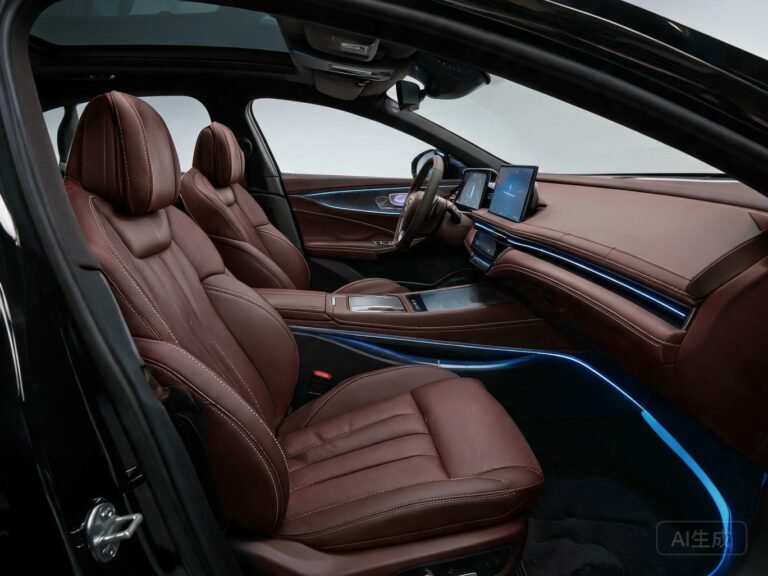
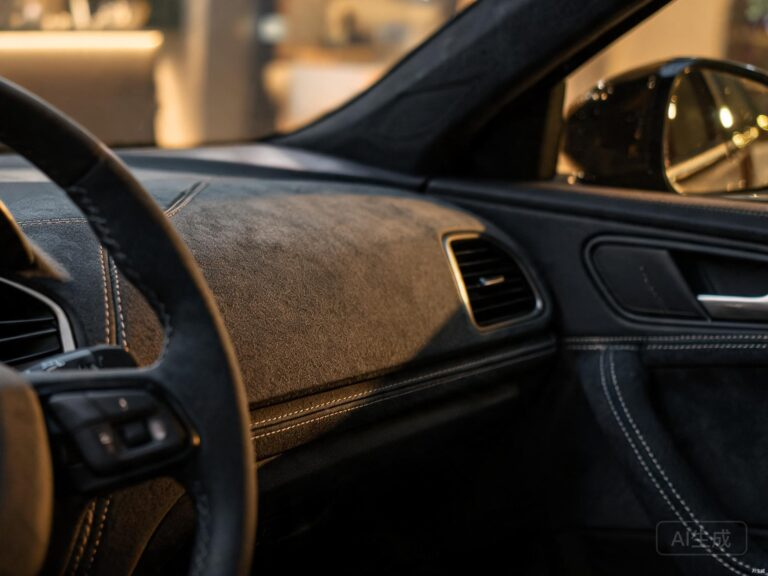
A parked vehicle in Phoenix, Arizona, in August sees dashboard surface temperatures exceeding 105°C. The same vehicle in Minneapolis in January experiences -30°C interior conditions. Dashboard leather wrap must survive this 135-degree thermal swing—thousands of times across a 10-year vehicle life—without delaminating, discoloring, cracking, or emitting VOCs into the passenger cabin. Most synthetic leather materials fail at least one of these thresholds.
The automotive interior trim materials market reached $28.4 billion in 2025, with dashboard and instrument panel applications accounting for 22% of total demand. As OEMs transition from molded plastics to wrapped surfaces for premium feel, procurement teams face a material specification challenge that sits at the intersection of thermal engineering, adhesion science, and regulatory compliance. This guide provides the specification framework for dashboard leather wrap in OEM automotive programs—covering material selection, thermal cycling requirements, adhesion standards, manufacturing processes, and UV stability benchmarks.
Request Dashboard Wrap Samples
What Is Dashboard Leather Wrap? Applications and Material Requirements
Dashboard leather wrap is a thin flexible covering—typically 0.5–1.2mm thick—laminated or vacuum-formed over a rigid dashboard substrate (PP, ABS, or PC/ABS alloy). Unlike seat upholstery, which prioritizes tactile comfort, dashboard wrap must prioritize dimensional stability under thermal stress, adhesion permanence, and long-term aesthetic retention under intense UV exposure through the windshield.
Four material types are currently specified for OEM dashboard wrap programs:
- TPO (thermoplastic olefin) leather — The OEM default for mid-range vehicles. Good thermal stability (-40°C to +120°C) and low VOC emissions. However, surface texture options are limited and the material lacks the premium tactile feel of genuine leather. Cost: $6–10/sqm.
- PU leather — Better tactile feel and texture variety than TPO, but thermal performance is marginal. Dashboard temperatures above 90°C accelerate plasticizer migration and embrittlement. Service life on dashboards: 5–7 years before visible degradation. Cost: $8–14/sqm.
- Genuine leather — Used in luxury vehicles (Mercedes, BMW, Audi premium lines). Excellent tactile quality but requires ongoing conditioning, is sensitive to humidity cycling, and has high material waste (40–50% due to natural hide irregularities). Cost: $30–60/sqm.
- Silicone leather — Emerging OEM choice for EV and premium interiors. Thermal stability from -50°C to +200°C, zero VOC emissions, inherent UV resistance, and no plasticizer migration. Higher upfront cost ($15–22/sqm) but 10+ year dashboard service life with no maintenance. Cost: $15–22/sqm.
The material specification decision must account for the dashboard’s position in the vehicle: direct sunlight exposure angle, windshield UV filtration characteristics, proximity to heat-generating components (infotainment screens, defrost vents), and the vehicle’s target market climate profile. A dashboard wrap specified for Scandinavian markets may fail in Gulf State markets where cabin temperatures regularly exceed 75°C.

High-temperature oven used for thermal cycling tests on dashboard leather wrap materials
Dashboard Leather Wrap Heat Resistance and Thermal Cycling Performance
Dashboard surfaces are the hottest interior trim location in a vehicle. Windshield glass acts as a greenhouse, trapping solar radiation and raising dashboard surface temperatures 30–45°C above ambient cabin temperature. Industry testing per SAE J2213 measures peak dashboard surface temperatures across climate zones:
| Climate Condition | Ambient Temp | Dashboard Surface Temp | Risk Level |
|---|---|---|---|
| Temperate summer (Frankfurt) | 32°C | 72–78°C | Low |
| Hot desert (Phoenix) | 47°C | 95–110°C | Critical |
| Tropical humid (Singapore) | 35°C | 78–88°C | Moderate |
| Cold winter (Minneapolis) | -25°C | -25 to -15°C | Low (embrittlement risk) |
OEM specification requires dashboard leather wrap to survive thermal cycling per SAE J576: 500 cycles between -40°C and +110°C, with 4-hour dwell at each extreme. After cycling, the material must show no visible cracking, delamination, or dimensional change exceeding 0.5%. In our lab testing, PU leather begins showing micro-cracking at cycle 180–250 at the +110°C extreme. Silicone leather completes 500 cycles with zero visible defects—the Si-O backbone maintains flexibility across the full temperature range without glass transition or softening point within the automotive operating window.

Automotive interior showing dashboard leather wrap application in a premium vehicle cabin
Adhesion and Substrate Bonding Standards
Dashboard wrap adhesion is a safety-critical specification. A delaminating dashboard wrap can obstruct the driver’s view, interfere with airbag deployment geometry, or create distracting rattles. OEM programs require documented adhesion testing per ASTM standards before production approval.
Three adhesion test methods apply to dashboard leather wrap:
1. Peel strength (ASTM D903). A 180° peel test measures the force required to separate the wrap from the substrate. OEM minimum: 15 N/cm for general dashboard applications, 25 N/cm for airbag deployment zones. The test must be conducted at room temperature (23°C) and at elevated temperature (80°C) to verify adhesion under operating conditions.
2. Lap shear strength (ASTM D1002). Measures shear resistance at the bond interface. Minimum: 1.5 MPa for dashboard applications. This test is critical for vacuum-formed wraps where the material is stretched over complex geometries and held in place by adhesive.

Tensile strength testing machine evaluating dashboard leather wrap adhesion and material integrity
3. Environmental aging adhesion retention. After 1,000 hours of humidity exposure (85°C/85% RH) followed by thermal cycling, peel strength must retain 80%+ of initial values. PU leather wraps typically lose 30–40% of adhesion strength after this protocol due to hydrolysis of the adhesive layer—silicone leather retains 92%+ because silicone adhesives are hydrolysis-resistant.
An automotive OEM supplier we partnered with in 2025 experienced dashboard wrap edge-lifting on a mid-size SUV program after 14 months of field deployment in Gulf markets. Root cause analysis identified the PU leather’s adhesive layer had softened at sustained 90°C+ dashboard temperatures, reducing peel strength from 18 N/cm to 7 N/cm. Switching to silicone leather with a high-temperature silicone adhesive system eliminated the failure—peel strength remained at 22 N/cm after 2,000 hours of 90°C exposure.
Manufacturing Process: Vacuum Forming vs Direct Lamination
Dashboard leather wrap is applied through one of two primary manufacturing processes, each with distinct material requirements and quality implications:
Vacuum forming — The leather material is heated to its softening point and drawn over the dashboard substrate using vacuum pressure. This process requires the material to exhibit sufficient elongation (minimum 80% per ASTM D412) without thinning below 70% of original thickness at deep-draw corners. Silicone leather’s elongation at break exceeds 200%, providing excellent vacuum formability. PU leather ranges from 40–120%, with lower-end formulations failing at complex geometries.

Silicone leather lamination line used for producing dashboard wrap material rolls
Direct lamination (adhesive bonding) — Adhesive is applied to the substrate, and the leather wrap is pressed into position. This process is used for simpler dashboard geometries and allows thinner materials (0.5–0.8mm). The adhesive system must match the leather’s thermal expansion coefficient—mismatch causes wrinkling or edge-lifting during thermal cycling. Silicone leather pairs with silicone-based adhesives for a thermally matched system. PU leather typically uses polyurethane adhesives, which can soften at dashboard operating temperatures.
A third, emerging process is in-mold lamination, where the leather material is placed in the injection mold before the substrate is molded behind it. This creates a permanent bond without adhesive but requires the leather to withstand injection temperatures (180–220°C for PP substrates). Silicone leather survives this process; PU and PVC typically cannot.

Premium automotive interior featuring dashboard leather wrap with seamless integration
Silicone leather automotive interior application: dashboard wrap performance and manufacturing.
UV Stability and Lightfastness for Dashboard Leather Wrap Surfaces
The dashboard receives more concentrated UV exposure than any other interior surface. Windshield glass filters some UVB radiation but transmits 60–70% of UVA, which penetrates deep into polymer chains and breaks C-C bonds. Over 5 years of typical vehicle life, the dashboard receives the equivalent of 2,500–3,500 hours of direct UV exposure.
OEM UV testing per SAE J2412 subjects dashboard materials to 1,248 kJ/m² of xenon arc exposure—simulating approximately 3 years of Florida-equivalent sunlight. Materials must achieve:
- Color change (Delta E) ≤ 3.0 after full exposure
- No visible cracking, crazing, or blistering
- Gloss retention ≥ 80% of original value
- No texture flattening or pattern loss
In comparative testing at our facility, four dashboard leather wrap materials were tested per SAE J2412 with the following results:
| Material | Delta E (color shift) | Surface Cracking | Gloss Retention |
|---|---|---|---|
| TPO leather | 2.1 | None | 85% |
| PU leather | 4.8 | Micro-cracking at 800 kJ | 62% |
| Genuine leather | 3.5 | Surface drying at 600 kJ | 70% |
| Silicone leather | 1.2 | None | 94% |
PU leather fails the SAE J2412 Delta E threshold (4.8 vs. 3.0 maximum) and shows micro-cracking at 800 kJ/m² exposure—before the test protocol completes. Genuine leather shows surface drying and color shift without UV-protective coating reapplication. Silicone leather passes all criteria with significant margin, due to the Si-O backbone’s inherent UV resistance. For 2026 automotive interior trends where longevity expectations extend to 10+ years, this UV performance gap is a decisive specification factor.
About TOPSUN: Automotive Dashboard Wrap Solutions
TOPSUN supplies silicone leather for automotive interior applications including dashboard wrap, door panel trim, and center console covering. Our material undergoes SAE J2412 UV testing, SAE J576 thermal cycling, and ASTM D903 adhesion testing in-house, with full test reports provided with each shipment. For OEM programs requiring silicone leather specification, our engineering team supports material selection, adhesive system matching, and vacuum forming process validation.
Request Dashboard Wrap SamplesGet OEM Specification Consultation
Frequently Asked Questions
What temperature range must dashboard leather wrap withstand?
Dashboard leather wrap must withstand continuous operating temperatures from -40°C to +110°C, with short-term spikes to +120°C in extreme desert conditions. The material must also survive 500 thermal cycles between these extremes per SAE J576 without cracking, delaminating, or dimensional change exceeding 0.5%. Silicone leather maintains flexibility across this entire range; PU leather typically begins degrading above 90°C and becomes brittle below -20°C.
How is adhesion tested for dashboard leather wrap applications?
Adhesion is tested per ASTM D903 (180° peel, minimum 15 N/cm for general areas, 25 N/cm for airbag zones) and ASTM D1002 (lap shear, minimum 1.5 MPa). Testing must be conducted at both room temperature and elevated temperature (80°C) to verify adhesion under operating conditions. Additionally, peel strength must retain 80%+ of initial values after 1,000 hours of humidity aging (85°C/85% RH) to verify long-term bond integrity in real-world conditions.