As a materials specifier, I’ve guided over 60 brands through custom leather item development — from luxury phone cases to automotive trim kits to hospitality furniture covers. The process looks simple on paper: design, sample, approve, produce. But the gap between a beautiful prototype and a 50,000-unit production run is where most projects fall apart. And it’s almost always the material specification that causes the breakage.
Custom leather items succeed or fail at the material level. The texture that looked stunning on a 10cm swatch might not emboss consistently across a 1,400mm roll. The color you Pantone-matched in the studio might shift half a delta-E under production curing temperatures. Here’s how to avoid the failures I see every month — and how to specify custom leather items that actually scale.
The Custom Leather Items OEM Process: 5 Stages
The custom leather items OEM process isn’t linear — it’s iterative. But every successful project I’ve managed follows five distinct stages, each with specific deliverables and decision points:
| Stage | What You Specify | What the Factory Controls | Common Failure |
|---|---|---|---|
| 1. Design Brief | Dimensions, function, aesthetic | Manufacturability review | Unspecified tolerances |
| 2. Material Selection | Leather type, thickness, texture | Substrate availability, lead time | Swatch ≠ production roll |
| 3. Sample Development | Color match, hand-feel, finish | Embossing depth, coating formula | Sample approved without QC spec |
| 4. Pilot Run | Acceptance criteria, test protocol | Line speed, temperature, pressure | Skipping pilot for speed |
| 5. Mass Production | Batch consistency, delivery schedule | QC sampling, packaging, logistics | Color drift between batches |
Stage 3 is where most projects derail. Brands approve a sample based on look and feel — without specifying quantitative acceptance criteria. Then the production run arrives with different embossing depth or a slight color shift, and there’s no spec sheet to reference. The fix: before approving any sample, define measurable criteria — ΔE ≤ 1.5 for color, embossing depth ±0.05mm, Martindale minimum cycles. Custom texture design requires the same rigor.

Custom-printed silicone leather — pattern customization is one of the strongest differentiators for branded leather items.
Material Selection: Where Most Custom Projects Derail
Here’s the thing about custom leather items material selection: the showroom swatch is the best-case version of the material. It was cut from the center of the roll, under ideal lighting, at the perfect temperature. The production roll will be different. Not dramatically — but enough to matter if you didn’t specify tolerances.
I always ask brands three questions before material selection. First: what’s the end-use environment? A phone case carried in pockets needs different abrasion specs than a furniture cover in a hotel lobby. Second: what’s the expected lifespan? A promotional item lasting 6 months has different requirements than a luxury accessory meant to last 10 years. Third: what compliance standards apply? If you’re selling in the EU, texture and material choice must pass REACH. These three answers narrow the material field dramatically.

Lychee texture in multiple colors — texture choice affects both aesthetics and production consistency across large runs.
Real example: A tech accessory brand specified PU leather for a premium earbud case. The prototype was beautiful. At 20,000 units, the PU surface began micro-cracking after 3 months in customer hands. We reformulated in silicone leather — same texture, same color. Zero cracking complaints after 18 months. The material switch cost $0.40/unit more. The warranty claim reduction saved $4.20/unit.
Texture, Color, and Finish: Customization Without Compromise
The biggest misconception about branded custom leather items manufacturing is that customization means compromising performance. It doesn’t — if you work with the right material. Silicone leather accepts 200+ embossed textures, Pantone-matched colors within ΔE 1.5, and surface finishes from matte to high-gloss. All without changing the underlying performance characteristics: 200K+ Martindale cycles, -40°C to 250°C stability, and zero VOC emissions.
With PU and PVC, customization is more constrained. Deep embossing on PU can weaken the coating layer. Dark colors on PVC accelerate UV degradation. Silicone leather doesn’t have these trade-offs — the silicon-oxygen backbone is inherently stable regardless of color, texture, or finish. Color customization is where silicone truly differentiates: every color maintains the same UV stability and abrasion performance.
See how custom patterns and textures are applied to silicone leather — from design file to finished production roll.

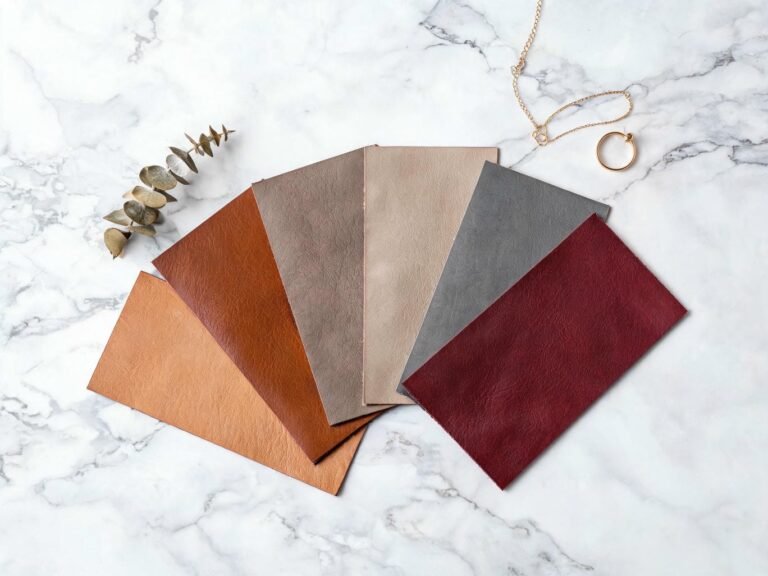
Custom texture samples — each swatch represents a specific embossing pattern, color match, and finish specification.
Scaling Custom Leather Items From Sample to 50K Units
The jump from sample approval to mass production is where consistency becomes the challenge. A sample is one piece, made by one technician, under controlled conditions. Mass production is thousands of meters, run across days, with operator changes and temperature fluctuations. Custom leather items minimum order quantity isn’t just a pricing threshold — it’s the volume where batch consistency becomes critical.
I recommend a pilot run of 500–1,000 units before full mass production. The pilot validates that the production line can maintain the sample’s specifications at scale. It also generates the baseline QC data — color measurements, texture depth readings, abrasion test results — that becomes the acceptance criteria for the full run. Without a pilot, you’re gambling. One brand we worked with skipped the pilot on a 30,000-unit run of custom leather wallets. The first batch passed. The second batch was 1.8 ΔE off on color. The third was 2.4 ΔE off. They had no pilot data to prove it was a production drift, not a spec change. Learn more about leather quality in custom production from our case studies.

Sample rack — each swatch becomes a production spec. Define tolerances before approving, not after.
Frequently Asked Questions
What is the minimum order quantity for custom leather items?
MOQ varies by customization level. For standard textures with custom colors, typical MOQ starts at 500–1,000 meters. For fully custom embossing patterns (new mold required), MOQ is usually 2,000–5,000 meters. For custom-printed designs, MOQ depends on print complexity. The key is to request a pilot run (200–500 units) before committing to full production — this validates scalability without the full MOQ investment.
How long does custom leather item development take?
Timeline depends on customization depth. For standard textures with Pantone-matched colors: 5–7 days for sample development, 2–3 weeks for pilot run, 4–6 weeks for mass production. For fully custom embossing (new texture mold): add 2–3 weeks for mold design and testing. For custom printing: add 1–2 weeks for artwork setup. Total project timeline from brief to delivery typically runs 8–12 weeks.
Spec Today, Scale Tomorrow
Custom leather items live or die by specification rigor. The brands that succeed don’t just approve samples — they define acceptance criteria, run pilots, and demand batch-level QC data. The brands that fail trust the showroom swatch and hope for the best. The five-stage process above isn’t complicated. But skipping any stage — especially the pilot — turns a custom project into a quality lottery.
If you’re planning a custom leather item project, start with the material. Get the specs right. Run the pilot. The upfront investment in specification saves tenfold in production rejects, warranty claims, and brand damage. That’s not opinion — it’s the pattern I’ve seen across 60+ projects.
About TOPSUN
TOPSUN produces custom silicone leather items for brand owners, accessory manufacturers, and OEM/ODM partners requiring bespoke textures, Pantone-matched colors, and performance-verified materials that pass REACH, FDA, and ISO 10993 standards across fashion, electronics, automotive, and furniture applications.
Custom texture embossing from 200+ patterns · Pantone color matching within ΔE 1.5 · 5-7 day sample development · 30+ country export experience