Cork leather sounds like the ultimate sustainable material — harvested from living trees, biodegradable, vegan. But when a B2B buyer asks “What’s the Martindale rating?” or “Does it pass FAR 25.853?”, the conversation gets quiet. That silence is the gap between a beautiful sustainability story and a material that can survive 200,000 abrasion cycles on a commercial bar stool.
This article examines cork and leather as upholstery materials from a procurement perspective — not a marketing one. We will cover where each material excels, where it fails, and where silicone leather offers a third path that resolves the trade-offs.

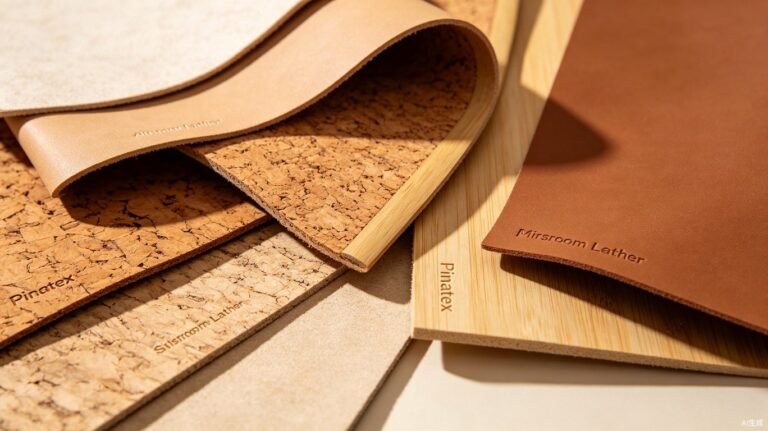
Warm-tone leather swatches — color and texture consistency matters in cork and leather sourcing.
What Are Cork and Leather Materials?
Cork leather is a composite material made by bonding thin sheets of natural cork bark — harvested from cork oak trees (Quercus suber) primarily in Portugal and Spain — to a fabric or polymer backing. The cork is boiled, pressed, and laminated with adhesive to create a flexible sheet that mimics leather’s hand feel. It is 100% plant-based, and the harvesting process does not kill the tree — bark regrows every 9–12 years.
Genuine leather, by contrast, is animal hide processed through tanning — chrome tanning for speed, vegetable tanning for environmental preference. It offers unmatched natural grain variation and develops a patina over time, but carries ethical, environmental, and consistency concerns that have driven buyers toward alternatives.
Both materials occupy the premium tier of the upholstery market, and both are frequently positioned in the same cork and leather comparison conversations. But they solve different problems — and neither solves all of them.
- Cork leather strengths — lightweight, naturally water-resistant, antimicrobial, unique aesthetic, FSC-certifiable sourcing
- Cork leather weaknesses — low abrasion resistance (typically 5,000–15,000 Martindale cycles), limited tear strength, narrow color range, poor fire performance without chemical treatment
- Genuine leather strengths — premium feel, natural breathability, develops patina, high consumer perception
- Genuine leather weaknesses — absorbs moisture, requires conditioning, variable quality, ethical and tanning-chemical concerns, inconsistent color between hides

Full-spectrum color display — cork leather’s limited palette is a constraint for design-driven brands.
Performance Trade-Offs Buyers Must Weigh
Let’s be honest about what the spec sheets reveal. A material can be sustainable and beautiful and still fail a Martindale test at 8,000 cycles. That is not a critique of cork — it is a material property that procurement teams need to account for.
Water resistance is where cork leather genuinely shines. The suberin in cork cell walls makes it naturally hydrophobic — water beads and rolls off. Genuine leather, by contrast, absorbs moisture, which leads to staining, mold, and structural degradation over time. Cork leather waterproof performance is one of the few metrics where it outperforms animal hide without chemical treatment.
But fire performance tells a different story. Commercial upholstery — cinema seating, hotel furniture, public transit interiors — requires flame retardancy certifications. Cork leather, untreated, does not pass EN 13773 or FAR 25.853. Adding flame retardants compromises its natural, chemical-free positioning. Genuine leather passes some fire standards but varies by tanning method. Neither is a reliable solution for regulated fire-safety environments.
Compliance reality check: A hotel brand specifying cork leather for lobby seating in the EU needs EN 1021-1/2 fire certification. Untreated cork cannot meet this. Treated cork loses its “chemical-free” selling point. This is the trade-off that sustainability-focused buyers confront.
UV stability is another weak spot. Cork leather fades and yellows under prolonged sun exposure — faster than genuine leather and far faster than silicone. For outdoor or sun-exposed applications, this limits cork leather to shaded indoor environments.
| Property | Cork Leather | Genuine Leather | Silicone Leather |
|---|---|---|---|
| Abrasion (Martindale) | 5K–15K cycles | Variable | 200K+ cycles |
| Water Resistance | Naturally hydrophobic | Absorbs moisture | 100% waterproof |
| Fire Rating (EN 13773) | Not rated (untreated) | Variable | Class 4 (highest) |
| UV Stability | Poor (fades/yellows) | Poor (fades/cracks) | Excellent |
| Certifications | FSC, PETA-approved | LWG (tannery audit) | ISO 10993, REACH, FDA |
Where Cork Leather Falls Short in Commercial Use
In our experience working with fashion brands and furniture manufacturers, cork leather’s limitations become visible within 12–18 months of commercial deployment. The cork surface begins to flake at edges and seams — not because the material is defective, but because cork’s cellular structure is inherently brittle when bent repeatedly.
One of our clients, a sustainable fashion accessories brand, initially sourced cork leather for a premium wallet line. The wallets looked stunning at launch. By month 14, customer returns for surface delamination reached 9%. They switched to silicone-coated faux leather and saw return rates drop below 1% within the same warranty period — while maintaining the vegan and eco-conscious positioning their brand required.
The cork and leather material trade-offs that matter most for B2B buyers:
- Limited color range — cork’s natural tone restricts dyeing options. Most cork leather products are brown, beige, or black. Pantone matching is technically possible but visually muted.
- Narrow thickness range — typically 0.8–1.5mm. Cannot match the 0.3–3.0mm range available with silicone leather, limiting structural applications.
- Cold weather brittleness — cork leather stiffens and can crack at temperatures below -5°C, making it unsuitable for outdoor sports or winter gear.
- Adhesive dependency — the cork-to-backing bond is the weakest link. In high-humidity environments, the adhesive can degrade, causing delamination.

Waterproof testing — silicone leather achieves what cork leather promises naturally.
Silicone Leather: The Performance Upgrade
Here’s where the story shifts. Silicone leather delivers the sustainability profile that draws buyers to cork — zero VOC, vegan, recyclable — while matching or exceeding the performance metrics that cork cannot reach. For B2B buyers who want both the eco story and the spec sheet, the silicone leather alternative resolves the compromise.
The numbers tell the story clearly. Silicone leather’s Martindale rating exceeds 200,000 cycles — over 13x the upper bound of cork leather. Its temperature range spans -40 to 250°C versus cork’s functional -5 to 60°C. And it passes EN 13773 Class 4 fire retardancy without chemical additives, because the silicon-oxygen backbone is inherently flame-resistant.
For buyers evaluating cork leather vs silicone leather, the decision framework is straightforward: if your application involves high-traffic commercial seating, fire-regulated environments, UV-exposed settings, or products with a 5+ year warranty obligation, silicone leather eliminates the trade-offs that cork leather imposes. Both are vegan and sustainable — only one is industrial-grade.
That said, cork leather retains legitimate niches. Decorative panels, low-wear fashion accessories, and short-lifecycle products where its unique aesthetic is the primary selling point are all appropriate applications. The mistake is specifying cork leather for a bar stool that will see 8 hours of daily use — or for a leather alternative material in regulated environments where fire and durability standards apply.

Sustainability concept — both cork and silicone leather are vegan, but performance profiles differ widely.
See how silicone leather’s eco-certifications compare to natural material alternatives like cork.
Frequently Asked Questions
Can cork leather be used for automotive interiors?
Not recommended. Automotive interiors require materials that pass FMVSS 302 flammability standards, withstand 85°C cabin temperatures, and survive 100,000+ abrasion cycles on seating surfaces. Cork leather’s Martindale rating of 5,000–15,000 cycles and its poor heat resistance make it unsuitable for automotive seating, door panels, or steering wheel wraps. Silicone leather, by contrast, is engineered specifically for these conditions and is increasingly specified by EV manufacturers.
Is cork leather more sustainable than silicone leather?
It depends on how you define sustainability. Cork is a natural, renewable resource harvested without killing trees — a strong raw-material story. Silicone leather is synthetic but produced through a solvent-free process with zero VOC emissions, and it lasts 10–15+ years versus cork leather’s 2–5 year commercial lifespan. When you factor in replacement frequency, the material that lasts 3x longer has a lower lifecycle environmental footprint, even if it is synthetic. According to the Textile Exchange, durability is one of the most overlooked levers in reducing textile waste.
Choosing the Right Material for Your Application
Cork and leather each have a place in the material landscape. Cork leather wins on raw-material narrative and natural water resistance for low-wear applications. Genuine leather wins on consumer perception and patina development for premium goods. But neither delivers the combination of sustainability, durability, fire safety, and UV stability that silicone leather provides.
The procurement question is not “Which is the most sustainable?” — it is “Which material meets all my performance requirements while aligning with my sustainability goals?” For an increasing number of B2B buyers, the answer is silicone leather, not because it is perfect, but because it does not force them to choose between eco-credentials and spec-sheet compliance.
Compare Material Samples Side by Side
About TOPSUN
TOPSUN produces silicone leather as a high-performance alternative to cork and leather for fashion, furniture, and automotive applications requiring both sustainability certifications and industrial-grade durability.
Zero-VOC solvent-free production · ISO 10993 biocompatibility · REACH compliant · FAR 25.853 aviation flame retardancy · EN 13773 Class 4 fire rating · 100+ custom embossing patterns