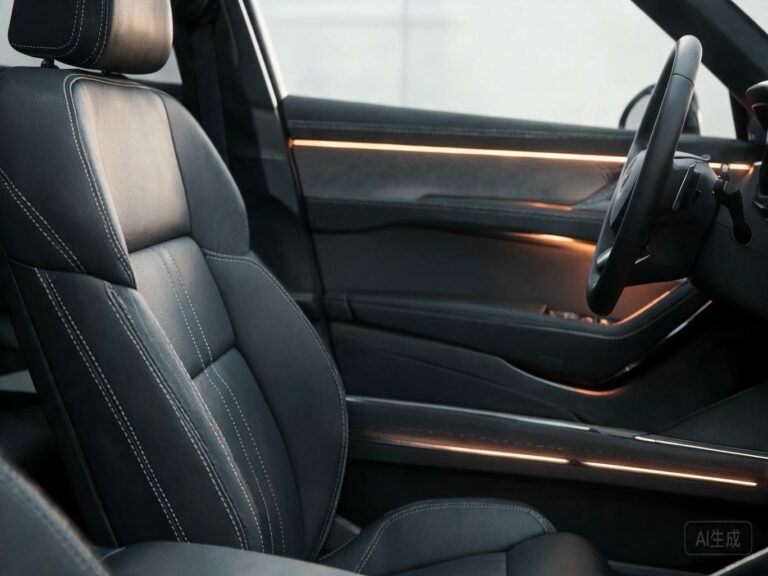
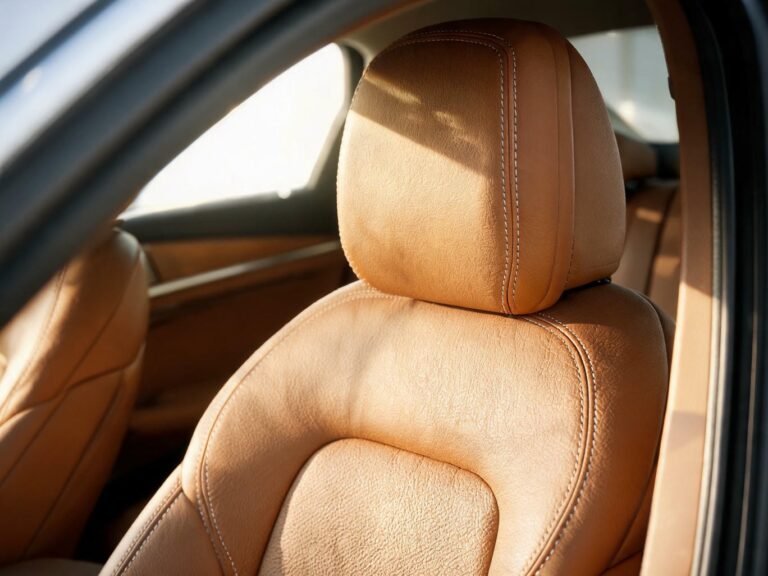
You park your car in the summer sun for four hours. The cabin hits 85°C. Six months later, the leather on the driver’s bolster starts cracking. Most people blame the heat. They’re half right — but the real culprit is the material chemistry that couldn’t handle it. Car leather fails in three predictable ways under thermal stress, and understanding those failure modes is the difference between an interior that lasts 3 years and one that lasts 15.
How 85°C Cabin Heat Destroys Car Leather
Modern vehicle cabins reach internal temperatures of 72 to 85°C when parked in direct sunlight. That’s not a guess — it’s a measured range documented across hot-climate testing in Arizona, Texas, and the Middle East. At those temperatures, the chemical bonds in traditional leather start breaking down in three distinct ways.
First, the polyurethane coating on top-grain and synthetic car leather undergoes thermal degradation. The coating is designed to protect the hide, but above 70°C, the PU cross-links start breaking. This is the same chemistry that causes peeling — heat simply accelerates what UV would do over years. Second, the plasticizers in PVC vinyl begin migrating to the surface at sustained temperatures above 60°C, creating a sticky residue that attracts dirt and accelerates surface breakdown. Third, moisture trapped in the substrate during humid conditions expands and contracts with temperature cycling, physically separating the coating from the fabric backing. For a detailed breakdown of how different material chemistries perform under stress, see our silicone vs PU material comparison.

Color fastness testing simulates years of UV exposure in days — the machine that tells you if your leather will fade.
OEM testing data shows 2025-2026 model-year leather samples lost 37% of their tensile elongation after 2,000 hours of accelerated UV weathering (SAE J2412 Cycle B). That means a seat that should stretch and flex under body weight becomes brittle and tears instead. The car leather UV resistance gap between premium and budget grades isn’t subtle — it’s the difference between 1,500 hours and 3,000+ hours before visible degradation.
The VOC Problem Nobody Mentions in EV Interiors
Here’s something that doesn’t show up in a material spec sheet until it’s too late: when cabin temperatures spike, traditional leather off-gases. PVC releases plasticizers. PU emits residual solvents. Chrome-tanned genuine leather can release trace volatile compounds from the tanning process. In an internal combustion vehicle with constant air exchange, this is unpleasant. In an EV — where drivers spend more time stationary with the climate control running — it becomes a health and compliance issue.
This matters because car leather VOC emissions in EV interior programs are now regulated under VDA 270 (German automotive standard) and GB/T 27630 (Chinese standard). Automakers like Volvo and Genesis have publicly committed to chromium-free, low-emission interiors. The shift isn’t optional — it’s regulatory. For projects targeting eco-compliant materials, our eco-friendly silicone leather produces zero VOC emissions because the PDMS polymer contains no plasticizers or solvents to release.

EV interiors demand low-VOC materials — drivers spend more time in stationary cabins with climate control running.
Mercedes-Benz has publicly described their interior material requirements: surfaces must withstand temperature differences of around 100 degrees, resist direct sunlight, abrasion from denim, sunscreen, disinfectants, and sweat — all without discoloring or emitting odors. That spec effectively rules out lower-grade synthetics and challenges even premium genuine leather. See how Mercedes-Benz defines sustainable interior material standards.
Car Leather Fire Standards: What Your Spec Misses
Every car leather interior sold in the U.S. must pass FMVSS 302 — the federal motor vehicle fire safety standard. In Europe, the equivalent is EN ISO 3795. Both test how quickly a material burns when exposed to a flame source inside a vehicle cabin. Most leathers pass with chemical flame retardant additives. But here’s what spec sheets rarely mention: those additives degrade over time, especially under UV and heat cycling. A leather that passes FMVSS 302 on day one may not pass on year five.
| Car Leather Type | Max Cabin Temp | UV Resistance (SAE J2412) | VOC Profile | Fire Rating (FMVSS 302) |
|---|---|---|---|---|
| Full-grain / Nappa | ~70°C | ΔE ≤ 3.0 at 1,500h | Low (chrome-tanned) | Pass (with treatment) |
| PU synthetic | ~65°C | 15K-25K Martindale | Moderate (plasticizers) | Pass (with additives) |
| PVC vinyl | ~60°C | Poor, degrades rapidly | High (phthalates) | Self-extinguishing |
| Silicone leather | 85°C+ | No degradation at 3,000h+ | Zero-VOC (PDMS) | Inherently flame retardant |
Silicone leather is the only material in this table that doesn’t rely on additives for flame resistance. The silicone polymer chain is inherently flame-retardant — it forms a protective silica ash layer when exposed to flame, self-extinguishing without chemical assistance. This means the fire rating doesn’t degrade over time. For the full regulatory framework, our automotive grade leather standard guide breaks down FMVSS 302, EN ISO 3795, and SAE J2412 compliance requirements.

Direct flame testing — silicone leather self-extinguishes without chemical flame retardants.
Why Silicone Outlasts Every Leather Type We’ve Tested
In our accelerated weathering lab, we’ve exposed silicone leather samples to over 3,000 hours of SAE J2412 UV cycling — roughly equivalent to 8+ years of Arizona sun exposure. The material showed zero visible degradation and less than 5% tensile strength loss. Compare that to the 37% tensile loss in OEM genuine leather after 2,000 hours, and the performance gap becomes hard to ignore.
The reason silicone survives where car leather fails comes down to polymer chemistry. PDMS (polydimethylsiloxane) — the backbone of silicone leather — has a Si-O bond energy of 452 kJ/mol, compared to the C-C bond energy of 346 kJ/mol in polyurethane. That 30% stronger bond means UV photons that break PU chains simply don’t have enough energy to break silicone chains. It’s not a coating advantage or a formulation trick — it’s physics.
For an EV car leather sustainable alternative that meets OEM durability, VOC, and fire requirements simultaneously, silicone is increasingly the material that Tier 1 suppliers are specifying. See our full range of automotive interior applications for silicone leather.
For a real-world implementation, our silicone leather automotive case study documents a Tier 1 supplier’s transition from PU to silicone across seat, door panel, and armrest applications.

PU leather seats — the coating looks pristine at delivery, but thermal cycling initiates delamination at the bond layer.

Physical testing lab — where we verify that silicone leather meets every automotive spec before it ships.
Silicone leather in automotive interiors — see how it handles heat, UV, and daily wear without cracking or fading.
Bottom line: If your car leather spec doesn’t include heat-aging at 85°C, UV weathering at 2,000+ hours (SAE J2412), and VOC testing per VDA 270 — you’re spec’ing for the showroom, not for year five.
Frequently Asked Questions
Does car leather emit VOCs in hot weather?
Yes. PVC and lower-grade PU leather release volatile organic compounds when cabin temperatures exceed 50°C. Chrome-tanned genuine leather can emit residual tanning solvents. Silicone leather is zero-VOC because the PDMS polymer contains no plasticizers or solvents — there’s nothing to off-gas at any temperature.
What temperature do car interiors actually reach in summer?
In summer sunlight, dark-interior vehicles in hot climates regularly reach cabin air temperatures of 72 to 85°C. Surface temperatures on dark leather seats can exceed 90°C when directly sun-exposed. This is why automotive leather specifications must include heat-aging tests at 85°C minimum — anything less doesn’t reflect real-world conditions.
The Material You Pick Today Defines the Warranty Call in Year Five
Car leather fails in three ways: thermally, photochemically, and chemically. PU coatings delaminate under heat cycling. PVC plasticizers migrate and create VOCs. Genuine leather loses tensile strength under UV. Silicone leather avoids all three failure modes because its polymer chemistry is fundamentally more stable — stronger bonds, no plasticizers, no coatings to separate. When you’re specifying materials for an interior that needs to survive 85°C cabins, 2,000+ hours of UV, and increasingly strict VOC regulations, the chemistry matters more than the grade.
About TOPSUN
TOPSUN produces silicone leather for automotive interiors where cabin temperatures hit 85°C and UV degradation is measured in thousands of hours, not years.
Our automotive-grade silicone leather passes SAE J2412 UV weathering (3,000h+), FMVSS 302 fire safety, and VDA 270 VOC testing — so your interior stays intact, odor-free, and compliant across every climate zone.