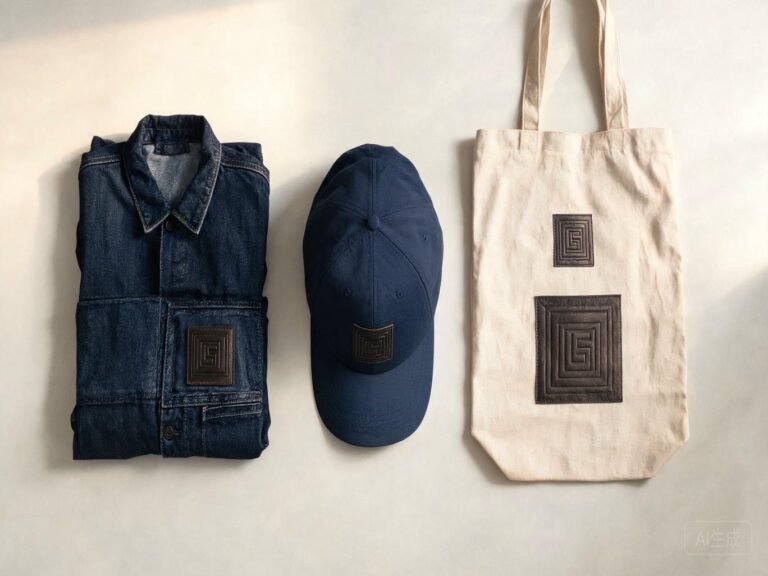
Branded leather programs usually start with a logo. A European accessories brand shipped 4,000 wallets last spring with a debossed, foil-filled mark. Six weeks later, the foil started lifting. By week ten, the mark read like a shadow. The brand blamed the finishing house. The finishing house blamed the coating. Nobody had asked whether the base material could hold an impression at all.
That case is why branded leather deserves a longer conversation than a logo placement guide. The private label market reached $948.86 billion in 2025. Every one of those brands faces the same question: what does the brand mark live on, and for how long?
What Branded Leather Actually Means in 2026
The term covers two different layers of investment. The first is surface branding: embossing, foil stamping, printing, patches. The second is material branding: a leather or leather-alternative specified in the brand’s own color, texture, and finish, produced to the same spec on every roll.
Retail data shows why the second layer is gaining ground. Store brands in the U.S. hit a record $282.8 billion in dollar sales for 2025. That growth ran at 3.3%, while national brands grew 1.2%. Shelf competition is now between brands that look and feel consistent, not just between logos. Our factory production process was built around that consistency requirement.

Brand identity starts on paper, but it is executed in the coating formulation.
Six Branding Methods and Where Each Fails
Most leather branding methods fail at the bond between the mark and the material. Here is the honest scorecard we give clients before they commit.
| Method | Best For | Common Failure |
|---|---|---|
| Embossing | Classic raised marks | Relax on thin coatings over time |
| Debossing | Clean recessed marks | Shallow impressions fade with flexing |
| Foil stamping | Metallic accents | Foil lifts where the coating flexes |
| Screen printing | Multi-color logos | Ink cracks on bending zones |
| Metal plates | Premium hardware look | Rivets stress the surrounding surface |
| In-material texture | Signature patterns | Cannot fail by delamination: it is the material |
Branded Leather at Material Level: Custom Color and Texture
Material-level branding moves the brand mark into the spec itself. Color is matched to Pantone or RAL with spectrophotometer control. Delta E stays within tolerance from the pilot roll to the last production lot. Texture is selected from a release-paper library of more than 100 patterns. Private patterns can also be cut for exclusive use. Fashion and sports accessory programs use this route to make counterfeiting harder: a signature grain is far more difficult to copy than a stamped mark.

Release paper carries the pattern into the coating: the texture is formed, not applied.
Pattern customization walkthrough: from brand reference to production-ready roll.
A silicone leather manufacturer working this way can also hold branding elements in the polymer itself. Marbling, dual-tone effects, and even a logo woven into the substrate are all possible. Because the effect is formed during curing, it survives flexing, abrasion, and cleaning cycles that peel surface marks off. As a silicone leather manufacturer, we treat every roll as part of the client’s brand system, not a commodity input.
The Result: A Program That Survives the Flex Test
Back to that wallet brand. We rebuilt the program on custom-textured silicone leather: their signature grain in-mill, color locked to their Pantone chip, foil dropped entirely. We then ran the finished panels through 100,000 flex cycles on our bending rig. The emboss die came down on them a second time. The grain held. The mark was the material.

Custom printed sample: brand artwork applied at the production stage, not as an after-treatment.

Bespoke design direction for 2026: brands increasingly own the material, not just the mark.
What is the MOQ for custom branded leather?
Our standard minimum is 500 meters per color and texture combination, with delivery in 7-15 days. Pilot runs for brand validation can be arranged against the same spec before full production.
Which logo method lasts longest on leather alternatives?
Methods formed into the material outlast every method applied to it. Deep embossing on a thick coating is the most durable surface option. In-material texture never delaminates because there is no separate layer to lift.
The Mark Should Be the Material
Branded leather programs fail when the brand is a sticker on a commodity. They last when the brand is baked into the roll. Specify the material like you specify the logo. Start Your Custom Branded Leather Program
About TOPSUN
TOPSUN produces custom-branded silicone leather for accessories and leather goods brands, from signature textures to locked color specs.
In-house capabilities cover Pantone/RAL matching, Delta E control, 100+ release-paper textures, and 500,000 m monthly capacity.