Black is the most specified leather color across every B2B application — automotive interiors, contract furniture, fashion accessories, consumer electronics. It is also the hardest color to manufacture consistently. Black leather absorbs more light energy than any other color, making it more susceptible to UV fading, thermal degradation, and surface defect visibility. A “black” leather swatch approved in January can arrive as a subtly different “black” in the March production batch — and that difference, invisible to the untrained eye under factory lighting, becomes glaringly obvious when the materials are installed side by side in a customer-facing environment.
The cost of getting black wrong is enormous. An automotive OEM that approves a black leather with marginal UV fastness may face dashboard fading claims within 18 months — across hundreds of thousands of vehicles. A furniture manufacturer that accepts black leather with ΔE variation above 1.0 between batches will see visible color mismatch across a sectional sofa assembled from different production runs. This guide explains how to evaluate black leather swatches using objective metrics — ΔE color consistency, color fastness ratings, texture specifications — so your approval decision is based on engineering data, not visual impression.
Request Black Leather Swatch Set
Why Black Is the Hardest Leather Color to Specify
Black leather presents three manufacturing challenges that no other color faces at the same intensity. Understanding these challenges explains why black requires more rigorous swatch evaluation than any other color in your specification.
Challenge 1 — Pigment concentration: Achieving a true, deep black requires higher pigment loading than any other color. In PU and PVC leather, this means more carbon black or iron oxide pigment in the coating formulation — which changes the coating’s viscosity, curing behavior, and mechanical properties. Higher pigment loading can reduce abrasion resistance and increase surface stiffness. Silicone leather avoids this trade-off because the silicone polymer’s optical properties allow deep black saturation without excessive pigment loading.
Challenge 2 — UV absorption: Black surfaces absorb all wavelengths of visible light and most UV radiation. This means the polymer coating absorbs more UV energy per unit area than a lighter color — accelerating photodegradation, color shift, and surface embrittlement. A black PU leather that achieves ISO 105-B02 Grade 4 light fastness is performing at the edge of the material’s capability; a black silicone leather achieving Grade 5 has significant performance margin because the inorganic Si-O backbone is inherently UV-stable.
Challenge 3 — Defect visibility: On black leather, every surface imperfection is visible — scratches, coating pinholes, texture inconsistencies, and dust contamination all show against the dark background. Lighter colors mask these defects; black amplifies them. This means the manufacturing process for black leather must meet higher cleanliness and quality control standards than for any other color.

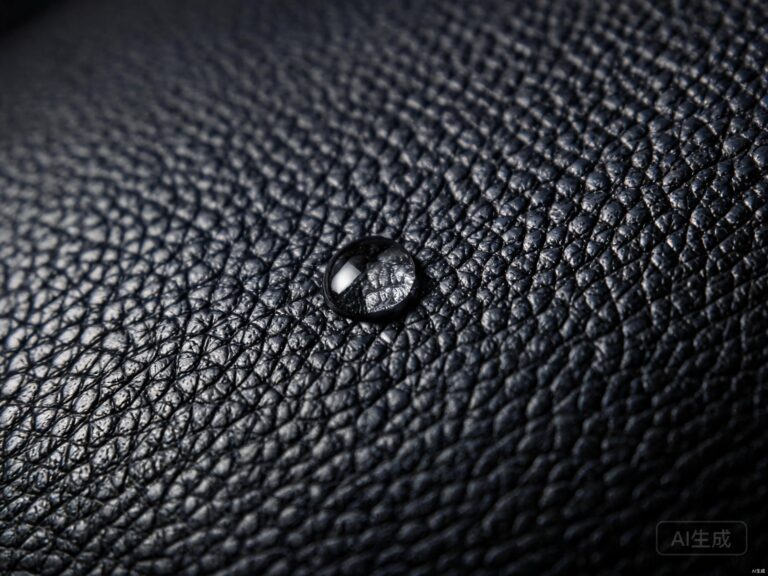
Black leather surface texture at macro scale — every grain detail and surface imperfection is visible against the dark background
ΔE: The Metric That Defines Color Consistency
ΔE (Delta E) is the industry-standard metric for measuring color difference between two samples. It quantifies the perceptual distance between colors in a three-dimensional color space (Lab color space), where a ΔE of 1.0 represents the minimum color difference that the average human eye can detect. Understanding ΔE is essential for evaluating black leather swatches because visual inspection alone cannot reliably distinguish between ΔE 0.5 (excellent consistency) and ΔE 1.5 (visible mismatch under certain lighting).
| ΔE Value | Perceptual Difference | Sourcing Implication |
|---|---|---|
| 0.0 – 0.5 | Imperceptible | Excellent — acceptable for all applications |
| 0.5 – 1.0 | Barely perceptible under D65 | Good — acceptable for most commercial use |
| 1.0 – 2.0 | Visible under controlled lighting | Marginal — visible mismatch in adjacent panels |
| 2.0 – 3.0 | Clearly visible | Unacceptable — reject batch |
| > 3.0 | Different color | Complete rejection — quality system failure |
For black leather, the acceptable ΔE threshold between approved swatch and production batch should be specified at ≤ 0.8. This is tighter than the general industry standard of ≤ 1.0 because black’s high contrast makes subtle differences more noticeable when materials are installed in adjacent panels — for example, a car door panel and seat bolster produced from different batches. Request ΔE data measured with a spectrophotometer under D65 (standard daylight) illuminant — not visual comparison under factory lighting, which is unreliable for black. For more on sample evaluation methodology, our leather sample ordering guide provides a structured process.
Color Fastness: Will Your Black Stay Black?
Color fastness testing determines whether the black leather you approve today will remain the same black after months of UV exposure, thermal cycling, and abrasion. For black leather, three color fastness tests are critical:
Light fastness (ISO 105-B02): The material is exposed to a xenon arc lamp simulating natural daylight for up to 1,500 hours. The color is rated on a 1-8 scale (Grade 8 = no change, Grade 1 = severe change). For black leather, Grade 5 is the minimum for commercial use; Grade 6+ is preferred for sun-exposed applications. Silicone leather achieves Grade 5+ due to the UV-stable inorganic backbone. PU leather typically achieves Grade 3-4, meaning visible fading after moderate UV exposure.

Color fastness testing equipment exposes leather swatches to controlled UV and heat — simulating years of service in days
Rubbing fastness (ISO 105-X12): Tests whether color transfers from the leather surface to a white cloth under friction. For black leather, this is particularly important because any color transfer is immediately visible on the white test cloth. Grade 5 (no transfer) is the target; Grade 4 (slight transfer) is acceptable for non-contact applications. Silicone leather achieves Grade 5 because the color is embedded in the polymer matrix, not applied as a surface coating.
Accelerated ageing (ISO 17228): Exposes the leather to elevated temperature and humidity to simulate years of service. Black leather that passes ISO 17228 ageing without color shift (ΔE < 1.0 after test) will maintain its color in real-world conditions. Request this data specifically for black leather — it is often omitted from standard test packages. For detailed test methodology, see our silicone leather color fastness test guide.
Texture and Finish: What Swatches Don’t Show
A black leather swatch conveys color — but it does not adequately convey texture, finish, and surface behavior. These properties become visible only when the material is installed at scale and viewed under real-world lighting conditions. Here is what swatches don’t show and how to evaluate it:
Gloss level: Black leather is available in matte, semi-gloss, and high-gloss finishes. A small swatch may not reveal how the gloss level interacts with ambient lighting — a high-gloss black leather that looks sophisticated on a 4×4 inch swatch can create unwanted glare on a full sofa surface under overhead lighting. Request gloss level specification in GU (gloss units) — matte is typically 1-5 GU, semi-gloss 10-20 GU, high-gloss 30+ GU.
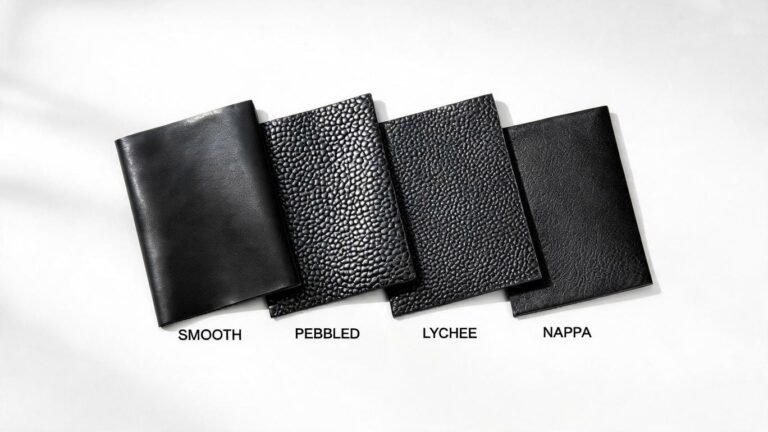
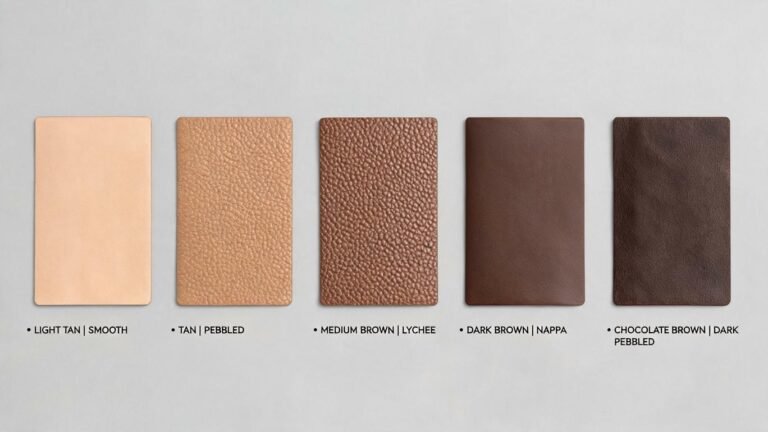
Texture consistency: The grain pattern on black leather — lychee, pebble, smooth, embossed — must be consistent across the entire production run. On a swatch, you see one small section; in production, texture variation across a roll becomes visible when the material is applied to large surfaces. Request a full-width sample (at least 30 cm wide) to evaluate texture consistency across the roll width. For more on texture evaluation, our leather textures buyer guide covers the key variables.
Metamerism: Black leather can appear differently under different light sources — matching under daylight (D65) but shifting under fluorescent or LED lighting. This is caused by the pigment’s spectral reflectance curve. Request evaluation under multiple light sources (D65, TL84, F11/A) to verify the black is truly consistent across lighting environments. Metamerism is particularly problematic when leather and plastic trim components are viewed together under mixed lighting.

Swatch racks provide initial color reference — but production batch approval requires spectrophotometer measurement, not visual comparison
The Swatch Approval Process: 5 Steps
Approving a black leather swatch for production requires a structured process that goes beyond visual inspection. Follow these five steps to ensure the approved material will perform consistently across the production program:
Step 1 — Obtain full-width production samples. Request a minimum 30 cm × 30 cm sample cut from a production roll, not a lab-prepared swatch. The sample must represent the actual manufacturing process, including any texture variation across the roll width.
Step 2 — Measure ΔE with a spectrophotometer. Compare the sample to your color standard using a calibrated spectrophotometer under D65 illuminant. Document the ΔE value. If ΔE > 0.8, reject the sample and request a new batch. Do not approve based on visual comparison alone — the human eye cannot reliably detect ΔE differences below 1.0 for black. For virtual sampling tools that complement physical swatches, see our virtual leather sampling guide.
Step 3 — Request color fastness test data. For the specific black grade being approved, request ISO 105-B02 (light fastness, minimum Grade 5), ISO 105-X12 (rubbing fastness, minimum Grade 4-5), and ISO 17228 (accelerated ageing, ΔE < 1.0 after test). These must be from third-party accredited labs, not the factory’s own testing.
Step 4 — Evaluate texture and finish under multiple lighting. View the sample under D65 (daylight), TL84 (store fluorescent), and A (incandescent) light sources. Check for metamerism and gloss level appropriateness for the application.
Step 5 — Lock the specification. Document the approved ΔE value, color fastness ratings, texture specification, gloss level, and Pantone reference in the technical specification. All future production batches must meet these documented standards. For custom color development, our color customization service supports Pantone matching and batch-level consistency.

Custom color matching ensures black leather meets specific ΔE targets and color fastness requirements for each project
Silicone Leather’s Black Color Advantage
Silicone leather offers inherent advantages for black color production that PU and PVC leather cannot match — advantages rooted in the material’s polymer chemistry rather than surface treatment.
The inorganic silicone backbone (Si-O-Si) is inherently UV-stable — it does not absorb UV energy the way organic C-C bonds in PU do. This means the black pigment in silicone leather is not subjected to the same photodegradation stress. The result: ISO 105-B02 light fastness of Grade 5+ (1,500+ hours with no color shift), versus Grade 3-4 for PU leather at the same pigment loading.
Color in silicone leather is embedded throughout the polymer matrix during the addition-cure process — not applied as a surface pigment layer. This means the color cannot rub off (ISO 105-X12 Grade 5), cannot be scratched off, and does not fade differentially at the surface versus the substrate. The color is structural, not cosmetic.
For batch-to-batch consistency, silicone leather’s controlled curing chemistry produces more uniform color than solvent-based PU processes. Our production target is ΔE ≤ 0.5 between batches — measured by in-line spectrophotometry on every production roll. To understand the full material technology, visit our silicone leather introduction page.
About TOPSUN Silicone Leather
TOPSUN manufactures silicone synthetic leather with full control over color formulation, texture design, and batch-level quality. Our black silicone leather is produced to ΔE ≤ 0.5 batch consistency, ISO 105-B02 Grade 5+ light fastness, ISO 105-X12 Grade 5 rubbing fastness, and passes ISO 17228 accelerated ageing with ΔE < 1.0. Every production roll is spectrophotometer-tested before release.
Available in matte, semi-gloss, and high-gloss black finishes across multiple texture patterns — lychee, pebble, smooth, and custom embossed. Substrate options include polyester knit, microfiber, and recycled PET for application-specific performance requirements. Full performance data: 150,000+ Martindale abrasion cycles, 1,500-hour UV stability, 14-week hydrolysis resistance, inherently self-extinguishing flame retardancy (BS5852, CAL TB 117, FMVSS 302).
Request Black Silicone Leather Swatches
Frequently Asked Questions
What ΔE is acceptable for black leather?
For black leather, ΔE ≤ 0.8 between approved standard and production batch is the recommended threshold. This is tighter than the general leather standard of ≤ 1.0 because black’s high contrast makes color differences more visible in adjacent panels. For automotive and premium furniture applications, ΔE ≤ 0.5 is the target. Always measure with a calibrated spectrophotometer under D65 illuminant — visual comparison is unreliable for black.
Why does black leather fade faster than other colors?
Black surfaces absorb all wavelengths of visible light and most UV radiation, meaning the polymer coating absorbs more UV energy per unit area than lighter colors. This accelerates photodegradation of the polymer matrix, causing pigment breakdown and color shift. Silicone leather mitigates this through its inherently UV-stable inorganic backbone (Si-O-Si), which resists photodegradation regardless of pigment color — achieving ISO 105-B02 Grade 5+ light fastness for black.
How do I evaluate black leather swatches under different lighting?
View swatches under at least three light sources: D65 (standard daylight), TL84 (store fluorescent), and A (incandescent). If the color appears consistent under all three sources, metamerism is not a concern. If the color shifts between sources, the pigment’s spectral reflectance curve is causing metamerism — which will create visible color differences when the material is installed under different lighting environments. Request spectrophotometer data under multiple illuminants to document this.
Can silicone leather achieve a true deep black?
Yes. Silicone leather achieves a true deep black (L* value below 20 in CIE Lab color space) without the excessive pigment loading that compromises PU and PVC leather performance. The silicone polymer’s optical properties allow deep color saturation with lower pigment concentration, maintaining coating flexibility and abrasion resistance. Batch consistency is ΔE ≤ 0.5 — verified by in-line spectrophotometry on every production roll.