The appeal of bicycle seat leather is obvious: it looks premium, it breaks in to the rider’s anatomy, and it carries the heritage of classic cycling. Brooks England has built a 150-year brand on vegetable-tanned leather saddles. But for B2B manufacturers sourcing bicycle seat leather at scale, the material has a fatal flaw that doesn’t show up in a showroom — it fails under sweat. A cyclist generates 0.5-1.5 liters of perspiration per hour of riding, and genuine leather absorbs every drop. Within 500 hours of cumulative riding, the tanning oils leach out, the hide stiffens, and surface cracking begins.
For athletic brands and bicycle manufacturers evaluating saddle materials, the question isn’t whether leather looks good — it does. The question is whether the material can maintain its comfort, structural integrity, and appearance after 1,000 hours of real-world riding in variable weather. Here’s what the data shows about genuine leather, PU leather, and silicone leather when tested against the one variable that destroys bicycle seats faster than any other: sustained moisture exposure.
Request Bicycle Seat Leather Samples
What Destroys Bicycle Seat Leather in Real Riding Conditions
Bicycle seats operate in one of the harshest material environments in consumer products. The saddle surface experiences concentrated body weight, continuous friction from riding motion, direct sweat absorption, UV exposure during daytime riding, and rain exposure during weather riding. No other leather application combines all five stressors simultaneously.

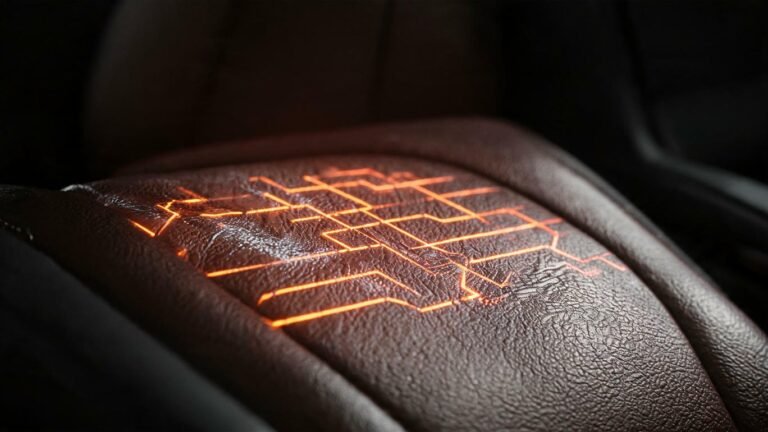
Flex resistance testing — simulating the repeated bending bicycle seat leather endures during riding
The failure sequence is predictable. Sweat moisture penetrates the leather’s fiber structure within minutes of riding. The moisture dissolves the tanning oils and conditioning agents that keep the leather supple. As the saddle dries between rides — often in UV-exposed storage — the oil-depleted fibers contract and stiffen. After 200-500 hours of this wet-dry-UV cycle, surface cracking appears at the points of maximum flex: the saddle nose and the rear edge where the rider’s weight creates the highest bending stress. By 1,000 hours, the cracks propagate through the grain layer and the saddle’s structural integrity is compromised.
PU leather bicycle seats face a different but equally rapid failure mode. The polyurethane coating is hydrolysis-prone — sustained moisture exposure breaks down the PU polymer chains, causing the coating to become tacky, then brittle, then flake away from the fabric base. In humid climates, PU bicycle seat leather shows visible degradation within 3-6 months of regular riding. For sports and fashion applications, this makes PU unsuitable for any product that contacts skin during physical activity.
The 1,000-Hour Sweat Test: Material Performance Data
To understand how different bicycle seat leather materials perform under sustained moisture stress, we need to look at what happens at key milestones in a cyclist’s cumulative riding hours. The data below reflects ISO-standardized testing (ISO 11507 hydrolysis resistance, ISO 105-B06 UV color fastness, ISO 5402 flex resistance) correlated with real-world riding conditions.
| Performance Milestone | Genuine Leather | PU Leather | Silicone Leather |
|---|---|---|---|
| Sweat absorption rate | High (porous) | Moderate (coating degrades) | Zero (non-porous) |
| First surface cracking | 200–500 hrs | N/A (coating flakes) | No cracking at 1,000+ hrs |
| Hydrolysis resistance | Moderate (oils leach) | Poor (polymer breaks down) | Excellent (inert polymer) |
| UV color fastness | Fades at 400 hrs | Fades at 200 hrs | 1,000+ hrs, no change |
| Flex cycles (ISO 5402) | 30,000–50,000 | 15,000–25,000 | 50,000–100,000 |
| Rain resistance | Absorbs, warps | Coating degrades | Fully waterproof |
| Maintenance needed | Conditioning every 3 months | Replace every 6–12 months | Water wipe only |
| Saddle lifespan (daily riding) | 1–3 years | 6–12 months | 10+ years |
Brand manager’s reality check: A $60 genuine leather saddle needs $15/quarter in conditioning products and still cracks within 2 years of daily riding. A $25 PU saddle needs replacement every 8 months. A silicone leather saddle at $35 material cost lasts 10+ years with zero maintenance. Over 5 years, the “premium” genuine leather saddle costs $180 in total — the silicone costs $35.
Why Silicone Leather Solves the Sweat Problem at the Molecular Level
The reason silicone leather doesn’t crack, absorb sweat, or degrade under UV is simple: silicone is an inert polymer. Unlike polyurethane, which reacts with water (hydrolysis) and breaks down over time, silicone’s Si-O backbone is chemically stable. Water doesn’t penetrate it. UV doesn’t break it. Sweat doesn’t leach anything out of it because there’s nothing to leach — no plasticizers, no tanning oils, no solvents.

Water droplet test on silicone leather — sweat and rain bead on the surface instead of absorbing
For bicycle seat applications, this means the saddle surface maintains its original tactility, color, and structural integrity regardless of how many hours of sweat it contacts. A cyclist can ride 2 hours in summer heat, leave the bike in the rain, and the saddle surface wipes dry with zero damage. No conditioning, no drying time, no oil replenishment. The material that felt right on day one feels the same on day 1,000.
The comfort question — does silicone leather break in like genuine leather? — has a nuanced answer. Genuine leather breaks in because the fibers compress and shape under body weight, creating a personalized contour. Silicone leather doesn’t compress the same way, but its lower durometer range and customizable thickness (0.8-2.0mm for the Classic Collection) can be engineered to match the give-and-take of broken-in leather from the start — no break-in period required. For brands targeting commuters and recreational riders (not Tour de France purists), this is an advantage, not a compromise. For more on the material, see our silicone leather overview.
Specifying Bicycle Seat Leather: What B2B Manufacturers Should Verify
For B2B manufacturers sourcing bicycle seat leather, three specifications determine whether the saddle will survive real-world riding or fail in warranty period.

Lychee grain macro closeup — the embossed texture that gives bicycle saddles their grip and character
1. Hydrolysis resistance test data. Require ISO 11507 test results showing the material’s performance under sustained moisture exposure. Genuine leather and PU leather cannot provide passing data at 1,000+ hours — if the supplier can’t provide this test, the material will fail in sweat conditions. TOPSUN’s silicone leather passes hydrolysis testing with no degradation at 1,000+ hours.
2. Flex resistance rating for saddle stress points. The saddle nose and rear edge experience the highest flex stress during riding. Require ISO 5402 flex data at 50,000+ cycles minimum. PU leather typically delivers 15,000-25,000 cycles — well below the threshold for a multi-year saddle. Silicone leather delivers 50,000-100,000 cycles, which is why it’s specified for applications where flex failure is the primary warranty claim.
3. UV color fastness for outdoor storage. Bicycles are stored outdoors, on car racks, and in UV-exposed locations. Require ISO 105-B06 color fastness data at 1,000+ hours. Genuine leather fades at 400 hours; PU fades at 200 hours. Silicone leather maintains color at 1,000+ hours with zero Delta E shift. For cleaning and maintenance, silicone leather also requires no conditioning products — water wipe only.

Sports equipment application — silicone leather in athletic gear where sweat resistance is critical
Watch: Outdoor weather resistance test — silicone leather under rain, UV, and temperature cycling
Frequently Asked Questions
Does silicone bicycle seat leather require a break-in period like genuine leather?
No. Genuine leather requires a 200-500 mile break-in period where the hide compresses and shapes to the rider’s anatomy. Silicone leather can be engineered with specific durometer and thickness (0.8-2.0mm) to deliver the desired give and contour from the first ride. For brands targeting commuters, fitness riders, and e-bike users, eliminating the break-in period is a feature — the saddle is comfortable from day one. For purist touring cyclists who prefer the personalized contouring of broken-in leather, genuine hide remains the heritage choice.
How long does silicone bicycle seat leather last compared to genuine leather?
Silicone leather bicycle saddles have a 10+ year service life under daily riding conditions, compared to 1-3 years for genuine leather (with regular conditioning) and 6-12 months for PU leather. The difference is driven by silicone’s hydrolysis-proof and UV-stable properties — the material doesn’t degrade from sweat, rain, or sun exposure, which are the three primary failure drivers for bicycle seat leather. Over a 10-year period, one silicone saddle replaces 3-5 genuine leather saddles or 10-20 PU saddles.
The Saddle Material That Outlasts the Bike
Genuine leather bicycle saddles carry undeniable heritage and aesthetic appeal — but their failure under sweat, rain, and UV is a material physics problem, not a quality control issue. PU leather fails faster, through hydrolysis and coating flaking. For B2B manufacturers who need bicycle seat leather that survives 1,000+ hours of real-world riding without conditioning, cracking, or fading, silicone leather is the only material that addresses all three failure modes at the molecular level. The saddle that looks and feels right on day one still looks and feels right after 10 years of daily riding — and that’s a specification that genuine leather and PU physically cannot meet.
Get Bicycle Seat Leather Specs
About TOPSUN
TOPSUN manufactures silicone leather for B2B bicycle saddle and sports equipment producers requiring sweat-proof, UV-stable, and flex-durable seat materials that maintain comfort and appearance across 1,000+ hours of real-world riding.
Hydrolysis-proof silicone polymer · 50K–100K flex cycles (ISO 5402) · 1,000+ hr UV stability · Sweat and rain resistant · Free A4 swatches for saddle prototyping