Most searches for best quality faux leather end at the same dead end: adjectives. “Premium feel.” “Top grade.” None of it survives a supplier negotiation. The actual gap between mid-grade and top-grade faux leather is numeric, and it is wide.
Mid-grade PU runs 3-5 years in service with UV holdout below 500 hours, at roughly $5-10 per square meter. Top-grade material doubles or triples those numbers on every axis that matters. This article turns “best” into six verifiable markers, with the test numbers attached, so your next quote can be graded objectively. The difference shows up in year three, on your maintenance ledger.
What “Best Quality” Actually Means on a Spec Sheet
“Quality” in coated textiles is not one property. It is a stack: base fabric, coating chemistry, thickness, and finish all contribute. Remove any layer and the surface fails early, no matter how good the rest looks in a sample book.
That is why serious buyers grade faux leather the way grading agencies grade anything else: with named tests and minimum numbers. Every marker below carries a test method. If a supplier cannot fill in the number, you have your answer about the grade.
The 6 Markers That Separate Premium From Mid-Grade
| Marker | Mid-Grade Reality | Best-Quality Benchmark |
|---|---|---|
| Base fabric | Thin, loose substrate | 300+ GSM tightly woven polyester |
| Thickness | 0.8-1.4 mm one-size pricing | 0.6-2.0 mm matched to application |
| Abrasion | 10,000-30,000 Martindale rubs | 100,000-200,000+ rubs |
| Flex endurance | Undeclared | 50,000-100,000+ cycles |
| Lightfastness | UV holdout under 500 h | ISO 105-B02 Grade 4-6 |
| Hydrolysis / service life | 3-5 years before peeling | 5-7+ years PU; 10-15 years silicone |
Two notes on reading this table. First, the benchmarks are floors, not marketing ceilings; premium microfiber constructions exceed 200,000 rubs routinely. Second, flex endurance is the marker most quotes omit. It is also the one that predicts crease-line cracking on seats and bag folds.

Grades are decided in the stack-up, not in the color chip.
Backing Fabric: The Marker Most Buyers Skip
Coatings get the attention; backings carry the loads. A 300+ GSM woven polyester base resists the stretch and surface separation that thin substrates develop under upholstery tension. Sourcing guides consistently flag this. Tightly woven backing improves tear strength, and “100% PU” labeling beats blends whose fillers quietly reduce durability.
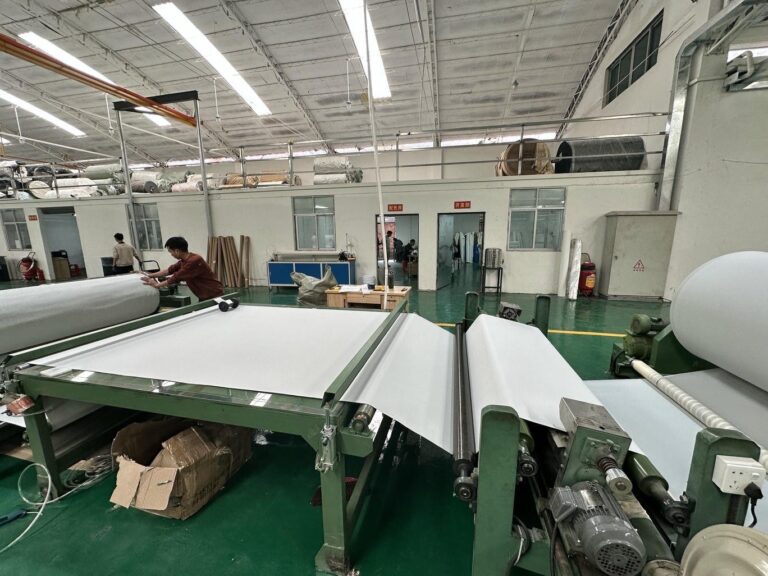
On our coating line, substrate choice is the first decision, not the last. Woven polyester gets scoured and heat-set before the first coat. A tie-coat then promotes bond strength so the finish never strike-throughs. Buyers who flip the roll and inspect the backing catch grade inflation in ten seconds. Buyers who only look at the face find out in year two.

Top grade starts at the substrate bench, before any coating touches the line.
Inside our QC line: how top-grade material is verified roll by roll, not just at sample stage.
Price Bands and What Each Band Actually Buys
Money maps cleanly onto the marker table. Mid-grade PU on polyester or cotton sits at $5-10 per square meter and delivers the 3-5 year column. Premium microfiber composites command several times that, and silicone-coated lines add the hydrolysis and chemical-resistance column on top.
The trap is comparing bands by meter price alone. We audited a luggage program last year where the “premium” quote was 60% higher per meter. Over the product’s five-year life, the premium material was cheaper per month of service. The mid-grade alternative would need one full re-cover inside that window. Grade is a unit-cost calculation wearing a fabric costume. If your application lives long, buy the column that lives with it.

The premium band buys service years, not just a softer surface.
Within the premium band, construction details still matter. Our full-silicone vs semi-silicone comparison shows how coating coverage percentage changes price and performance inside the same product family. For eco-led brands, recycled-PET substrates are also entering the premium tier, documented through PET-based silicone leather lines with traceable content.
Two Program Reviews That Put the Markers to Work
Numbers get real in tender reviews. Two programs from our order book last quarter show the marker table doing its job before a purchase order moved.
A regional hospital chain tendered waiting-area seating for 400 seats. Daily alcohol-based disinfection was non-negotiable. Mid-grade PU samples failed wipe testing within weeks of lab exposure, bubbling at the seams. The silicone-coated line passed the same protocol unchanged, and its 10-15 year service expectation sealed the decision despite the higher meter price. The compliance file clinched it: biocompatibility documentation was ready on request.
A yacht refit yard faced a different brief: lounge upholstery for a Mediterranean charter boat. Lightfastness was the whole story, because sun exposure on open water is brutal. The chosen material held color past 1,500 hours of UV testing. A cheaper alternative in the running documented only 400 hours. One marker, one decision.
A rejected quote from that same marine review is worth recording. It looked identical in photos. Its spec sheet, however, listed no UV method, no backing weight, and a thickness that shrank on the caliper. Photos have never predicted a failure we later traced. Spec sheets, or the absence of one, always have.
Both buyers ran the same review: sample the candidates, test against the real service condition, and file the numbers. Neither bought on feel. That is the practical meaning of best quality faux leather. It is the grade that survives your service conditions, documented in numbers your procurement file can defend later.
Compliance Files: The Seventh Marker in Regulated Markets
For buyers shipping into the US, EU, or regulated verticals, there is a seventh marker that outranks all six: the compliance file. Top-grade material arrives with documents, not just a surface.
- Flame retardancy. CAL 117 for California furniture, BS 5852 for UK upholstery, FMVSS 302 for vehicle interiors. Top-grade lines name the standard they meet; mid-grade lines name none.
- Chemical compliance. REACH, RoHS, PAHs, and Proposition 65 govern what the coating may contain. Ask for the declaration letter and the test date, not just the logo.
- Vertical certifications. ISO 10993 biocompatibility for medical contact, FDA food-contact grades for children’s products. These are the markers that decide bids in healthcare and juvenile segments.
From our export desk, the pattern is consistent: customs and retail onboarding now ask for these files before the container moves. A factory that produces top-grade material already runs the tests; producing the paperwork costs it nothing. When a supplier hesitates on compliance documents, that hesitation grades its material more accurately than any swatch. In regulated markets, the file is the product.
Before you send the next RFQ, paste these six lines into the requirements table:
- Base fabric: woven polyester, 300+ GSM minimum, GSM declared per batch
- Thickness: millimeter class matched to the application, stated on the quote
- Abrasion: Martindale cycles with the test method declared
- Flex endurance: cycles at the declared flex test
- Lightfastness: ISO 105-B02 grade, not hours of marketing claims
- Hydrolysis: service-life data with the chamber method attached
Quotes that answer all six lines are quotable. Quotes that answer none are priced for a different conversation. Set that requirements table once, and every future quote grades itself in minutes.
The Bottom Line: Grade Is a Checklist, Not a Feeling
The best quality faux leather is the one whose grade you can prove with six numbers. Every serious supplier can quote them:
- Base fabric GSM, verified on the backing, not the brochure
- Thickness matched to the application, not to a one-size price list
- Martindale abrasion cycles, method declared
- Flex endurance in cycles
- Lightfastness by ISO 105-B02 grade
- Hydrolysis life in years, from a named chamber test
The suppliers that dodge those questions are telling you which grade they actually sell. Run the six-marker check before the price discussion on your next quote. And if you want an experienced faux leather manufacturer to grade a competitor’s spec against your target application, our engineers do that review routinely.
How much does best quality faux leather cost?
Mid-grade PU runs $5-10 per square meter. Premium microfiber and silicone constructions price higher, typically by a multiple, and the honest comparison is cost per service year, not per meter. A material that lasts three times as long is usually cheaper over the program. Compliance paperwork is included in top-grade pricing; treating it as an upcharge is a signal you are not buying the top grade.
Is thicker faux leather always better quality?
No. Thickness only counts when matched to the application. Upholstery wants 1.2 mm class material; bags and apparel trims perform better and cost less at 0.6-1.0 mm. Over-thick material adds weight and stiffness without adding service life if the coating chemistry is mid-grade. Grade lives in the coating stack and the backing, not in the caliper reading alone.
About TOPSUN
TOPSUN grades and manufactures silicone leather for buyers who quote material by test numbers, from luggage and furniture programs to automotive interiors.
Every roll ships with UV, abrasion, and hydrolysis data attached, backed by SGS-verified reports and a factory that welcomes third-party inspection.
References
1. https://szoneierleather.com/custom-leather-fabr… — Spec targets: thickness 0.6-2.0 mm, abrasion 25k-50k cycles, flex ≥50k-100k, lightfastness ISO 105-B02 ≥4-6, PU hydrolysis ≥5-7 years
2. https://smartbuy.alibaba.com/buyingguides/faux-… — Sourcing markers: woven 300+ GSM backing, 0.8-1.2 mm thickness, “100% PU” labeling (2025)