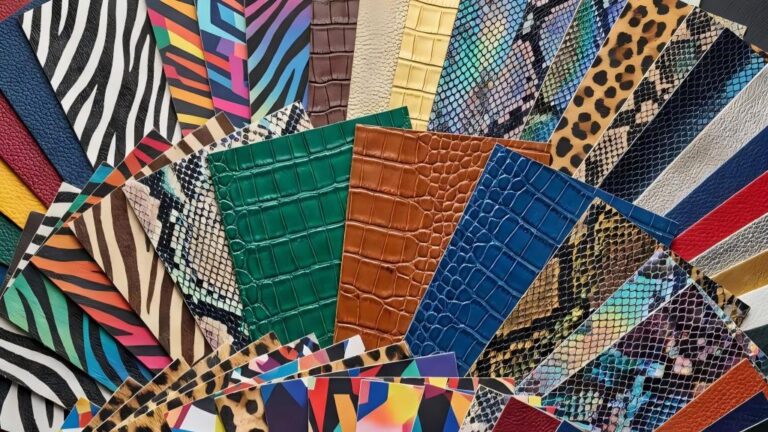
What actually separates one artificial leather manufacturer from the next? Not the swatch book, and not the unit price. Market analysts put the global synthetic and artificial leather market at $38.32 billion in 2025, heading to $57.49 billion by 2030. At that scale, every buyer has options. The real question is which numbers, checked before signing, predict a partnership that still works in year three.
We have watched programs succeed and fail across hundreds of OEM projects. The difference rarely shows up in the sample. It shows up in six measurable numbers. This article lays them out as a scorecard, with the thresholds we consider acceptable in 2026.
| Number | Acceptable threshold | Why it matters |
|---|---|---|
| On-time delivery rate | 95%+ | Late material delays every downstream step |
| Client reorder rate | 25%+ | Repeat buyers are the honest quality signal |
| MOQ | 500 m or lower | High MOQs force overstock on new programs |
| Production lead time | 7-15 days | Longer cycles hide capacity problems |
| Monthly capacity | 500,000 m scale | Headroom absorbs your peak seasons |
| Certifications on file | REACH, ISO 9001, market-specific | Expired or missing files block customs and audits |
The Artificial Leather Manufacturing Market Behind Your Quote
The market context explains why vetting matters more each year. Growth of 8.5% annually pulls new entrants into coating, and Asia-Pacific remains both the largest and the fastest-growing region. More factories means more quotes on your desk. It also means a wider spread between operations that test every batch and operations that only photograph well.
Procurement guides now recommend layered audits: chemical compliance with full SVHC declarations, a valid ISO 9001 certificate within its three-year cycle, social compliance through BSCI or Sedex, and batch-coded roll tracking for full traceability. Each layer is verifiable in a document request. None of them require a site visit to start.

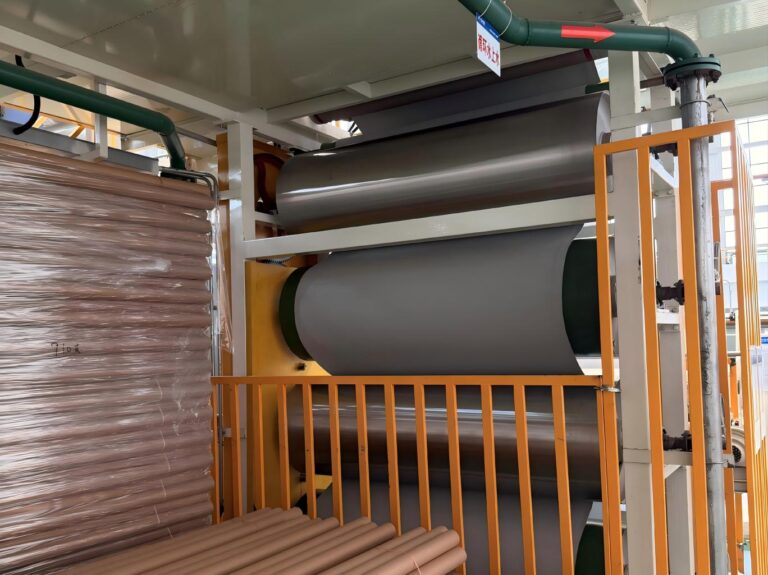
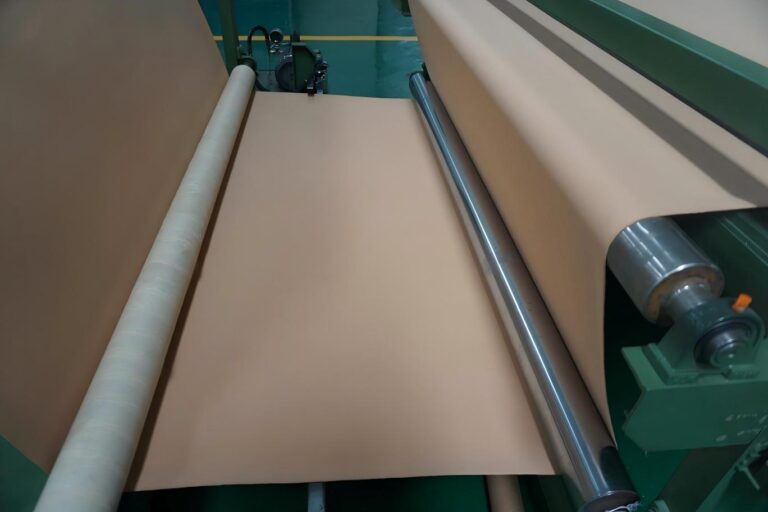
Coating scale shows in the workshop: organized lines, controlled environment, material flow that does not bottleneck.
What Separates a Manufacturer From a Middleman
Trading companies are not the enemy. The risk is paying manufacturer prices for trader service. Three checks settle it fast. Ask for the business license and match the address to production photos. Ask who runs the in-line QC and put that person on a video call. Ask for a batch-coded roll report from a recent shipment. Our own factory production flow, for example, logs viscosity and solids at the mixing stage, coating thickness in-line, and spectrophotometer color control through the run.
Verification extends to materials too. When a program needs a step up in chemistry, buyers increasingly compare PU against silicone on the same bench tests. Our company background page covers how silicone coating is built for programs where hydrolysis and VOC claims must survive an audit.

A manufacturer tests what a middleman only quotes: tensile, peel, and abrasion on real production lots.
Inside a 500,000-meter-per-month coating operation: where scale and QC meet.
Reading a Test Report the Way an Auditor Does
Test documents separate the two tiers faster than any factory tour. When a datasheet arrives, check three things. First, is the test method named? A wear number without a standard behind it, such as ISO 12947 for Martindale abrasion, is decoration. Second, is the sample identified as a production lot? Datasheets printed five years ago describe a factory that may no longer exist. Third, do the numbers map to your application? Contract seating and a handbag strap live at different durability tiers.
Chemistry claims deserve the same rigor. For silicone-coated materials, an FTIR scan should show PDMS peaks only, near 1,260 cm⁻¹ for Si-CH₃ and 1,020 cm⁻¹ for Si-O-Si, with no PU carbonyl signature. Our silicone leather introduction explains why that spectral evidence matters for buyers making long-life claims.
Climate testing rounds out the picture. We run 85°C / 85% RH chambers for up to 14 weeks to demonstrate zero hydrolysis degradation, and our high-performance grade clears 200,000+ Martindale cycles for contract use. Ask any shortlisted factory what its equivalent chamber time and abrasion ceilings are. Vague answers on chemistry are how cheap quotes become expensive replacements.
Choose the Partner, Not the Price List
The artificial leather market will keep growing, and quotes will keep arriving. Our position stays the same: run the six numbers, verify the license and the QC owner, and pick the factory that documents what it ships. A manufacturer that volunteers its test data is the one that will still answer emails after the deposit clears.
Request Manufacturer Data Sheets
Frequently Asked Questions
Q: What MOQ should I expect from an artificial leather manufacturer?
A: Production runs typically start at 500 meters for coated materials, with stock colors sometimes lower. Quotes with very small MOQs usually mean stock lots or trader inventory. Ask whether the material can be reproduced to spec at volume before committing a program to it.
Q: How do I verify a supplier is a real manufacturer?
A: Match the business license address to production photos, put the QC owner on a video call, and request a batch-coded roll report from a recent shipment. A genuine coating line answers all three within a day or two.
References
- 1. https://www.thebusinessresearchcompany.com/repo… — synthetic/artificial leather market $38.32B (2025), projected $57.49B by 2030, CAGR 8.5%; Asia-Pacific largest and fastest-growing region
- 2. https://www.solamninewmaterial.com/info/sourcin… — audit layer thresholds: REACH/RoHS full SVHC declaration, ISO 9001 valid within 3-year cycle, BSCI/Sedex social compliance, 100% batch-coded roll traceability
- 3. https://www.accio.ai/find-supplier/china-oem-co… — supplier vetting thresholds: on-time delivery rate at 95% or above, client reorder rates above 25%