Who actually runs the coating line when you wire a deposit to a vegan leather factory? The question sounds blunt, yet most buyers never answer it before the wire clears. The vegan leather market is valued at $4.07 billion in 2026 and projected to reach $8.14 billion by 2035, a 7.8% annual rate, according to Business Research Insights. Growth that fast pulls brokers into every inquiry thread, and a polished brochure says nothing about the mixing room or the curing oven. An audit closes that gap. This guide walks the eight checks a factory auditor runs, in the order that exposes problems fastest.
Keep the audit order fixed. Each check below either clears a supplier in minutes or disqualifies one before the deposit conversation starts. Auditors who skip steps pay for it in claim letters. The sequence also keeps a full visit under two hours.
| Audit dimension | Real vegan leather factory | Broker or weak factory |
|---|---|---|
| Business scope | Manufacturing listed, entity owns the line | Trading only, outsources everything |
| Traceability | Roll traces back to raw batch, line, shift | Stops at a roll number with no history |
| Certificates | Numbers verify on the registrar database | PDFs only, unverifiable or expired |
| Test reports | Batch-linked, third-party, reproducible | Generic lab sheets of unknown origin |
| Process control | Coating thickness and cure temps logged | No in-line records to show |
| Inspection access | Welcomes SGS, BV, TÜV, and video walks | Defers, reschedules, or charges for it |
| Capacity claims | Line count and shifts add up | Round numbers with no line detail |
| Payment terms | Standard deposit tied to milestones | Front-loaded terms before any audit |
The Vegan Leather Market Behind the Factory Gates
A 7.8% growth rate means capacity expansions, new entrants, and rapidly changing price lists. It also means the supplier you quoted last year may have sublet production this year. Automotive brands now specify vegan interiors, footwear majors run vegan lines, and furniture programs increasingly ask for animal-free upholstery. Demand is not the risk. The risk is assuming every company that answers your inquiry controls production. Auditing before the deposit protects both your margin and your launch date.

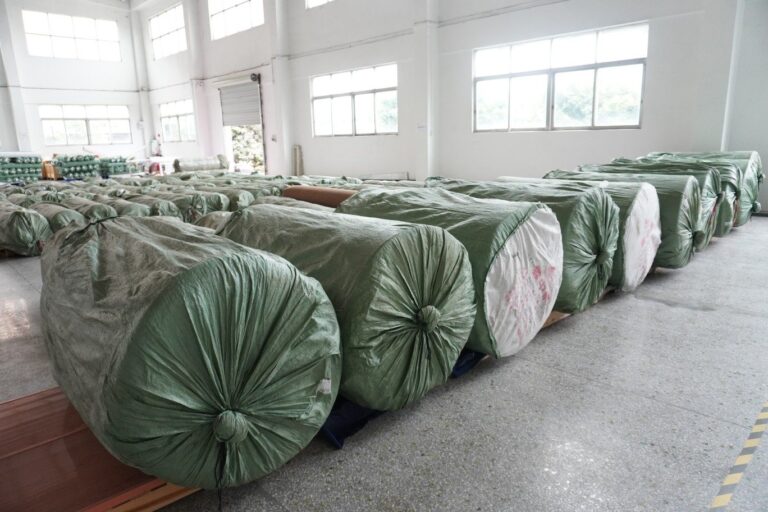
Finished goods tell you what a supplier wants to sell; the production floor tells you what they control.
Vegan Leather Factory or Trading Company: The License Test
Start with the business license and its registered scope. A genuine vegan leather factory lists manufacturing among its activities and owns or leases the production address. A trading company can still be a fine partner, but you deserve to know which one you picked, because the pricing structure and the blame chain differ. Cross-check the license against the factory address on the invoice. Then ask one direct question: which entity operates the coating line, and under whose quality system?
Brokers rarely lie outright. They blur. The license test forces clarity early, while walking away still costs nothing.
The Traceability Test That Exposes a Weak QMS
Audit guides for ISO 9001 plants recommend a simple, devastating exercise: pick a finished roll at random and trace it backward through inspection logs, routing sheets, and raw material entries. Operator signatures, timestamps, and batch numbers should align without gaps or back-dated entries. On a real production floor this takes fifteen minutes. In a weak system, the trail dies at the warehouse door.
We run the same discipline in reverse. Every order we ship carries SGS reports tied to its production batch, and our multi-stage QC links viscosity checks at the mixing stage to Delta E color readings and final roll inspection. If a claim ever surfaces, the history exists. Ask every candidate supplier to demonstrate theirs.
Request Batch-Linked Material Samples

Ask the operator what the numbers on the panel mean; rehearsed floors stumble here.
Certifications That Actually Verify
Forged certificates are common enough that auditors treat every PDF as a claim, not a fact. Each ISO 9001, ISO 14001, or REACH document carries a number that resolves on the issuing body database. Verify it yourself in five minutes. Then check the scope: a certificate covering assembly does not cover coating chemistry. For vegan programs, add REACH and PAHs screening, and for anything touching skin or food service, confirm the relevant food-contact or biocompatibility reports.
A factory that resists verification is telling you something. So is one that hands over a folder of test reports spanning five years but nothing from this quarter.

Culture shows on the walls and in the logs before it shows in the product.
Lab Tests That Back the Vegan Leather Claim
Materials testing turns the vegan claim into numbers. Martindale abrasion runs under ISO 12947, and the spread between materials is wide. Standard PU fabrics typically land between 30,000 and 80,000 cycles, while microfiber constructions pass 100,000, according to Kothea. Our High Performance collection is rated at 200,000 cycles or more for contract seating. Ask each factory which tier its data represents, and demand the standard number alongside the result.
Hydrolysis testing predicts how the surface ages in humid climates. We condition samples at 85°C and 85% relative humidity for up to 14 weeks with no delamination or strength loss. PU formulations typically show their first cracking within three to five years of service. The chamber result is the closest proxy to real aging that a lab can sell you.
| Test | Standard | What a pass looks like |
|---|---|---|
| Martindale abrasion | ISO 12947 | 200,000+ cycles for contract grade |
| Hydrolysis aging | 85°C / 85% RH, 14 weeks | No delamination or strength loss |
| FTIR identity | PDMS 1,260 / 1,020 cm⁻¹ | No PU carbonyl peaks in the spectrum |
| VOC screening | ISO 16000-6 | Non-detect for a solvent-free build |
Chemistry checks verify what the coating actually is. Fourier-transform infrared spectroscopy shows PDMS peaks for full silicone at 1,260 and 1,020 wavenumbers, with no PU carbonyl signature. VOC screening under ISO 16000-6 should come back non-detect for a solvent-free construction. A confident plant runs these on request. Hesitation usually means the formula is not theirs.
Frequency matters as much as method. A single lab sheet from 2023 proves the formula existed then, not that your roll matches it. Ask how often each test repeats, whether it runs per batch or per quarter, and who pays for third-party verification. Reasonable programs test abrasion per batch and chemistry per formula change. Anything less frequent leaves room for silent substitutions between your approval and your shipment.
The Audit Walkthrough: From Warehouse to Curing Line
Walk the floor in production order and watch four stations. At raw material intake, check whether incoming resins and base fabrics are sampled and logged. At the coating head, look for in-line thickness monitoring and a logbook, not just a dial. At the curing section, confirm that temperatures are recorded per batch, because cure drift is the hidden killer of peel strength.
At final inspection, watch a roll get measured and ask what happens when a roll fails. A factory with a working nonconformance process describes rework or scrap honestly. A factory without one changes the subject.
Can the team explain the difference between a full-silicone and a semi-silicone construction, and when each earns its cost? Depth on materials questions predicts depth on quality questions. Our full silicone versus semi-silicone leather guide shows the level of material literacy a serious plant brings to that conversation.
Capacity, MOQ, and Lead Time Reality
Ask how many coating lines run, on how many shifts, at what nominal speed. Multiply it yourself. A claim of half a million meters a month is plausible for a multi-line plant on double shifts; it is fantasy for a two-line workshop. Compare the stated MOQ and lead time against the capacity math. Consistent numbers, realistic 7-to-15-day lead times for standard constructions, and a willingness to put milestones in the contract all point the same direction. Our factory production process page lists the line details behind our own capacity, so buyers can run the math themselves.
R&D capability on camera: formulation, coating, and testing under one roof.
Verdict Table: Matching the Factory to Your Program
| If your program needs | Choose | Why |
|---|---|---|
| Long-life upholstery or automotive vegan interiors | Direct silicone leather factory | Hydrolysis resistance and 200K+ Martindale are chemistry-backed |
| Fast fashion runs with changing prints | Factory with release-paper texture library | Texture changeovers need in-house control |
| Small mixed-material programs | Vetted trading company | Consolidation beats depth when specs are light |
| Regulated contact or medical-adjacent use | Factory with verifiable cert scope | Scope and batch traceability decide audits |
Frequently Asked Questions
Is a vegan leather factory always cheaper than a trading company?
Usually, but not always. Factories cut the middle margin, while some trading companies aggregate volume from the same plants. The difference that matters is accountability: a factory fixes problems on its own line, while a trader can only relay them.
Can I audit remotely if travel is not possible?
Yes, with structure. Request a live video walk in production order, ask the operator-level questions live, and pair the call with third-party inspection from SGS, BV, or TÜV before the deposit. Remote audits filter most risk when they are scheduled, not improvised.
References
- Business Research Insights, Vegan Leather Market Size 2026-2035: https://www.businessresearchinsights.com/market…
- TradeAider, ISO 9001 Factory Audit Guide: https://www.tradeaiders.com/wiki/iso-9001-quali…
- ISO Certification Consultants, 12-Point ISO 9001 Internal Audit Checklist: https://isocertificationconsultants.ca/blog/12-…
- Kothea, PU and Microfiber Leather Martindale Benchmarks: https://kothea.com/2026/04/05/martindale-rub-te…