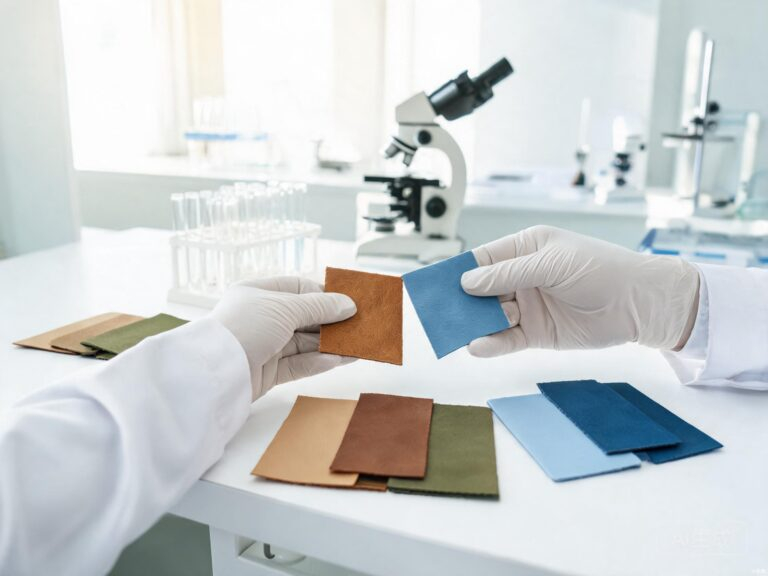
Two 2026 forecasts put the bio based leather market $153 million apart. One values the category at $255 million. Another lands at $408 million for the same year. The material data spreads even wider: finished tensile strength runs from 0.2 MPa to 20.8 MPa under one label. Both gaps point to the same conclusion. Bio based leather is a spectrum, not a single material, and the label alone tells you almost nothing. This guide sorts out the numbers, then lists the checks that separate spec-ready rolls from marketing sheets.
| Finished material | Tensile (MPa) | Tear (N/mm) | Flex cycles | Watch-out |
|---|---|---|---|---|
| Cactus (Desserto) | 20.8 | 37.2 | ~30,000 | Flex far below conventional leaders |
| Pineapple (Piñatex) | 4.5 | 31.0 | ~150,000 | Low tensile, strong flex |
| Apple (AppleSkin) | 14.0 | 18.4 | — | Tear resistance is the weak point |
| Grape (Vegea) | — | — | — | 45% water-based PU binder inside |
| Mushroom (MuSkin) | 0.2 | — | — | Lab-scale, weakest measured |
| Conventional PU (measured) | 10.6 | 34.4 | >200,000 | Petrochemical base, hydrolysis risk |
Why Every Bio Based Leather Market Forecast Disagrees
The forecasts disagree because they count different things. One 2026 report values the category at $213 million in 2025, rising to $255 million in 2026, with a 20.3% CAGR toward $1.35 billion by 2035. A separate estimate starts from a much larger base: $361.77 million in 2025 and $407.64 million in 2026. Its 12.88% CAGR lands at $845 million by 2032. Neither number is wrong. They simply draw the category border at different places.
The border question is the hybrid question. Materials that blend plant feedstock with polymer coatings sit inside some counts and outside others. The supply side is still concentrated either way. MycoWorks alone held 11.3% market share in 2025. The top five players, including MycoWorks, Ananas Anam, Desserto, Hzcork, and Ecovative Design, held 35.3% together. Volume capacity is thin, and lead times reflect it. That matters more to a buyer than any forecast curve.
What Bio-Based Actually Covers on the Label
Bio-based describes the feedstock story, not the finished composition. Grape waste leather is the clearest example. One commercial grape-derived construction runs about 1.1 mm thick and contains 55% vegetal resins plus grape content. The other 45% is water-based polyurethane. That material is legitimately bio-based and legitimately a hybrid. Both facts belong on the same spec sheet, and most marketing pages print only one of them.

Resin and binder mixing: the ratio of plant content to polymer binder decides both the eco story and the aging behavior.
The fix is carbon testing, not storytelling. Bio-content can be measured with ASTM D6866, a carbon-14 method that reports the renewable fraction as a percentage. Serious suppliers publish the number. Vague suppliers publish adjectives. When a quote says plant-based without a percentage, ask for the D6866 report before anything else. The same discipline applies to any eco-friendly silicone leather program, where the claim to verify is solvent-free chemistry rather than bio-content.
The Performance Spread That Decides the Application
Flex endurance separates the usable from the decorative. Cactus material holds about 30,000 flex cycles. Piñatex reaches roughly 150,000. Conventional leaders exceed 200,000. Tensile tells the same story from a different angle: the measured range runs from 0.2 MPa for MuSkin to 20.8 MPa for Desserto, with conventional PU at 10.6 MPa in the same comparison. No single bio based leather wins every metric, so the application must pick the material.
Abrasion thresholds make the choice concrete. In our own testing reviews, mycelium materials land at 15,000 to 25,000 Martindale cycles. Contract furniture specifications call for a 40,000 minimum, and heavy commercial use demands 100,000 or more. Full silicone constructions test at 200,000+. A bag panel and an airport seat live under completely different loads. The silicone vs PU leather trade-off covers the same logic: chemistry decides how the surface ages, and the test report decides whether the claim survives contact with reality.
Mycelium materials lead the bio-based story, yet their Martindale range still sits below contract furniture thresholds.
How to Verify a Bio Based Leather Claim in Five Checks
Verification is a paperwork exercise before it is a lab exercise. Run these five checks in order.
1. Demand a current ASTM D6866 report. The percentage on it is the only bio-content claim that means anything. 2. Request flex testing at production thickness, because a 0.8 mm sheet and a 1.4 mm sheet from the same recipe fail at different cycle counts. 3. Match Martindale to the application, with 50,000 for residential use and 100,000+ for contract work. 4. Ask for the binder disclosure, since the PU fraction decides hydrolysis and peel behavior years later. 5. Order one pilot roll before any program commitment, and inspect it against the same report numbers.
Recycled inputs can enter the same checklist. A PET-based silicone leather construction carries a different claim, but it answers to the same standard: written proof for every percentage on the spec sheet.

A finished fold tells you what no label can: surface integrity under bending, at production thickness.
Watch how certification paperwork maps to real material performance on our production line.
Bio Based Leather Is a Spectrum, Not a Spec
The category deserves its momentum. It does not deserve a free pass on evidence. Treat every bio based leather quote as three questions: what percentage is renewable, what chemistry binds it, and what the flex and abrasion numbers say at production thickness. Suppliers who answer with reports are worth a pilot order. Suppliers who answer with adjectives are worth nothing yet.
FAQ
Is bio based leather biodegradable?
Not automatically. Biodegradability depends on the full construction, including binders and coatings. A hybrid with 45% polyurethane will not compost like its plant fraction suggests. Ask for end-of-life data on the finished material, not the feedstock.
Can bio based leather replace PU for commercial use?
Only where the load is light. Most finished bio-based materials sit well below the 100,000-cycle threshold that contract seating demands. For heavy-use programs, a high-abrasion synthetic with documented testing remains the safer specification today.
References
1. https://www.gminsights.com/industry-analysis/bi… — Bio-based leather $213M 2025 → $255M 2026, 20.3% CAGR to $1.35B 2035; MycoWorks 11.3% share, top 5 at 35.3% (2026)
2. https://www.fabulive.com/blogs/news/the-bio-bas… — Finished-material benchmarks: Desserto 20.8 MPa, Piñatex flex ~150,000 cycles, Vegea 45% water-based PU binder, conventional leaders >200,000 flex cycles (2026)