How much stretch does your product actually need, and what happens when the fabric stops recovering? Those are two different questions, and most specifications answer only the first. Stretch is easy to demonstrate on a sample table. Recovery shows up months later, as bagged knees, loose cuffs, and warped seat panels. Our verdict after comparing all four textile elastic classes is simple. Recovery, not stretch, decides whether a material survives its contract. The sections below put elastomeric yarns, stretch weaves and knits, elastic webbing, and coated fabrics through the same test logic. Each section shows what the class is made of and what it gives back.
What Textile Elastic Means in a Specification
ISO 20932-1 gives the working definition. Elasticity is the ability to recover original size and shape immediately after the deforming force is removed. Two words carry the weight in that sentence. Recover means the fabric returns to dimension, not just relaxes. Immediately rules out materials that creep back over hours. The standard family splits the work. Part 1 covers strip tests and Part 2 covers multiaxial tests. Part 3 handles narrow fabrics, which behave differently enough to need their own method.
In practice, textile elastic performance comes from four different sources. Elastomeric yarns stretch at the molecular level. Knits stretch through loop geometry. Stretch wovens borrow power from a small share of elastane. Coated fabrics rarely stretch at all, so their version of the property is flex endurance.
The market keeps expanding across all of them. The global stretch fabric market reached USD 6.38 billion in 2025. It is projected to climb to USD 10.35 billion by 2032, a 7.15% CAGR. Spandex or elastane fabric held 55.0% of that market in 2025. Activewear and sportswear took 48.0% of application demand.

Tensile testing: where stretch numbers start, and where recovery claims get checked.
Elastomeric Yarns: Power Stretch With a PU Core
Spandex, also called elastane, is a synthetic elastic fiber built on polyurethane chemistry. It is the highest-power option in the textile elastic lineup, and it is a large business on its own. The global spandex market was valued at USD 9.43 billion in 2025 and is forecast to reach USD 15.82 billion by 2035, growing at a 5.3% CAGR.
ASTM D2731 is the standard test method for the elastic properties of these yarns. It measures three things that buyers should ask for by name. Force at specified elongation, or FASE, records the force needed to reach 100%, 200%, or 300% extension. That number predicts how hard a garment is to put on. It also indicates the resistance the fabric offers during normal body movement.
Permanent deformation, called set, tracks the length a yarn fails to recover after cyclic stretching. The method notes that little or no additional set develops after five cycles. That makes a five-cycle check a cheap early warning. Stress decay is the drop in force while the yarn is held extended. It happens mostly in the first 30 seconds and becomes insignificant after 5 minutes.
One scope detail matters in procurement. D2731 covers as-produced elastomeric yarns from 40 to 3200 dtex and excludes covered, wrapped, or core-spun constructions. If your fabric uses a core-spun yarn, ask which form was actually tested before comparing datasheets.
Stretch Weaves and Knits: Structure or Blend
Knit fabrics earn their stretch from loop geometry. Pull a jersey knit and the loops deform; release them and the loops spring back. That recovery is real, but it has a limit. Once loops are pulled out of shape past their elastic range, the fabric grows and does not fully return. Strip tests under ISO 20932-1 are the right tool here. They measure extension and recovery on the finished fabric rather than the yarn.
Stretch wovens work differently. A small percentage of elastane, often under 5%, changes the behavior of a structured woven. The fabric moves with the body while keeping its tailored shape. The blend shifts the failure mode from grown-out loops to bagging. That shows up at high-movement zones like knees and seat panels. Activewear and sportswear dominate demand for both constructions, taking 48.0% of the stretch fabric market in 2025. See how these materials sit inside finished lines on our fashion and sports applications page.

Sports applications judge materials on repeated movement, not on a single pull.
Elastic Webbing and Narrow Fabrics: Load-Bearing Stretch
Braided, woven, and knit elastics form their own class because width changes the physics. ISO 20932-3 exists separately for narrow fabrics for exactly that reason. Webbing carries load across furniture frames, luggage, medical straps, and apparel edges. Its version of textile elastic behavior mixes recovery with sustained tension.
The failure modes are visible and specific. Edges curl. Ribboning twists the band under load. Recovery fades after repeated tension cycles near the elastic limit. Furniture programs feel this first, because a sagging strap reads as a broken chair long before the frame fails. When you spec webbing, ask for recovery data at the working load, not at laboratory elongation. The two numbers describe different service conditions.
Coated Fabrics: Flex Endurance Instead of Stretch
Coated fabrics answer a different question. Upholstery, bags, and electronic accessories rarely need the fabric to elongate. They need the surface to survive thousands of bends, presses, and folds without cracking or delaminating. In that world, the elastic property that matters is flex endurance, and the enemy is a coating that embrittles.
This is where our material class earns its place. TOPSUN silicone leather in the Ultra Thin collection runs 0.23 to 0.8 mm thick and withstands 360-degree bending. That is why 3C accessory brands use it on surfaces that fold daily. Tensile strength reaches 15+ N/mm and tear strength 20+ N in the Classic line.
The material stays flexible at -40°C instead of cold-cracking. The High Performance collection is rated at 200,000+ Martindale cycles for contract seating. The flexing test below shows the mechanism at work.
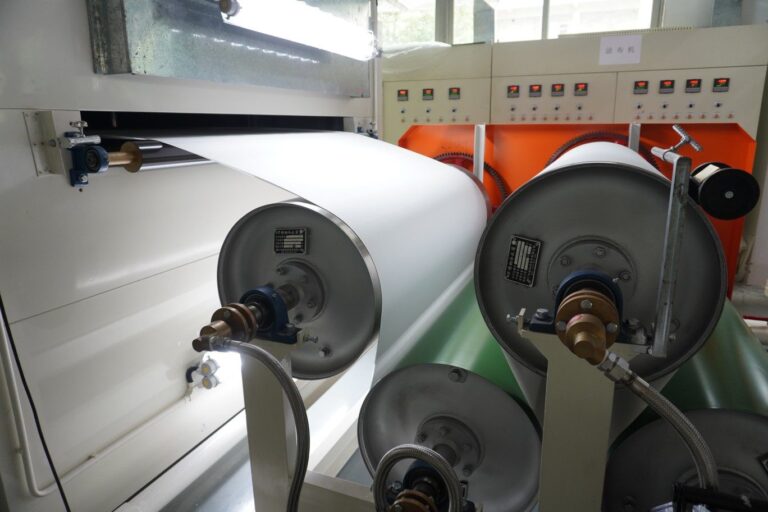
Flexing test: repeated bending is where elastic claims are proved or broken.
Some products need a softer, more yielding handfeel than standard coated surfaces. Our silicone microfiber leather pairs a denser base with the same stable surface chemistry.

Bending test machine: flex endurance replaces elongation as the number to watch.

Soft-hand layers: drape and yield are part of the elastic conversation for buyers.
The Verdict Table: Match the Class to the Application
The table below compresses the whole comparison. Read it left to right: where the stretch comes from, what the standard measures, how the class usually fails, and where it belongs.
| Class | Stretch source | What tests measure | Typical failure | Best fit |
|---|---|---|---|---|
| Elastomeric yarn | Molecular, PU-based | FASE, set, stress decay (ASTM D2731) | Set after cyclic stretching | Cuffs, swimwear, compression |
| Stretch knit | Loop geometry | Strip tests (ISO 20932-1) | Grown-out loops | Activewear tops, base layers |
| Stretch woven | Elastane blend in weave | Strip and multiaxial tests | Bagging at knees and seats | Tailored motion garments |
| Narrow elastic | Geometry under tension | Narrow-fabric method (ISO 20932-3) | Edge curl and ribboning | Webbing, straps, waistbands |
| Coated fabric | Flex, not elongation | Bending cycles, Martindale, tensile | Coating cracks (PU aging) | Upholstery, bags, 3C accessories |
How to Verify Elastic Claims Before You Order
Four requests filter most elastic marketing in one email. First, ask for the named test standard. That means the ISO 20932 series for finished fabrics or ASTM D2731 for elastomeric yarns. Second, ask for recovery and set numbers, not only stretch percentage. Third, ask which form was tested, because D2731 excludes covered and core-spun yarns and ISO 20932-1 excludes narrow fabrics.
Fourth, ask whether third-party verification is welcome. Our orders ship with SGS reports, and SGS, BV, or TÜV inspection at the factory is an open offer.
The verdict rests on one distinction. Stretch sells the sample. Recovery keeps the customer. A specification that records both numbers, tied to a named standard, beats any datasheet that lists only stretch distance.
Ask Our Engineers About Flex Specs
Is elastane the same as spandex?
Yes. Elastane is the generic name used in Europe and in ISO terminology. Spandex is the term common in North America. Lycra is a brand name for the same polyurethane-based fiber. Performance differences come from the yarn construction and fabric integration, not from the name on the label.
Can a coated fabric be textile elastic?
Not in the stretch sense, and honest suppliers will not claim it. Coated fabrics should be judged on flex endurance, bending recovery, and softness instead. Those are measurable properties, and a supplier who redirects the conversation to them is describing the material accurately.
What recovery rate should I require?
There is no universal threshold, because acceptable recovery depends on the application and the class. Set the number by method and use case. Recovery is measured per ISO 20932 for fabrics. Set after five cycles follows the D2731 logic for yarn-based products. A supplier who returns both figures with the test conditions attached is ready to be taken seriously.
Request Stretch and Flex Test Reports
References
- https://pmarketresearch.com/worldwide-stretch-f… — Stretch fabric market USD 6.38B (2025) to USD 10.35B (2032), CAGR 7.15%; elastane fabric 55.0%; activewear 48.0%
- https://www.reportsanddata.com/report-detail/sp… — Spandex market USD 9.43B (2025) to USD 15.82B (2035), CAGR 5.3%
- https://www.astm.org/d2731-15.html — ASTM D2731: FASE at 100/200/300% elongation; set stabilizes after 5 cycles; stress decay negligible after 5 min
- https://www.iso.org/standard/69489.html — ISO 20932-1:2018: strip tests for elasticity of fabrics, excluding narrow fabrics; confirmed 2024