Which marine upholstery materials actually survive five seasons on salt water? Ask three refit yards and you will get three different answers. The honest baseline is that every candidate material has a test record, and most buyers never get to see it. This guide lines up the four main candidates: marine vinyl, solution-dyed acrylic, genuine leather and silicone leather. Each is judged on salt spray hours, UV stability, abrasion cycles and flex life.
One material passes a 1,000-hour ASTM B117 salt spray test with no structural change. Another begins surface breakdown inside 120 hours. Here is how the numbers sort out.
| Material | Salt Spray (ASTM B117) | UV Stability | Active Lifespan | Primary Weak Point |
|---|---|---|---|---|
| Marine vinyl (PVC) | 48-200h before surface breakdown (bench data) | 500-2,500h with stabilizers | 7-10 yrs covered; 3-5 exposed | Plasticizer migration, mildew |
| Solution-dyed acrylic | Water-resistant, not sealed | Lightfastness grade 7-8 | 5-10 yrs | Slow drying, mildew on soil |
| Woven canvas | Absorbs water | Moderate | 3-6 yrs | Rot at stitch lines |
| Genuine leather | Not recommended on deck | Fades without treatment | 10+ yrs, salon only | Water spotting, stiffening |
| Silicone leather | 1,000+ h, no degradation | 1,500+ h no fading | 10-15 yrs | Higher upfront cost |
What Destroys Marine Upholstery Materials First: Four Failure Modes
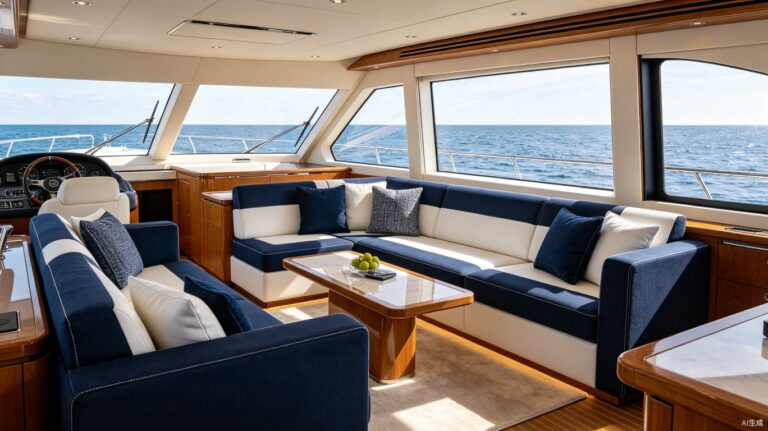
Deck seating fails in predictable ways. Ultraviolet radiation breaks polymer chains and bleaches pigment. Salt spray and humidity attack any material with hydrolyzable bonds. Mildew colonies feed on surface dirt and plasticizers. Flex fatigue then works every seam and cushion edge thousands of times per season. Any one of these can ruin a seat; on an open boat they all run at once.

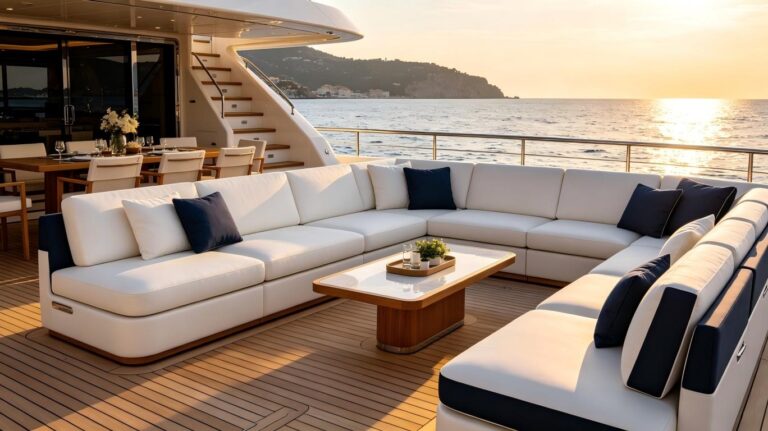
Open-deck boat seating combines all four failure modes at once: UV, salt, moisture and flex.
We keep cut samples of every returned warranty panel in our lab. The pattern is consistent: failure almost always starts at a stitch hole or a drainage channel, where water pools and UV hits at an angle. Material choice decides how fast that process moves.
Marine Vinyl: A 7-10 Year Rating With Conditions
Marine vinyl is PVC over a polyester backing, and it remains the default on production boats. Properly maintained, premium grades last 7 to 10+ years, while standard indoor vinyl can fail within 1 to 3 seasons on the water. The gap comes from UV stabilizers, mildew inhibitors and cold-crack additives, not from the base polymer. If you are weighing vinyl against newer options, it helps to see how silicone compares with PU and PVC on the same tests.
The conditions matter. Plasticizer migration begins around year two and shows up as progressive stiffening. Industry guidance puts preventive replacement at 4 to 8 years depending on storage, and covered storage is what protects the 7-10 year figure. Leave the boat on a lift in equatorial sun and that timeline compresses fast.

Color fastness and UV aging tests separate true marine-grade stock from indoor vinyl sold as marine.
Discuss Your Marine Project
Acrylic and Canvas: Breathable, but a Different Job
Solution-dyed acrylics such as Sunbrella dominate the enclosure and cushion-top market for good reason. Lightfastness ratings reach grade 7-8 on the ISO 105-B02 scale, and premium lines post 50,000+ Wyzenbeek double rubs. The trade-off is water behavior: these fabrics shed rain but soak in standing water, and mildew grows on surface soil if cushions stay damp.

Abrasion and flex testing translate directly into years of service on deck.
Canvas sits below acrylic on every measure. Expect 3 to 6 years of service, rot risk at the stitch lines, and more frequent re-treatment. Neither fabric is the right answer for wet seating. Both are strong picks for Bimini tops, enclosures and cockpit cushions that dry quickly.
Genuine Leather and Silicone Leather: Two Ends of the Spectrum
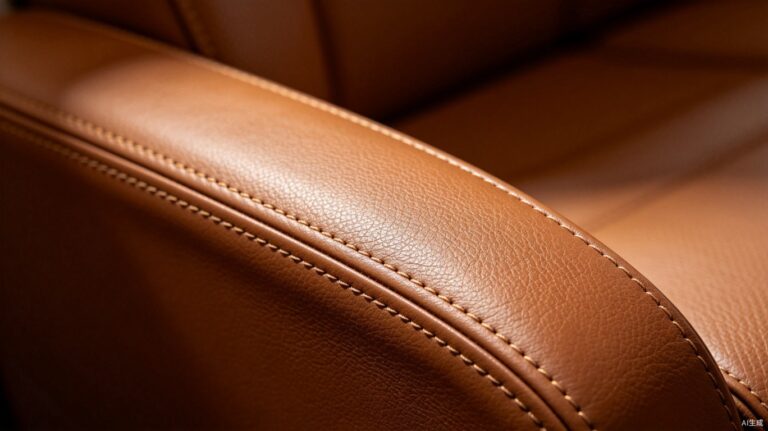
Genuine leather belongs inside climate-controlled salons, where it ages well for a decade or more. On deck it is a liability. Tannins react with salt water, spots set permanently, and the material stiffens after each wet-dry cycle. Superyacht interiors use it; center consoles do not.

Genuine leather offers unmatched hand feel, but only in climate-controlled cabins.
Silicone leather takes the opposite approach. Its Si-O backbone has no hydrolyzable bonds for salt water to attack. That is why samples in our chamber pass 1,000+ hours of ASTM B117 exposure with zero adhesion failure. That resistance comes from the polymer itself, which is the core claim behind hydrolysis-resistant silicone leather. UV stabilization holds color past 1,500 hours, cold crack resistance reaches -40°C, and the High Performance line is rated at 200,000+ Martindale cycles. There are no plasticizers to migrate out, so flexibility does not fade with age.
Watch how silicone leather holds color and flexibility after simulated seasons of outdoor weather exposure.
The one honest drawback is price per meter. Silicone grades typically run above marine vinyl at purchase. The math changes once replacement cycles enter the picture.
Choosing Marine Upholstery Materials by Application
Market pressure is not letting up. The marine fabrics market reached $2.15 billion in 2025 and is projected to reach $3.06 billion by 2032. Upholstery applications take 48.5% of that spend. More builds mean more material decisions. The verdict table below is how our team maps them. You can browse finished marine and outdoor silicone leather applications to see the material in place.
| If your project involves… | Specify… | Why |
|---|---|---|
| Open deck seating, saltwater, full sun | Silicone leather | 1,000+ h B117, 1,500+ h UV, no plasticizers |
| Covered cruisers, budget refits | Marine vinyl | 7-10 yrs with care, lowest upfront cost |
| Enclosures, Bimini tops, dry cushions | Solution-dyed acrylic | Grade 7-8 lightfastness, breathable |
| Climate-controlled yacht salon | Genuine leather | 10+ yr service, premium finish |
| Charter fleets, heavy-duty contracts | High-performance silicone | 200,000+ Martindale cycles |

Water beading on silicone leather: no absorption, no wicking, no hydrolysis pathway.
Marine upholstery material selection is never one-size-fits-all. Match the material to the exposure, and ask for test reports before you commit. Our team runs salt spray, UV and Martindale verification on every production batch, and third-party inspection through SGS, BV or TÜV is always welcome.
About TOPSUN
TOPSUN supplies salt-spray-verified silicone leather to yacht builders and marine OEMs across North America, Europe and Australia.
ASTM B117 1,000+ hour salt spray verification, ISO 10993 and REACH compliance with SGS reports on every order, Pantone/RAL custom colors, 500,000 m monthly capacity.
References
- https://pmarketresearch.com/worldwide-marine-fa… — Marine fabrics market $2.15B (2025) to $3.06B (2032), CAGR 5.19%, upholstery 48.5% share
- https://www.decorativefabricsdirect.com/blog/ma… — Marine vinyl lifespan 7-10+ years vs standard vinyl 1-3 seasons; UV 500+ test hours
- https://midwestfabrics.com/blogs/recent-posts-o… — Marine vinyl abrasion 100,000+ cycles; vinyl vs canvas vs acrylic lifespan comparison (2026)