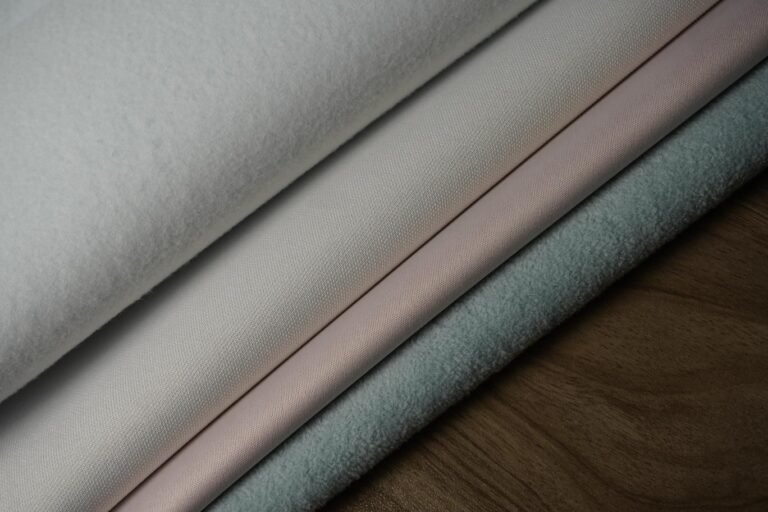
The sample books lie open side by side on a hotel group’s procurement table, ours and a competitor’s. Both covers list the same five fabric benefits in nearly the same words. Easy to clean, built to last, waterproof, antimicrobial, and warranted for years. The lead runs a finger down both pages and asks the only question that matters. Which of these claims can you actually test?
That question decides most sourcing arguments. A benefit without a number is a mood. Moods fade the first time a housekeeper attacks a chair with bleach. Below are the five claims we hear most, and the test that should stand behind each one. Each section ends with the exact number we publish for our own silicone leather.
What a Fabric Benefits Claim Must Survive
A claim earns its spec-sheet place only after a machine, a chemical bath, or a clock signs off. Coated fabrics make this easy to check, because the industry publishes its methods. Wyzenbeek rigs count double rubs for abrasion. Martindale does the same job on a different machine. Hydrolysis ovens push heat and humidity until the polymer admits defeat. Standard fabrics lean on a soft hand and a friendly price. Genuine performance fabrics carry fiber-level treatments with published counters.
Claim 1: Easy Clean Means Bleach and Hospital Disinfectants
Easy to clean is the easiest claim to fake. The honest version starts with chemistry. A film-forming polymer bonds into a dense, non-porous surface. Ink, coffee, and dye sit on top instead of soaking in. Coated-fabric makers publish exactly that. Polycarbonate-based polyurethanes are rated bleach cleanable and approved for hospital-grade disinfectants. That is why they survive rooms wiped down twenty times a day.
Our silicone surface takes the logic further. The polymer itself resists breakdown under repeated alcohol and quaternary ammonium wipes. Our cleaning and maintenance guide lists every agent we test against, so your team can run the identical routine at home. Ask any supplier one question: name the disinfectants your surface is approved for. If the answer stops at soap and water, keep walking.
Claim 2: Durability Is a Number, Not an Adjective
Abrasion is the one benefit with an honest scoreboard. On the Wyzenbeek rig, standard coated fabrics run about 100,000 double rubs. Upgraded lines reach 200,000, and a few composites claim a million. On the Martindale side, performance fabrics start above 50,000 cycles while ordinary upholstery sits at 15,000 to 25,000. Our silicone leather clears 200,000 Martindale cycles, and we attach the report to every lot.

The number matters most in seats that never rest: hotel lobbies, cinemas, transit lounges, and airport gates. Home buyers run the same math for the sofa that hosts the family every evening. Our sofa application guide translates lab counts into years of daily seating, so a 200,000-cycle rating stops being an abstraction.
Claim 3: Waterproof Should Be Built In, Not Sprayed On
Waterproof splits into two very different products. A topical spray beads water on day one, then wears away under friction and cleaning. Most coatings need re-treatment after 12 to 18 months. A genuine performance fabric carries the repellency inside the fiber or the polymer, so no wipe can remove it.
The giveaway is a glass of red wine. On a built-in surface the liquid sits as a bead until you lift it away. A sprayed surface lets the color creep in after a season. For pet households the difference compounds, because claws and frequent washing strip topical layers fast. Our pet-proof silicone leather is waterproof by construction, not by aftercare.

Claim 4: Antimicrobial Should Be Inherent, Not Added
Antimicrobial comes in two versions as well. Added biocides can leach out and lose strength, while inherent protection lives inside the polymer and cannot wash off. Polycarbonate sheets are marketed as inherently antimicrobial, resisting bacteria and mold with no additive at all. That matters in clinic seating, where a chair must survive disinfectant, spills, and odor in the same afternoon.

Check the chemistry card while you are at it. Our sheets test non-detect for volatile organic compounds, and the formulation is free of PVC and PFAS. A seat that claims health benefits should not carry a chemistry list that argues the opposite.
Claim 5: A Warranty Is Confidence in Writing
A written warranty is a maker betting money on its own numbers. Coated-fabric warranties run from five years on standard polycarbonate lines up to ten years on premium silicone-coated grades. Hydrolysis is the failure mode behind most denied claims, so ask how the figure was earned. We age our sheets at 85 degrees and 85 percent humidity for 14 weeks before we print a warranty. One backed by an oven beats one backed by optimism.
The Claims Worth Demanding
Bring this table to your next supplier meeting. Every row pairs a marketing word with the number that proves it. Any vendor who hesitates has answered for you.
| Your Program | Benefit to Demand | The Number or Proof to Ask For |
|---|---|---|
| Healthcare and clinic seating | Bleach cleanable, inherent antimicrobial | Approved disinfectant list plus a 5-year warranty |
| Hospitality lobby and cinema | High abrasion, easy clean | 200,000 double rubs or 50,000+ Martindale |
| Family sofa with kids and pets | Built-in waterproofing, clean chemistry | Polymer-level repellency, VOC non-detect, PVC-free |
| Marine and outdoor contract work | Hydrolysis and UV resistance | 14-week oven aging, 10-year warranty |
See the Test Reports Behind Every Claim
Five claims, five numbers, one habit. Make the supplier show the test, not the advertisement. The fabric benefits on your spec sheet will still be true in year five.
Order a Sample Set With Lab Data
About TOPSUN
TOPSUN prints the test number next to every claim in its catalog. Silicone leather rolls ship with SGS reports covering Martindale abrasion, hydrolysis oven aging, salt spray, and VOC screening.
Pantone and RAL matching spans 100+ textures, and published MOQ terms start at 500 meters. Monthly capacity tops 500,000 meters for contract programs.
References
1. https://carnegiefabrics.com/resources/your-esse… — Coated-fabric maker Carnegie publishes polycarbonate PU rated for 250,000 double rubs, bleach cleanability, hospital-grade disinfectant approval, inherent antimicrobial protection, and warranties of five to ten years.
2. https://fibreguard.com/performance-fabrics — FibreGuard explains that genuine performance fabrics carry fiber-level stain, moisture, and UV resistance, with antimicrobial options that guard against bacteria and mold.
3. https://goodrichglobal.com/singapore/article/cr… — Topical sprays wear off in 12 to 18 months while genuine performance fabrics embed repellency in the material, holding 50,000+ Martindale cycles against 15,000 to 25,000 for standard cloth.(2026)