A purchasing lead once put three supplier datasheets on our bench and asked a question that sounds naive. What is leather, really? All three sheets said leather. Only one described an actual hide.
That gap is the whole problem with the word. The supply chain ships at least five different materials under one label, and no rule forces them apart. Here is the answer with numbers. You will see what real leather is, what the other four families actually are, and how to verify which roll lands on your dock.
| The Label Says | What Actually Ships | Where It Comes From | Typical Failure in Contract Use | Field Verification |
|---|---|---|---|---|
| Full-grain leather | Untouched top layer of the hide | One animal, tightest fiber mesh | Scarce; price follows the beef cycle | Irregular grain, warm scent |
| Genuine leather | Corrected or coated split | Lower hide layers under a film | Surface cracks and peels | Cross-section shows coating over loose fiber |
| Bonded leather | 10-20% hide pulp in glue | Ground offcuts and scrap | Flakes within months of flex | Adhesive smell, edges crumble |
| PU / faux leather | Polyurethane skin on fabric | Petrochemical line, no hide | Hydrolysis, seam wear | Fabric back, repeating grain pattern |
| Silicone leather | Organosilicone coating on textile | Coating line, no hide | Rare; rated past 200k Martindale cycles | Slice shows uniform skin over weave |
Leather, What Is It? One Word, Five Material Families
Start with the narrow definition. Leather is animal skin that tanning has stabilized, so its collagen fiber network resists decay. Everything else on a purchase order is a different material family wearing the same word.
The volume behind that definition is enormous. FAO figures put global bovine hide output at roughly 5.7 million tonnes per year on a wet-salted basis, from a herd near 1.5 billion head. Over 330 million cattle are slaughtered annually for beef, and the hide is a by-product, not the point of the animal.
Much of that side stream never becomes leather. Roughly 40 percent of cattle hides end up landfilled. Supply follows the beef cycle, not buyer demand. That single fact sets prices, quality spread and traceability for every project you quote.
What Real Leather Is: A Fiber Network, Not a Finish
Ask what is leather made of and the honest answer is a woven protein. The dermis is a three-dimensional mesh of collagen bundles. Tanning locks that mesh in place. Finishing only colors the surface. The strength lives inside, never on top.
That structure explains the grades. The outer grain layer carries the tightest mesh and most of the real strength. Below it, the corium of a split is looser fiber. We have pulled samples from both depths of one hide on our tensile bench. The grain layer held roughly twice the load before permanent deformation.

Grain layer and split from the same hide, mid-pull on our tensile frame. The load gap is the grade gap.
A coated split is still leather by the letter of the definition. It is not the same material. When a genuine leather sofa peels like sunburn, a surface film is holding together what the fiber underneath no longer can.
The Grades Behind the Label, Ranked by What Survives Use
So what does genuine leather mean on a spec sheet? Almost nothing, legally. The term covers corrected grain and coated splits alike. It never signals top grade. Buyers who read it as a quality promise are reading a label as a grade.
Bonded leather sits even further from the definition. It grinds offcuts into pulp, mixes the fiber with latex or polyurethane, and presses a sheet. Typical hide content is 10 to 20 percent. The rest is glue and plastic. Under daily flex it cracks within months, and no conditioner reaches the bond line.
PU faux leather skips the hide entirely. A fabric backer gets a polyurethane skin and a printed grain. It is a real material with honest uses. The confusion starts when it is sold under leather vocabulary. Our written comparison of silicone leather against PU tracks where the two coatings diverge after year three.

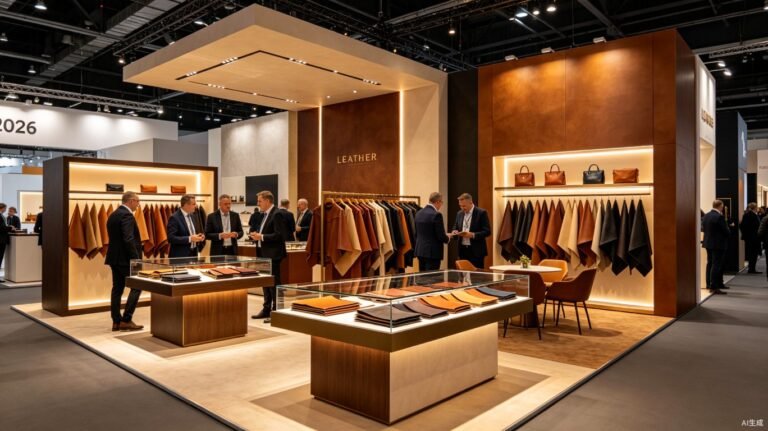
Coated upholstery rolls that all answer to the word leather. Only one family in this picture contains hide.
Leather: What Is It When It Is Not Hide?
Silicone leather answers the same question from the coating side. A textile backer carries a platinum-cured organosilicone layer. No collagen is involved. What it shares with hide is the application brief. What it replaces is the fiber, and with it the moisture, hydrolysis and VOC questions.
On our production floor the identity check is not the smell test. It is the datasheet. Martindale cycles, flex endurance, color fastness, VOC under ISO 16000-6. The silicone leather introduction lists the constructions we ship.
Backing choice follows the flex profile of the product. Microfiber-backed rolls take tight, repeated bending; woven PET suits flat lamination and panel work.

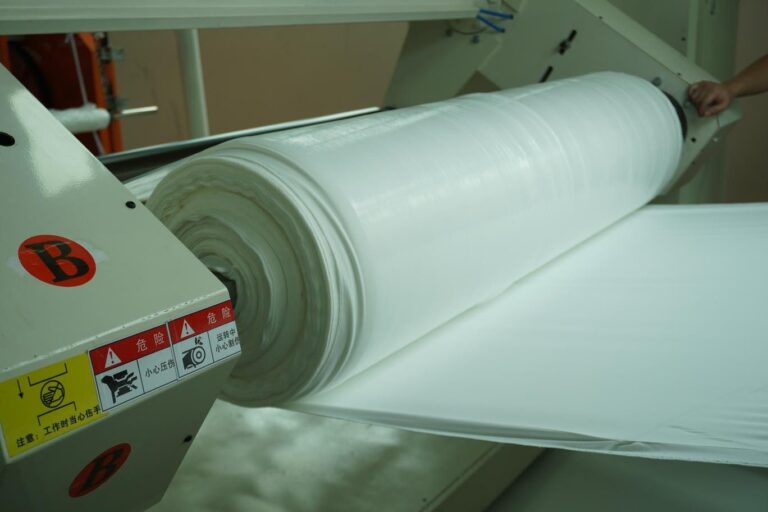
A silicone layer meeting a textile back on the laminator. No drum, no hide, no beamhouse.
Incoming inspection settles the question in two minutes. We slice the edge of a new roll and read the cross-section. Hide tears as fiber. A coated fabric lifts as one uniform film over a woven base. A blade answers what is leather faster than any label.
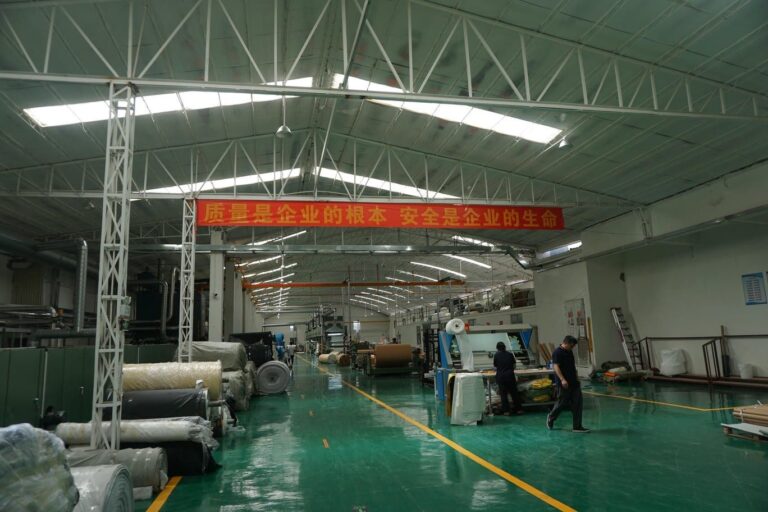
Two minutes inside the plant where hide-free leather is made: mixing, coating, testing and shipping under one roof.
Three Questions Our Lab Gets Weekly
Does a genuine leather label guarantee a full-hide product?
No. Genuine covers corrected grain and coated splits. The label states origin, not grade. Ask which layer of the hide shipped, and put the answer in the order text.
Can bonded leather be repaired once it starts to flake?
Rarely. The pulp-and-glue sheet has no structural reserve to re-anchor a coating. Conditioners sit on the plastic and do nothing for the bond line. Replacement is cheaper than repair, which is why bonded fails fastest in contract settings.
What is the fastest way to tell hide from a coating?
Cut a sample edge and look at it. Hide tears as fiber. A coating lifts as one film from a woven base. Flame and smell tests help, but the cross-section is the one you can photograph into a claim file.
Before You Sign: Five Checks That Answer What Leather Is
Run these five checks on any roll sold under the word. They turn a definition into a document.
- Ask which layer ships: grain, split, or bonded pulp. Put the answer in the order text.
- Demand the hide percentage in writing for anything described as bonded or reconstituted.
- Replace names with test numbers: Martindale cycles, flex count, adhesion, VOC.
- Slice one sample edge and photograph the cross-section before you approve the batch.
- Verify the backing material on the datasheet, then match it to the use, not the price.
Leather, what is it? After five checks, the question becomes paperwork you can test. A tested sheet beats a trusted label on every purchase order.
Request Label-Verified Silicone Leather Swatches
About TOPSUN
TOPSUN states the construction of every silicone leather roll for buyers who need to know exactly what a leather line on a purchase order covers.
Three production bases and 6 million metres a year, 200,000-cycle Martindale verification to ISO 12947-2, non-detect VOC under ISO 16000-6, and OEM color and grain matching for furniture, transit and healthcare programs.
References
1. https://market.us/report/tannin-market/ — FAO World Statistical Compendium figures: ~5.7 million tonnes of bovine hides annually (wet-salted), ~1,500 million head cattle, 1,765 million sheep and goats yielding ~643,000 tonnes of raw skins
2. https://one4leather.com/2025/04/ — Over 330 million cattle slaughtered annually; hides as a beef by-product, with roughly 40% of cattle hides unused and landfilled (2025)
3. https://sulkowski.fr/en/journal/guide-cuir-reco… — Bonded leather contains typically 10-20 percent leather fiber; genuine leather covers coated and corrected splits (2026)