A 45-foot sport yacht in the Mediterranean gets re-upholstered every 4 years — not because the owner wants a new look, but because the marine PVC seating has cracked, faded, and begun absorbing saltwater into its foam core. Each replacement cycle costs €8,000–12,000 in materials and labor, plus 2–3 weeks of dock time. Over a 10-year ownership period, that’s €20,000–30,000 spent on the same seats — repeatedly. For procurement teams at boat builders and refit yards, the marine PVC replacement cycle is a predictable but rarely calculated cost line. It should be.
Request Marine Material Samples
Marine PVC: What It Is and Why It Dominates Boat Seating
Marine PVC is a heavy-duty polyvinyl chloride coated fabric designed for saltwater, UV, and moisture exposure. A polyester base fabric is coated with PVC resin blended with plasticizers, UV inhibitors, and anti-microbial additives. It’s the default material for boat seating, yacht cushions, and marine upholstery because it’s waterproof, relatively inexpensive ($3–8/meter), and available in hundreds of colors and textures.

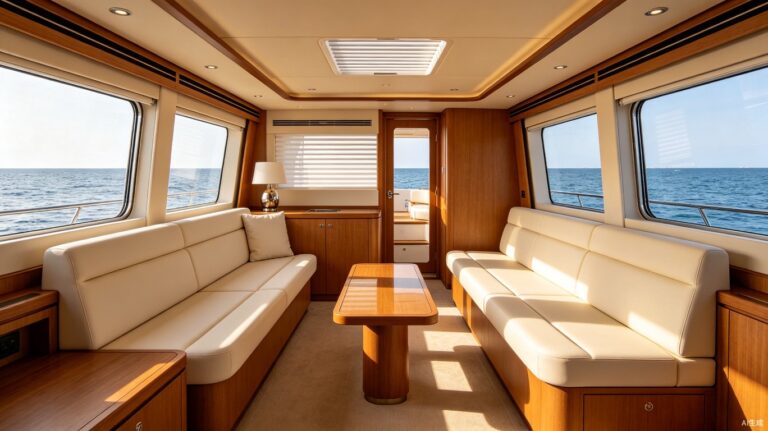
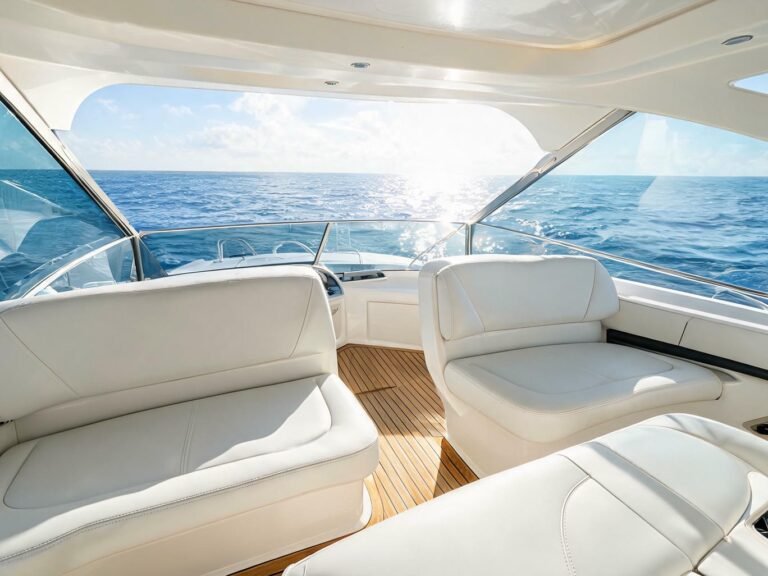
Marine PVC yacht upholstery — the application where UV and salt spray drive the replacement cycle
But marine PVC’s market dominance is a cost story, not a performance story. Standard furniture or automotive vinyl deteriorates 3–5× faster in marine environments because it faces four simultaneous destructive processes: UV-driven plasticizer loss, hydrolysis, salt crystallization inside the material’s pores, and chemical attack from sunscreen oils and body perspiration. Marine-grade PVC adds UV inhibitors and mildew treatments — which extends life from 2–3 years to 5–7 years — but doesn’t change the fundamental chemistry that fails.
Why Marine PVC Fails: UV, Salt, and Plasticizer Migration
The failure mechanism in marine PVC is well-documented. UV radiation breaks the carbon-carbon bonds in the PVC polymer chain, causing the surface to lose flexibility and crack. Simultaneously, plasticizers — the chemicals that make PVC flexible — migrate to the surface and evaporate. This is the “sticky then brittle” progression boat owners recognize: the material first feels tacky (plasticizers surfacing), then turns hard and cracks (plasticizers gone).

Color fastness and UV testing equipment — where marine PVC’s 200-hour limit becomes visible
Salt spray accelerates the process. Salt crystals penetrate micro-cracks in the PVC surface, expanding and contracting with temperature changes. In our hydrolysis resistance testing, we’ve seen PVC samples develop visible surface cracking after 200 hours of ASTM G154 UV exposure. Silicone leather, by contrast, shows zero degradation after 1,000+ hours of the same test — a 5× margin that directly maps to real-world lifespan.
In tropical and equatorial climates, the marine PVC failure timeline compresses dramatically. PVC inflatable boat fabrics show brittleness within 5–10 years in tropical sun, while high-grade alternatives like Hypalon maintain structural integrity for 15–25 years. Silicone leather bridges this gap: its Si-O molecular backbone is inherently UV-stable, meaning it doesn’t need UV inhibitors that deplete over time — the stability is structural, not additive.
The Real Cost of Marine PVC: 10-Year TCO Analysis
Here’s the cost calculation that most boat builders skip when comparing marine PVC to alternatives:
| Cost Factor | Marine PVC (5-yr cycle) | Silicone Leather (10+ yr) |
|---|---|---|
| Material cost per meter | $3–8 | $8–15 |
| Replacements in 10 years | 2 (at year 5 and year 10) | 0 |
| Labor per replacement | $2,000–4,000 | $0 |
| Dock downtime (lost revenue) | 2–3 weeks × 2 cycles | None |
| 10-year TCO per meter | $15–30 (material + labor + downtime) | $8–15 |
The math is unambiguous. Marine PVC’s lower upfront price evaporates by year 6. The marine fabric TCO analysis shows that a 45-foot yacht with 40 meters of seating upholstery spends roughly $600–1,200 on material per replacement — but $4,000–8,000 in labor and lost charter revenue. Over 10 years, the PVC route costs $12,000–24,000 total; silicone leather costs $320–600 for material with zero replacement.

Waterproof testing — silicone leather’s non-porous surface repels saltwater without absorbing it into the foam core
Silicone Leather in Marine: The Material Shipyards Are Switching To

Outdoor marine durability — silicone leather maintains structural integrity in full saltwater and UV exposure
Yacht builders who have switched from marine PVC to silicone leather report the same pattern: initial material cost is higher, but year 6 — when the first PVC replacement would have been due — is when the investment pays back. From that point forward, every year without replacement is pure savings.
Silicone leather’s marine advantages go beyond UV and salt spray. It’s inherently non-porous, meaning saltwater sits on the surface and wipes clean rather than wicking into the foam core. It operates from -40°C to 250°C — no cold-cracking in winter storage, no heat degradation in tropical sun. It produces near-zero VOC emissions, which matters in the enclosed cabin environment of a yacht. And it’s 100% recyclable at end of life, while PVC is not.
Watch silicone leather’s UV resistance test — the same exposure that cracks marine PVC in 200 hours
How long does marine PVC last compared to silicone leather in saltwater environments?
Marine-grade PVC lasts 5–7 years in typical marine use with proper care — shorter in tropical climates (3–5 years). Silicone leather lasts 10+ years in identical conditions, with verified 1,000+ hours of ASTM G154 UV stability and 1,000+ hours of ISO 9227 salt spray resistance. The 2–3× lifespan difference directly drives the TCO gap: marine PVC requires 2 replacements per decade, silicone leather requires zero.
Is silicone leather more expensive than marine PVC?
Upfront, yes — silicone leather costs roughly 1.5–2× more per meter than marine PVC. But the total cost of ownership flips the equation within 6 years. Marine PVC’s 5-year replacement cycle means paying for material, labor, and dock downtime twice per decade. Silicone leather’s 10+ year lifespan with zero replacement delivers lower TCO despite higher initial spend. For commercial vessels and charter yachts where downtime directly costs revenue, the break-even point arrives even sooner.
Decision Guide: Marine PVC or Silicone Leather?
- If your vessel operates in freshwater only and is stored indoors → Marine PVC is adequate (5–7 year lifespan, lower upfront cost)
- If your vessel operates in saltwater with seasonal use → Marine PVC with UV protectant (plan replacement at year 5)
- If your vessel operates in tropical/equatorial saltwater → Silicone leather required (PVC fails in 3–5 years, silicone lasts 10+)
- If your vessel is a charter/commercial yacht where downtime = lost revenue → Silicone leather (zero replacement cycles over 10 years)
- If your project requires near-zero VOC cabin interiors → Silicone leather (PVC off-gases plasticizers in enclosed spaces)
Marine PVC served the industry well as a cost-effective, waterproof option — and for budget-conscious boats in mild climates, it still does. But for any vessel that faces real saltwater, tropical sun, or commercial uptime requirements, the 5-year replacement cycle is a cost that compounds. The question isn’t whether silicone leather costs more upfront. It’s whether you can afford to re-upholster every 5 years.
About TOPSUN
TOPSUN supplies silicone leather marine upholstery materials to yacht builders and marine refit yards, replacing PVC vinyl with a hydrolysis-proof, salt-spray-resistant alternative engineered for 10+ year service life in open-ocean conditions.
1,000+ hours ASTM G154 UV stability · 1,000+ hours ISO 9227 salt spray resistance · -40°C cold crack flexibility · Zero plasticizer migration in marine environments