When someone asks “leather — what is it made of?” the answer depends entirely on which leather they’re holding. Genuine leather is made of collagen fibers from animal hides, preserved with chromium salts and tanning oils. PU leather is made of polyurethane resin dissolved in DMF solvent, coated onto polyester fabric. PVC leather is made of polyvinyl chloride paste plasticized with phthalates. Silicone leather is made of polysiloxane derived from silica sand. Bio-based leather is made of plant fibers bonded with petroleum-derived polyurethane. Five materials, five completely different compositions, all sold under the single word “leather.” For B2B specifiers, understanding what leather is made of isn’t academic curiosity — it determines product safety, durability, regulatory compliance, and end-of-life recyclability.
This guide breaks down the composition of every leather type so you can answer the question what is leather made of with chemistry, not marketing.
Type 1: Genuine Leather — Collagen + Tanning Chemicals
Genuine leather is made from the dermis layer of animal hides — primarily cattle, sheep, and goats. The hide consists of collagen fibers, a protein structure that provides natural strength and flexibility. But raw hide decomposes within days, so it must be chemically stabilized through tanning.
What genuine leather contains:
- Collagen fibers: The structural protein of the hide — this is the “leather” itself
- Chromium III salts: 80-90% of global leather is chrome-tanned. Chromium sulfate cross-links with collagen, preventing decomposition. Residual chromium VI (hexavalent) can form through oxidation — a known carcinogen restricted under REACH.
- Tanning agents (vegetable-tanned alternative): Tannins from tree bark (oak, quebracho, mimosa). 10-15% of production. Slower process, lower durability, higher cost.
- Fat liquors: Animal or vegetable oils reintroduced after tanning to restore flexibility. These oils evaporate over 5-10 years, requiring conditioning (“leather food”).
- Dyes and finishes: Aniline, semi-aniline, or pigmented coatings applied for color and surface protection.
Genuine leather’s composition creates two persistent issues for B2B specifiers: chromium VI contamination risk (which fails REACH limits and food-contact standards) and the requirement for ongoing conditioning as fat liquors evaporate. The material is “natural” but it’s stabilized with heavy metals and maintained with chemical products throughout its life.

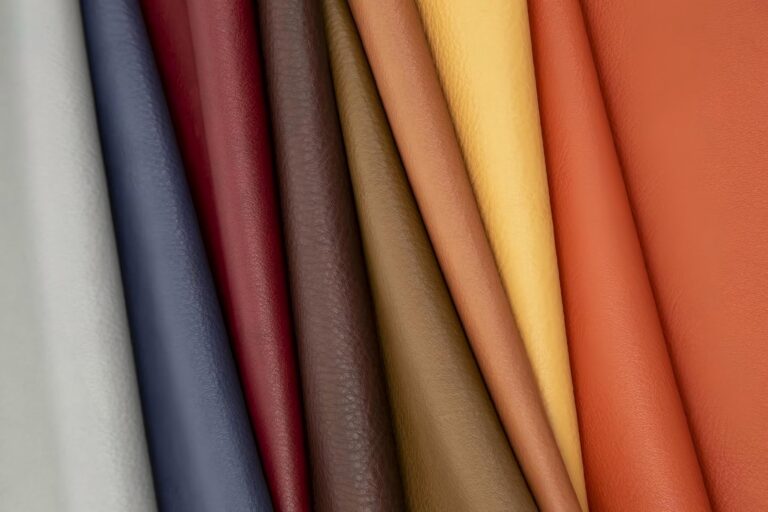
Genuine leather texture — collagen fibers stabilized with chromium salts and finished with aniline dye.
Type 2: PU Leather — Polyurethane + DMF Solvent
PU leather is made of a polyurethane coating on a textile substrate. The composition:
- Polyurethane resin: Synthesized from MDI (methylene diphenyl diisocyanate) and polyols (polyether or polyester). This is the coating that gives PU leather its leather-like appearance.
- DMF solvent: Dimethylformamide — dissolves the PU resin for application. Residual DMF remains in the finished product, contributing to VOC emissions. DMF is restricted under REACH Annex XVII.
- Polyester base fabric: Woven or non-woven PET (polyethylene terephthalate) — petroleum-derived textile substrate.
- Additives: Cross-linkers, UV stabilizers (benzotriazole derivatives), flame retardants (phosphorus or halogenated compounds), pigments.
PU leather’s composition explains its 2-5 year lifespan: the ester bonds in the polyol segment are susceptible to hydrolysis, and the solvent residue continues to off-gas throughout the material’s life. The “leather” is really a petroleum-derived polymer film on a petroleum-derived fabric, held together with petroleum-derived solvent.

PU leather cross-section — polyurethane coating layer on polyester base fabric, bonded with residual DMF solvent.
Type 3: PVC Leather — PVC Paste + Phthalates
PVC leather is the simplest and cheapest to manufacture. Its composition is also the most problematic:
- PVC paste resin: Polyvinyl chloride particles dispersed in liquid plasticizer. The PVC itself is rigid — without plasticizer, it’s the material used in PVC pipes.
- Phthalate plasticizers (30-50% by weight): DEHP, DINP, or DIDP. These make the rigid PVC flexible enough for upholstery. They are not chemically bonded — they migrate out over time, causing embrittlement and health concerns.
- Heat stabilizers: Zinc, calcium-zinc, or (in older formulations) lead compounds. Prevent thermal degradation during processing.
- Fillers: Calcium carbonate (up to 30%) — reduces cost, adds weight, reduces performance.
- Pigments and base fabric: Same polyester substrate as PU leather.
PVC leather is essentially plasticized vinyl — and the plasticizer migration is why it cracks, why it fails food-contact standards, and why it faces regulatory restrictions globally. The “leather” is a plasticized polymer sheet that loses its flexibility over time as the plasticizer evaporates.

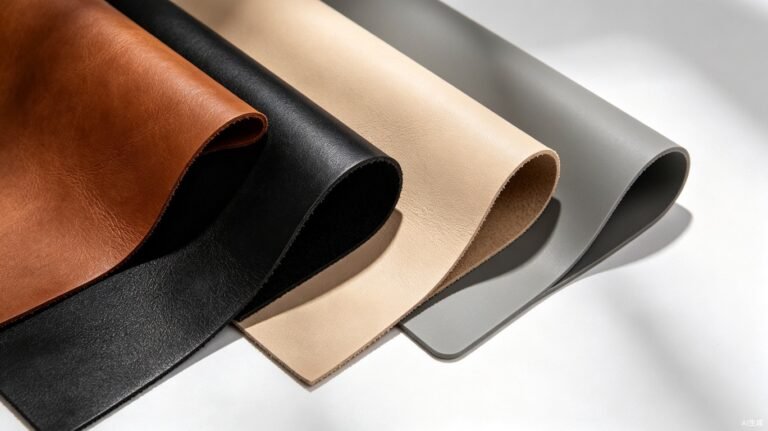
Synthetic vs genuine — visually similar surfaces, completely different chemical compositions.
Type 4: Silicone Leather — Polysiloxane, Nothing Else
Silicone leather has the simplest and cleanest composition of any leather type:
- Polysiloxane coating: A silicone elastomer with an Si-O-Si (silicon-oxygen) backbone. Derived from silica (sand). No petroleum content in the coating layer.
- Silicone adhesive: 100% silicone-based bonding layer. No solvent-based adhesives.
- Polyester knit base fabric: Knitted (not woven) polyester — provides stretch and recovery for upholstery applications.
- Additives: None. No plasticizers, no phthalates, no UV stabilizers, no flame retardants, no DMF, no solvents.
The composition explains the performance: the Si-O bond energy (452 kJ/mol) is higher than C-O (358) or C-Cl (339), meaning the polymer backbone is thermally stable to 250°C, UV-stable for 1,000+ hours, inherently flame-retardant (EN 13773 Class 4), and hydrolysis-proof. No additives are needed because the base chemistry already delivers what other leathers require chemical help to approximate.

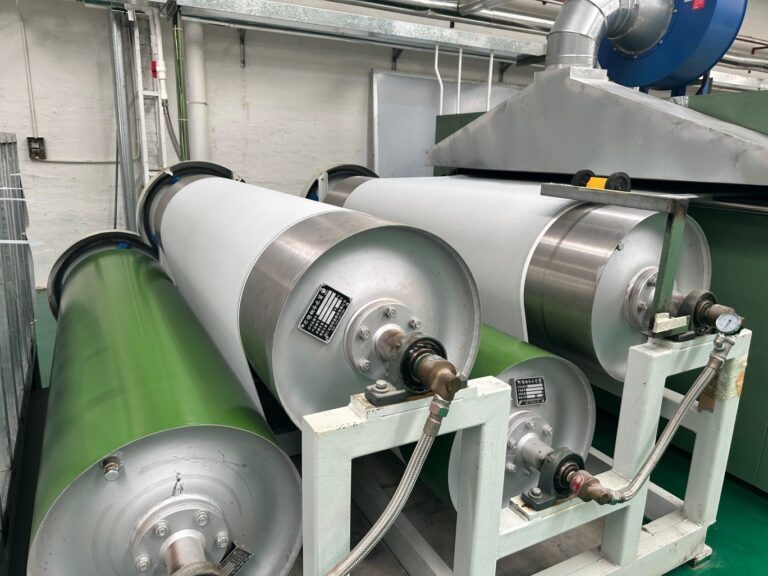
Calender equipment — silicone elastomer is applied via heated rollers without solvents, creating a pure polymer coating on textile substrate.
Type 5: Bio-Based Leather — Plant Fiber + Petroleum Binder
Bio-based leather is marketed as plant-derived, but its composition reveals a hybrid formulation:
- Plant fiber matrix (20-60%): Cactus mucilage, pineapple leaf fiber, apple waste, or mushroom mycelium — provides texture, appearance, and the marketing narrative.
- Petroleum-derived binder (40-70%): Polyurethane resin (Desserto, apple leather) or PLA/petroleum resin combination (Piñatex). This is the structural component that holds the plant fibers together and provides water resistance.
- Topcoat: Often a petroleum-based polymer coating for water resistance and durability — because plant fibers alone cannot provide these properties.
- Base fabric: Sometimes included, sometimes the plant fiber itself serves as the substrate.
The composition explains why bio-based leather often has similar durability limitations to PU leather — the binding chemistry is the same. The plant content provides marketing differentiation, but the structural performance comes from the petroleum-derived binder.

Top-grain genuine leather on furniture — the collagen surface has been coated with pigmented finish, making composition harder to identify visually.
Material comparison — how genuine, PU, PVC, and silicone leather differ in composition and performance.
Composition Comparison Table
| What It Contains | Genuine | PU | PVC | Silicone | Bio-Based |
|---|---|---|---|---|---|
| Animal product | Yes (hide) | No | No | No | No |
| Petroleum content | Minimal (dyes) | High (resin+solvent+fabric) | High (resin+plasticizer+fabric) | Low (fabric only) | Medium (binder+fabric) |
| Heavy metals | Chromium III/VI | None | Possible (stabilizers) | None | None |
| Solvents | None (finished) | DMF residue | None (paste) | None | DMF possible |
| Plasticizers | Fat liquors | None | Phthalates (30-50%) | None | None |
| Food-contact safe | No (chromium) | No (DMF) | No (phthalates) | Yes (FDA 177.2600) | No (PU binder) |
| 100% recyclable | No (biodegrades) | Limited | No | Yes | Limited |

Water-cooling section of the coating line — solvent-free manufacturing process means no emission recovery infrastructure needed for silicone leather.
About TOPSUN
TOPSUN manufactures silicone leather made from one ingredient: polysiloxane derived from silica sand. No chromium, no DMF, no phthalates, no petroleum-based solvents, no hidden binders. Our coating is FDA 21 CFR 177.2600 food-contact compliant, ISO 10993-5 biocompatible, and 100% recyclable at end of life. With 60,000+ m² of production capacity across three Chinese facilities, we supply leather that B2B buyers can explain to their customers in one sentence: “It’s made from silica — the same material as glass — coated onto fabric without solvents.”
How to Identify What Your Leather Is Made Of
- Request the material safety data sheet (MSDS) — it lists all chemical components including solvents and additives
- Ask for the polymer specification — the primary coating resin should be named specifically (polyurethane, polyvinyl chloride, polysiloxane)
- Check for chromium content — genuine leather should provide chromium VI test results (EN 71 or REACH Annex XVII)
- Verify DMF residual levels — PU leather should provide VDA 277 or ISO 16000-6 VOC test data
- Request phthalate test results — PVC leather should provide CPSIA or REACH phthalate compliance data
- Ask for the bio-based content percentage — if claimed, it should be backed by ASTM D6866 carbon-14 testing
- For silicone leather, request FDA 21 CFR 177.2600 extractables test report
The question “leather — what is it made of?” has five correct answers. Only one of those answers — polysiloxane, derived from silica, applied without solvents — eliminates every chemical of concern from the bill of materials. Every other leather type includes at least one component that triggers regulatory, durability, or safety concerns.
Want leather you can explain in one sentence? Request MSDS, polymer specs, and FDA test reports from TOPSUN, plus free A4 swatch samples. Contact info@topsunsiliconeleather.com or WhatsApp +44 744 461 7933.