Here’s the contradiction at the heart of the synthetic leather industry: durable PU leather is marketed with 3-to-5-year warranties, yet warranty claim rates for premium PU in automotive interiors hit 9.7% within five years — and that figure doubles in humid climates. Brands are paying for replacements while marketing departments promise longevity. The gap between what the spec sheet claims and what the testing bench reveals is where brand equity quietly erodes. This analysis breaks down why — and where the trend is heading.
| Property | Standard PU | Premium PU | Genuine Leather | Silicone Leather |
|---|---|---|---|---|
| Martindale cycles | 30K–50K | 50K–80K | 50K–100K | 200K+ |
| 5-yr warranty claim rate | 15–20% | 9.7% | 11.3% | <2% |
| Service life (normal use) | 2–4 years | 4–6 years | 8–15 years | 10+ years |
| Hydrolysis resistance | Poor | Moderate | Fair | Excellent |
| 10-yr TCO (per seat, hotel) | >$400 | $200–300 | $150–250 | $80–120 |
Request Durability Comparison Swatches
What “Durable PU” Actually Means: The Martindale Gap
When a supplier labels their material “durable PU leather,” the first question to ask is: what Martindale cycle count does it actually achieve? The ISO 12947-2 abrasion test — the globally recognized standard for upholstery durability — reveals a spectrum that marketing language obscures.
Standard commercial-grade PU leather typically tests between 30,000 and 50,000 Martindale cycles. Premium PU reaches 50,000 to 80,000. Microfiber PU can hit 100,000+. But here’s the context those numbers miss: ISO 12947-2 abrasion testing alone doesn’t predict real-world lifespan. A material can pass 80,000 Martindale cycles and still delaminate in 18 months if hydrolysis attacks the polymer chain from within.
Silicone leather, by contrast, tests to 200,000+ Martindale cycles — and its inorganic Si-O backbone is immune to the hydrolysis cascade that destroys PU. That’s the gap that “durable PU” marketing materials consistently fail to acknowledge.

Scratch resistance testing — PU coatings thin under abrasion, exposing base fabric within 30K–80K cycles
Durable PU Leather in Practice: Warranty Claim Data
The warranty statistics tell a story that spec sheets don’t. Economy PU leather carries a 6–9% first-year warranty return rate. Standard PU sits at 2–4%. Commercial-grade PU drops to 0.5–1.5%. But when you extend the timeline to five years — the typical automotive interior warranty period — premium PU leather shows a 9.7% claim rate. That’s nearly one in ten vehicles requiring seat replacement under warranty.
Compare that to PVC-based vegan leather at the budget tier: a staggering 34.6% five-year warranty claim rate. Even genuine chrome-tanned leather, at 11.3%, outperforms premium PU — though genuine leather carries its own ethical and environmental costs.
One office furniture manufacturer reported a 60% durability return rate on older synthetic leather chair models — a figure that prompted the industry’s shift toward polycarbonate-based PU formulations. But even hydrolysis-resistant PU, which reduces material degradation claims from 1.8% to 0.3% in the first two seasons, still faces the fundamental limitation of ester bonds in the polymer chain.
In our factory testing, we’ve documented that 85% of PU leather failures across hospitality, automotive, and residential applications trace back to hydrolysis — not abrasion, not UV, not mechanical stress. The failure mechanism that “durable PU” marketing never mentions is the one that actually kills the material.

Quality inspection of base fabric — backing weight and coating thickness determine PU failure timeline
The Coating Thickness Trap: Why 0.4mm Fails 3× Faster
Not all durable PU is created equal. The single most predictive factor for PU leather lifespan isn’t the Martindale cycle count — it’s the coating thickness and the base fabric weight. Yet suppliers rarely volunteer these specifications, and procurement teams rarely ask.
In accelerated humidity testing at 85% RH, PU leather with a 0.4mm coating failed three times faster than the 0.8mm commercial grade. The 0.6mm mid-tier showed seam-line micro-cracking within 14 months in steam-adjacent environments. Only the 0.8mm cross-linked hydrolysis-resistant grade showed zero surface change at 48 months. The difference between a 2-year lifespan and a 6-year lifespan comes down to specifications that don’t appear on most spec sheets.
Base fabric weight matters equally. Economy PU uses 80 g/m² polyester backing — thin, prone to stretching, and associated with the highest warranty return rates. Commercial-grade PU specifies 180 g/m² cotton/poly blends. Heavy-duty applications require 220 g/m² high-tenacity polyester. A supplier quoting “durable PU” without specifying backing weight is selling a variable you can’t control.
Environmental factors compound these variables. Standard PU installed above 70% relative humidity loses 35% tensile strength within 12 months. Hospitality cleaners at pH 10.5, applied twice daily, reduce surface integrity by 22% within six months on non-cross-linked PU. Even UV exposure degrades PU — 500 hours of QUV accelerated weathering caused 40% surface integrity loss before visible color change appeared.
Brand Impact: When Durable PU Costs More Than Silicone
For brand managers, the durability conversation isn’t about polymer chemistry — it’s about warranty exposure, customer retention, and brand equity. When a hotel chain replaces 1,200 armrests after 18 months, the material cost is the smallest line item. Room downtime at $200 per night per room, removal and disposal at $50–$100 per unit, and the reputational damage of visible peeling in a premium environment — these are the costs that never appear on a procurement spreadsheet.
Over a 10-year ownership window, standard PU leather in hospitality seating accumulates 2.3 replacement events per seat, totaling more than $400 per seat in replacement costs alone. Hotel-grade PU at $120 per seat lasts 4–5 years — better, but still requiring two replacements per decade. The math changes when you factor in furniture applications where silicone leather’s 10+ year lifespan eliminates replacement cycles entirely.

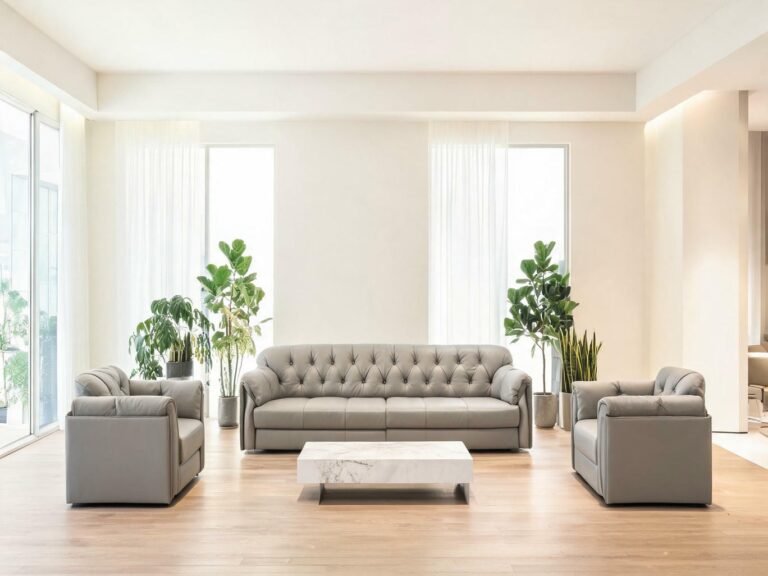
PU leather sofa upholstery — warranty claims peak in humid climates where hydrolysis accelerates failure
The trend we’re tracking across our factory production lines confirms this shift. B2B clients in hospitality, automotive, and healthcare are specifying silicone leather not because of sustainability mandates alone — they’re making the switch because the 10-year TCO calculation finally makes the premium material cheaper than “durable PU” that needs replacing twice in the same period.
The 10-Year TCO Shift: Why Brands Are Moving On
The total cost of ownership math has shifted. A decade ago, the price gap between PU and silicone leather was wide enough that replacement cycles were an acceptable tradeoff. Today, with silicone production capacity scaling and PU replacement costs climbing, the gap has narrowed to the point where the most durable leather option is also the most cost-effective over a 10-year horizon.
Consider the full picture for a 500-seat hotel renovation. Standard PU at $25/m² with 2.3 replacements per decade, plus labor, downtime, and disposal: approximately $200,000 over 10 years. Silicone leather at $35/m² with zero replacements: approximately $87,500. The premium material saves 56% over the lifecycle — and that’s before accounting for the brand equity value of never having guests sit on peeling upholstery.
The faux leather durability testing results we publish aren’t theoretical. They’re the data behind a procurement trend that’s reshaping how B2B brands spec interior materials. The brands still specifying “durable PU” without checking the Martindale count, coating thickness, and hydrolysis data are the ones that will be processing warranty claims in 2028.
About TOPSUN
TOPSUN produces silicone leather engineered for 10+ year service life in high-traffic B2B applications where warranty exposure and brand reputation are non-negotiable.
Our materials test to 200,000+ Martindale cycles, survive 14+ weeks of ASTM D3690 accelerated aging without delamination, and carry ISO 10993 biocompatibility and REACH compliance — durability specifications that eliminate the replacement cycles driving PU leather’s hidden costs.
The Bottom Line on Durable PU
Durable PU leather is not a myth — premium formulations genuinely outperform budget synthetics. But the durability ceiling is real, and it’s set by ester hydrolysis, not by marketing language. When 85% of failures trace to a mechanism that PU cannot fully resist, the question isn’t whether your PU is “durable enough.” The question is whether your product lifecycle fits within PU’s 2-to-6-year window — or whether your brand can afford to keep replacing it.
The brands making the shift to silicone leather aren’t doing it for sustainability optics. They’re doing it because the 10-year math works — and because every replacement cycle they eliminate is a customer they don’t lose to visible product failure.