In 2025, Chinese leather exports worth USD 230 million were rejected or returned at EU borders due to REACH violations. SGS tested 862 batches of leather shoe uppers exported to the EU — 11.3% failed, primarily due to hexavalent chromium exceeding the 3 mg/kg limit or missing SVHC declarations. The European Chemicals Agency’s SVHC Candidate List now contains 247 substances as of May 2025, updated biannually. For B2B buyers sourcing leather for EU-bound products, REACH compliance isn’t a checkbox — it’s a 247-substance gatekeeper that determines whether your shipment clears customs or gets destroyed at your expense.

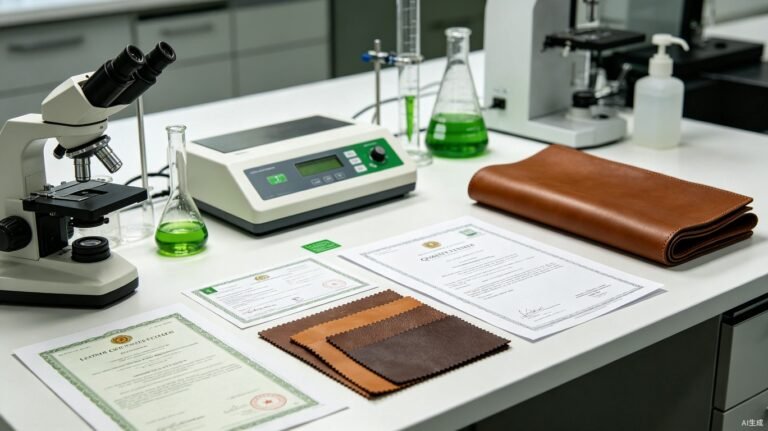
Quality inspection — every leather batch bound for the EU must pass REACH substance screening
What REACH Compliance Means for Leather: The 247-Substance Reality
REACH (EC 1907/2006) is the European Union’s chemical regulation framework, in force since June 2007. It covers all chemical substances — including those present in finished “articles” such as leather goods, furniture, automotive interiors, and footwear. Under REACH Article 33, if any SVHC exceeds 0.1% weight-by-weight in an article, the supplier must provide safe-use information to professional recipients and respond to consumer information requests within 45 days. Since January 2021, the SCIP database requires EU suppliers to submit notifications for articles containing SVHCs above the 0.1% threshold.
For leather specifically, REACH compliance operates on two levels: the leather certification standards for SVHC declaration (Candidate List) and the Annex XVII restriction list, which sets hard limits on specific substances. The critical distinction — often misunderstood — is that “REACH compliant” and “SVHC free” are not synonyms. A material can contain an SVHC below the 0.1% threshold and still be REACH compliant. Conversely, a material can be SVHC-free but violate an Annex XVII restriction on a non-SVHC substance.
Annex XVII Leather Restrictions: Chromium VI, DMF, and PFHxA
REACH Annex XVII contains 77 restriction entries, several directly targeting leather and synthetic leather materials. These are the restrictions that cause the most customs rejections:
| Substance | Annex XVII Entry | Leather Limit | Test Method |
|---|---|---|---|
| Chromium VI (Cr VI) | Entry 47 | ≤3 mg/kg | EN ISO 17075-2:2017 |
| Azo dyes (aromatic amines) | Entry 43 | 30 mg/kg | EN ISO 17234-1:2024 |
| Organotin compounds | Entry 20 | 1,000 mg/kg | SATRA TM277:2023 |
| PFHxA (PFAS) | Entry 79 | 25 µg/kg | EN ISO 23702-1:2023 |
| Phthalates (DEHP/DBP/BBP/DIBP) | Entries 51 & 52 | <0.1% sum | EN 14372 / CPSC-CH-C1001 |
| Cadmium | Entry 23 | 100 mg/kg | EN 1122 |
Sources: SATRA Annex XVII analysis; chinahandbagfactory REACH compliance guide. Note: PFHxA restriction (Entry 79) takes effect October 10, 2026.
The October 2026 PFHxA enforcement date is particularly critical for synthetic leather buyers. PFAS (per- and polyfluoroalkyl substances) have been used in some synthetic leather coatings for water repellency and stain resistance. The new 25 µg/kg limit means any leather using fluoropolymer treatments must be reformulated before that date or risk border rejection. For sustainable fabric certifications like OEKO-TEX, the alignment between REACH restrictions and certification standards creates a dual-compliance pathway that simplifies sourcing.

Fabric inspection area — every batch must be screened against the 247-substance SVHC list before EU shipment
The Cost of Non-Compliance: €85K Per Rejected Shipment
REACH non-compliance is not a theoretical risk — it’s a measurable cost center with quantifiable financial impact. The compliance burden for a typical leather goods brand includes:
| Cost Category | Amount | Frequency |
|---|---|---|
| Basic REACH test package (5 substances) | €200–400 | Per material/SKU |
| Standard handbag panel (15–20 substances) | €600–1,200 | Per material/SKU |
| Comprehensive SVHC screening | €1,500–2,000 | Per material/SKU |
| 20-SKU annual testing program | €15,000–30,000/year | Annual |
The cost of failure is orders of magnitude higher:
| Penalty Type | Cost |
|---|---|
| Customs rejection per shipment | €18,000–85,000 |
| Retrospective testing per product line | €12,000–30,000 |
| SVHC non-declaration fine | €10,000–50,000 |
| Annex XVII violation | €50,000–500,000 |
| Repeat offenses | Up to €2 million |
Sources: chinahandbagfactory compliance guide; SATRA REACH analysis.
A single customs rejection can wipe out the entire annual compliance testing budget — and that’s before factoring in brand reputation damage, which studies show causes an average 23% order reduction following a public REACH violation. The OEKO-TEX leather certification framework provides an additional compliance layer, but the fundamental risk is determined by the material itself.

Quality inspection at a Chinese leather manufacturer — the front line of EU REACH compliance
Silicone Leather: Inherently REACH-Compliant by Design
The most effective REACH compliance strategy is eliminating restricted substances at the material level rather than testing for them after production. Silicone leather achieves this through fundamental chemistry: its Si-O polymer backbone does not require DMF as a solvent, does not use phthalate plasticizers, does not involve chromium tanning, and does not contain PFAS coatings. The production process is solvent-free and zero-VOC, meaning there are no chemical residues to test for — because they were never present.
For comparison, here’s how three leather material types compare on REACH risk factors:
| REACH Risk Factor | Chrome-Tanned Leather | PU Synthetic Leather | Silicone Leather |
|---|---|---|---|
| Chromium VI risk | High (tanning residue) | Low | None (no chromium) |
| DMF / DMFa residue | Low | High (solvent residue) | None (solvent-free) |
| Phthalate content | Low | High (plasticizers) | None (phthalate-free) |
| PFAS (PFHxA) | Variable (treatments) | Possible (coatings) | None (no PFAS used) |
| Formaldehyde | Possible (tanning) | Possible (binders) | None (formaldehyde-free) |
| VOC emissions | Moderate | Contains solvents | Zero VOC |
The table shows why automotive silicone leather has become the preferred material for EU-bound vehicle interiors. Silicone leather doesn’t just pass REACH — it structurally eliminates the compliance risk by removing restricted substances from the manufacturing process entirely. This reduces testing costs, simplifies SVHC declarations, and eliminates the SCIP notification requirement for most product categories.

Quality and safety compliance banner — REACH compliance starts on the factory floor, not at the testing lab
6-Step REACH Compliance Verification Protocol for Leather Buyers
- Request the current SVHC Candidate List version: The list updates biannually. Confirm your supplier’s test report references the correct version (January or July of the current year) and covers all 247 substances.
- Demand article-specific test reports: Generic “REACH compliant” certificates are insufficient. Require reports that identify the exact article, material composition, color, and coating — not a blanket statement covering the entire product line.
- Verify Annex XVII compliance separately: SVHC testing does not cover Annex XVII restrictions. Request specific test data for chromium VI (EN ISO 17075-2), azo dyes (EN ISO 17234-1), and phthalates (EN 14372).
- Confirm ISO/IEC 17025 laboratory accreditation: Test reports from non-accredited labs carry no regulatory weight. Verify SGS, Intertek, TUV, or SATRA accreditation on the report header.
- Check the PFHxA deadline (October 2026): If your leather uses any fluoropolymer treatments, confirm compliance with the new 25 µg/kg PFHxA limit before the enforcement date. Reformulation takes 3–6 months.
- Request SCIP registration confirmation: If any SVHC exceeds 0.1% w/w, your supplier must have submitted SCIP notifications. Ask for the SCIP reference number as proof of compliance.
About TOPSUN: TOPSUN manufactures silicone leather that is inherently REACH-compliant (EC 1907/2006) through solvent-free, zero-VOC production. TOPSUN’s silicone leather contains no chromium, no DMF, no phthalates, no formaldehyde, and no PFAS — eliminating REACH compliance risk at the material level rather than managing it through testing. Full compliance dossiers (REACH, RoHS, PAHs, FDA, ISO 10993-5) available on request. Free A4 swatches shipped worldwide via DHL/FedEx — contact info@topsunsiliconeleather.com or WhatsApp +44 744 461 7933.
Export certification overview — how TOPSUN’s silicone leather eliminates REACH compliance risk by design