A 28-liter full-grain leather backpack weighs over 4 kilograms empty — nearly 2.5 times the weight of an equivalent nylon pack. For luggage brands, that weight penalty doesn’t just annoy travelers — it inflates shipping costs, triggers airline overweight surcharges, and erodes the premium positioning that leather is supposed to deliver. The global suitcases market reached USD 25.1 billion in 2025, with soft-case leather luggage holding 44.3% share. Yet most brands still specify genuine leather without calculating the total cost of ownership — material weight, abrasion replacement cycles, and hydrolysis-driven warranty claims. Here’s a data-driven breakdown of four luggage leather materials that reveals where the real costs hide.

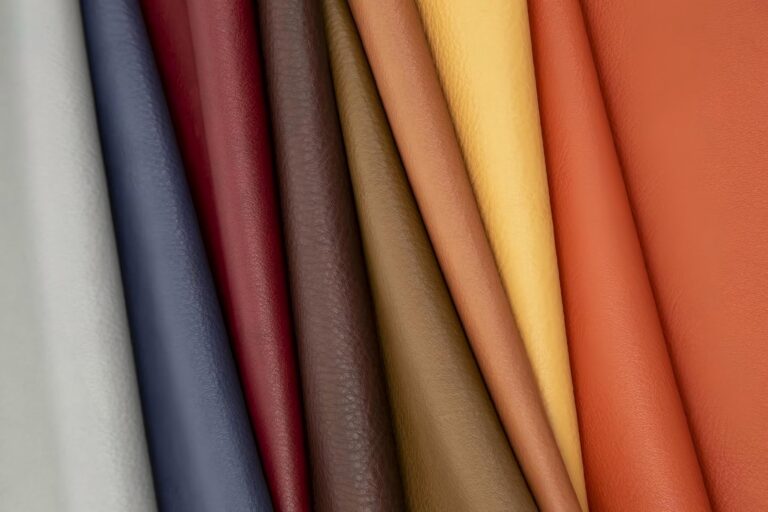
Layered leather swatches — the material foundation of luggage shell construction
The Weight Penalty: When Leather Luggage Costs More to Ship Than to Make
Full-grain leather constitutes only 12% of global hide production, which is why it commands a 30–50% price premium over synthetic alternatives. But the material cost is only the tip of the iceberg. A standard 22-inch leather suitcase shell uses approximately 1.2 square meters of 1.2–1.4 mm thick leather. At 1.1 g/cm³ density, that’s roughly 1.3 kg of leather alone — before lining, hardware, wheels, and telescopic handles push the total past 4.5 kg. Compare that to a synthetic-leather equivalent at 0.6 g/cm³ density: the same shell weighs under 700 grams.
For D2C brands shipping from Asian factories to Western markets, that 3 kg difference per unit translates to roughly $2.50–$4.00 in excess air freight per suitcase. At 10,000 units per quarter, the weight penalty alone costs $100,000–$160,000 annually — money that could fund a premium artificial leather fabric upgrade with superior durability and still save on logistics.

Kraft-paper wrapped rolls — logistics weight directly impacts per-unit freight cost
4 Luggage Leather Materials Ranked by Abrasion and Tensile Strength
Luggage endures more abuse than almost any other leather application — baggage handler impacts, conveyor belt abrasion, overhead bin compression, and repeated zip-axis flexing. Thestandard material selection criteria for suitcase exteriors prioritize abrasion resistance, tear strength, and flex endurance. Here’s how four materials compare on the metrics that determine warranty rates:
| Material | Martindale Abrasion | Tensile Strength | Weight (g/m²) | Hydrolysis | 5-Yr TCO/m² |
|---|---|---|---|---|---|
| Genuine (Top-Grain) | ≥30,000 cycles | ≥25 N/mm² | 800–1,100 | Moderate | $28–42 |
| Microfiber Synthetic | ≥50,000 cycles | ≥18 N/mm² | 400–600 | Good | $14–22 |
| PU Leather | ≥10,000 cycles | ≥10 N/mm² | 300–450 | Poor (degrades) | $18–30* |
| Silicone Leather | ≥200,000 cycles | ≥10–15 N/mm² | 200–800 | Excellent | $12–18 |
*PU leather TCO includes replacement cost from hydrolysis failure at 3–5 years. Sources: CLK Luggage material specifications; TOPSUN laboratory testing data.
The data reveals a counterintuitive pattern: genuine leather’s 30,000-cycle Martindale threshold — while adequate for furniture — is marginal for luggage, where conveyor-belt abrasion exceeds 50,000 rub cycles in a single year of regular travel. Microfiber synthetic doubles that to 50,000 cycles, but its hydrolysis resistance degrades in humid climates. PU leather’s 10,000-cycle rating means visible surface wear within 12–18 months — unacceptable for any brand positioning itself as premium. Understanding leather grade differences is the first step; matching them to luggage’s specific abuse profile is what separates brands that last from those that recall.

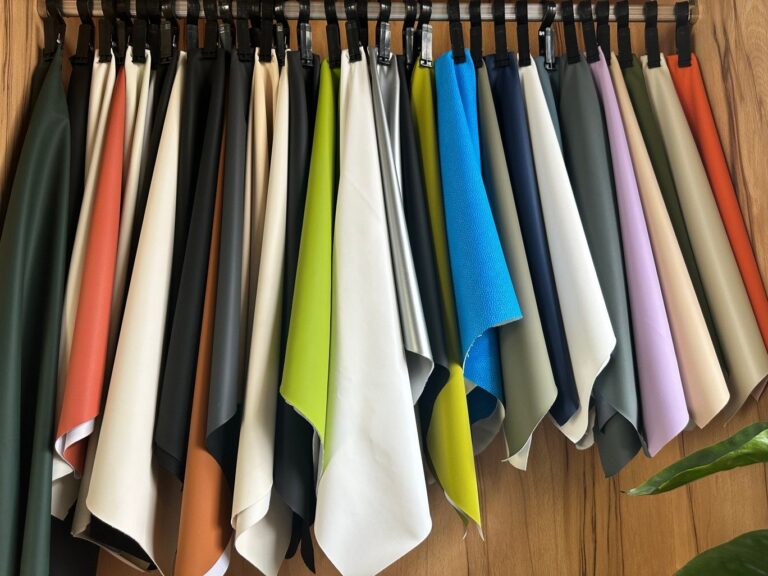
Synthetic vs genuine leather — visual comparison reveals minimal aesthetic difference at travel distance
Hydrolysis and Weather Resistance: The Hidden Luggage Killer
Luggage encounters more environmental extremes than furniture, automotive interiors, or fashion accessories combined. A single international trip can expose a suitcase to 40°C cabin heat, -20°C cargo-hold temperatures, tropical humidity, and salt-spray coastal air. PU leather begins hydrolytic degradation at 60% relative humidity — meaning that monsoon-season transit through Southeast Asia or storage in a humid warehouse accelerates the molecular breakdown of the polyurethane coating. Within 18–36 months, the surface develops micro-cracks, followed by peeling and delamination.
Genuine leather resists hydrolysis better but absorbs moisture — causing dimensional swelling, warping of structured shells, and mildew in unventilated storage. Silicone leather’s cross-linked polymer structure is inherently hydrolysis-proof: it does not absorb water, does not swell, and maintains dimensional stability from -40°C to 250°C. For brands selling into markets with variable climate conditions, the durability of faux leather materials under weather exposure is the single strongest predictor of warranty claim rates.
Silicone Leather for Luggage: Where Weight Meets Durability
Silicone leather resolves the weight-versus-durability paradox that has plagued luggage material selection for decades. At 200–800 g/m² — adjustable by substrate selection — it delivers the leather aesthetic and tactile experience that premium travelers expect, while weighing less than half of genuine leather. The 200,000+ Martindale abrasion rating means a silicone-leather suitcase exterior will outlast the luggage frame, wheels, and telescopic handle — the typical failure points that determine actual product lifespan.
From a manufacturing perspective, silicone leather’s solvent-free dry coating process eliminates DMF residue — a critical compliance factor for luggage exported to EU markets under REACH regulations. The material is inherently flame-retardant (EN 13773 Class 4), which matters for air-travel compatibility and cost comparison models that factor in certification testing. For brands evaluating the total cost equation — material, weight, shipping, certification, warranty, and replacement — silicone leather consistently delivers the lowest 5-year TCO.

Finished silicone leather rolls in warehouse — ready for luggage shell production
6-Point Sourcing Checklist for Luggage Leather Material
Before finalizing your luggage leather material specification, verify these six data points with your supplier — not as marketing claims, but as laboratory test reports from accredited bodies (SGS, Intertek, or equivalent):
- Martindale abrasion certificate (ISO 12947-2): Require the actual test report, not a spec sheet. Anything below 50,000 cycles will show visible wear within one travel season.
- Hydrolysis resistance data (ISO 11507): Request 4-week accelerated hydrolysis test results. PU leather that passes a 1-week test may still fail in real-world tropical conditions.
- Flex resistance cycles (ISO 5402): Luggage zippers, hinges, and corner radii create concentrated flex stress. Demand 50,000+ cycle ratings minimum.
- Weight per square meter: Calculate your shell’s total leather weight and compare it against air-freight cost impact. A 300 g/m² reduction across a 10,000-unit order can save $75,000+ in shipping alone.
- REACH and DMF compliance: EU-bound luggage must meet REACH SVHC thresholds and be DMF-free. Request the full chemical compliance dossier, not a summary certificate.
- Batch-to-batch color consistency (Delta E): Luggage lines run across multiple seasons. Require Delta E ≤ 1.0 to avoid visible color mismatch between production runs.
About TOPSUN: TOPSUN manufactures silicone leather engineered for luggage and travel-goods applications, combining genuine-leather aesthetics with synthetic-leather weight advantages. With 200,000+ Martindale abrasion cycles, -40°C to 250°C temperature stability, and zero-VOC solvent-free production, TOPSUN’s silicone leather delivers the lowest 5-year TCO for luggage shell construction. Free A4 swatches shipped worldwide via DHL/FedEx — contact info@topsunsiliconeleather.com or WhatsApp +44 744 461 7933.
How silicone leather reduces luggage production costs — without cutting quality