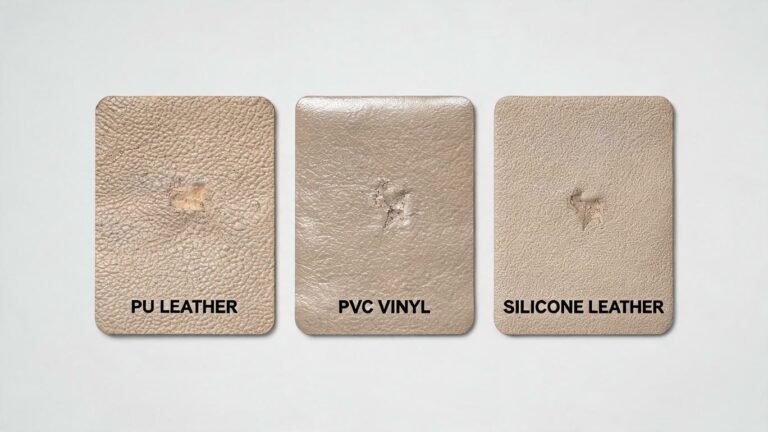
PVC imitation leather seems like the cheapest option on the quote sheet — until plasticizers migrate at month 18, the surface hardens, and the material starts cracking across your product line. That’s not a quality defect. It’s the chemistry. PVC leather depends on phthalate plasticizers to stay flexible, and those plasticizers are exactly what REACH Annex XVII, CPSIA, and California Proposition 65 are restricting in 2026. Industry testing shows standard PVC automotive trim begins cracking after 12–18 months in high-temperature climates. For procurement teams, the real cost of PVC imitation leather isn’t the unit price — it’s the replacement cycle and the compliance exposure that comes with it.
Request Free Compliance Comparison Samples
| Property | PVC Imitation Leather | Silicone Leather | PU Leather |
|---|---|---|---|
| Service Life | 2–3 years | 10+ years | 3–5 years |
| Temperature Range | -10°C to 60°C | -40°C to 250°C | -20°C to 80°C |
| UV Resistance | Poor, cracks in 1–2 years | Excellent, no cracking | Poor, cracks in 1–2 years |
| VOC Emission | Contains plasticizers | Zero / Near-zero | Contains solvents |
| Flame Retardancy | Flammable, toxic smoke | Self-extinguishing, Class 4 | Flammable |
| Recyclable | No (chlorine content) | Yes | Limited |
What PVC Imitation Leather Actually Contains
PVC imitation leather is manufactured by coating a fabric backing — typically polyester or cotton — with a plastisol of polyvinyl chloride resin, plasticizers, stabilizers, and pigments. The plasticizers, historically ortho-phthalates such as DEHP and DINP, are what give the material its leather-like flexibility. Without them, PVC is rigid and brittle. Stabilizers prevent thermal degradation during processing and often include lead-based compounds, which carry their own restrictions under RoHS and REACH.
This composition creates two structural problems for B2B sourcing. First, plasticizers are not chemically bound to the PVC matrix — they migrate over time, accelerated by heat, UV exposure, and mechanical flexing. As plasticizers leave, the material hardens, shrinks, and cracks. Second, the chlorine in PVC means that when the material is overheated or incinerated at end-of-life, it releases hydrochloric acid and potentially dioxins — a concern for brands with ESG commitments and manufacturers subject to EU waste regulations.
The 3 Compliance Gaps B2B Buyers Miss
Most procurement teams evaluate PVC imitation leather on price and aesthetics. Compliance documentation arrives as a certificate — and that’s where the gap hides. Here are the three compliance risks that surface after the PO is signed:
| Compliance Gap | What Happens in Production | Regulation at Risk | B2B Impact |
|---|---|---|---|
| Phthalate migration | DEHP/DINP leaches out over 18–36 months; material hardens and cracks | REACH Annex XVII, CPSIA, Prop 65 | Product recall risk; warranty claims; customs hold |
| Lead stabilizers | Lead-based heat stabilizers still used in budget PVC formulations | RoHS, REACH SVHC | Fails EU import testing; brand reputation damage |
| Dioxin at end-of-life | PVC incineration releases HCl and chlorinated dioxins | EU Waste Framework Directive | Fails ESG reporting; circular economy incompatibility |
A single compliance certificate from the factory doesn’t cover any of these. What it covers is a snapshot of the sample you approved — not the production lot that ships 6 months later. For a deeper look at how PVC compares to other synthetic leather types, see our PU vs PVC leather comparison.
Phthalate-Free PVC: Does It Actually Solve the Problem?
Some suppliers now offer “phthalate-free” PVC leather, substituting DEHP and DINP with alternative plasticizers like DOTP (dioctyl terephthalate) or DINCH (1,2-cyclohexane dicarboxylic acid diisononyl ester). These alternatives do pass REACH and CPSIA testing at the time of production. But they don’t solve the fundamental problem: plasticizer migration still occurs.
DOTP and DINCH are still physically mixed into the PVC matrix — not chemically bonded. They migrate at a slower rate than ortho-phthalates, extending the service life from roughly 2 years to perhaps 3–4 years. But the end state is identical: the material hardens, loses flexibility, and cracks. The compliance certificate is cleaner, but the product failure timeline just gets longer, not eliminated. For buyers evaluating PVC-free faux leather alternatives, the question isn’t which plasticizer is used — it’s whether the material relies on plasticizers at all.
PVC vs Silicone Leather: 5-Year TCO Comparison
The unit price of PVC imitation leather typically runs $2–4 per meter. Silicone leather runs higher — but the TCO math changes when you account for replacement cycles, warranty claims, and disposal costs. Here’s the 5-year cost reality for a 10,000-meter furniture upholstery order:
| Cost Factor (5-Year Horizon) | PVC Imitation Leather | Silicone Leather |
|---|---|---|
| Initial material cost (10K m) | $20K–40K | $50K–80K |
| Replacement cycles in 5 years | 2 replacements (cracks at 18–24 months) | 0 replacements (10+ year life) |
| Reupholstering labor cost | $40K–60K per cycle | $0 |
| Warranty claim risk | High (phthalate migration failures) | Low (zero VOC, no migration) |
| Disposal / ESG cost | Non-recyclable, dioxin risk | 100% recyclable |
| 5-Year Total Cost | $100K–160K | $50K–80K |
The PVC quote wins on day one. By year three, the replacement labor alone has exceeded the entire silicone leather investment. For a full breakdown across PU, PVC, and silicone, see our technical material comparison guide.
The 2026 Sourcing Decision: Replace or Risk?
The regulatory window is narrowing. REACH Annex XVII restricts DEHP, DBP, and BBP to concentrations below 0.1% in articles — and the 2025 update added DINP to the candidate list of Substances of Very High Concern. California Proposition 65 requires warning labels for products containing listed phthalates, with no safe harbor for DINP. For children’s products, CPSIA sets a total phthalate content limit of 0.1% — making PVC leather effectively unusable in toys, baby products, and child-accessible furniture.
For B2B buyers, the decision framework is straightforward. If your product has a warranty under 2 years and no skin-contact or child-access requirements, PVC may still pass compliance — at the cost of replacement cycles. If your product has a warranty over 3 years, serves automotive interiors, healthcare environments, or any application involving direct skin contact, the compliance math favors a migration away from PVC entirely. TOPSUN manufactures phthalate-free, zero-VOC silicone leather that eliminates plasticizer migration as a failure mechanism — no plasticizers means no migration, no hardening, and no REACH exposure. Our material passes ISO 10993-5 biocompatibility testing, FDA 21 CFR 177.2600 food-contact compliance, and EN 13773 Class 4 flame retardancy — certifications PVC leather cannot achieve.
The 2026 sourcing question isn’t whether PVC imitation leather is cheap. It’s whether your compliance documentation, warranty program, and ESG reporting can survive the replacement cycle. For most B2B categories, the answer is already no.
About TOPSUN: TOPSUN is a B2B silicone leather manufacturer headquartered in Dongguan, Guangdong, with production facilities spanning 60,000+ m² and a monthly capacity of 500,000+ meters. The company supplies PVC-free, phthalate-free silicone leather to automotive, furniture, medical, marine, and 3C electronics brands across 100+ partners. All materials are REACH-compliant, RoHS-compliant, and certified by SGS and Intertek. Free A4 swatch samples ship worldwide via DHL/FedEx.
Decision Summary
| If Your Product… | PVC Risk Level | Recommended Material |
|---|---|---|
| Warranty under 2 years, no skin contact | Moderate | PVC or PU (short lifecycle acceptable) |
| Automotive interior, 3+ year warranty | High | Silicone leather |
| Healthcare / medical equipment | Prohibited | Silicone leather (ISO 10993-5) |
| Children’s products / baby items | Prohibited (CPSIA) | Silicone leather (EN 71) |
| Furniture upholstery, 5+ year warranty | High | Silicone leather |
Get a Custom Compliance Spec Sheet