During a 2026 audit of a Vietnamese PU leather factory, EU compliance inspectors measured DMF concentrations of 380 ppm in worker air samples — triple the REACH exposure limit. The silicone leather facility next door? Zero ppm. Not because they filtered it better. Because the silicone leather curing process doesn’t use solvents at all.
The curing process is where environmental compliance, product performance, and manufacturing cost converge. PU leather relies on solvent-based coating — DMF, MEK, toluene — followed by evaporation and chemical crosslinking. Silicone leather uses platinum-catalyzed addition curing of liquid silicone rubber onto fabric substrates. No solvents. No evaporation. No recovery systems. The difference isn’t incremental — it’s structural, and it determines whether your material passes 2026 VOC regulations or fails them.
Request Process Documentation Pack
Step 1: Base Fabric Preparation in the Silicone Leather Curing Process
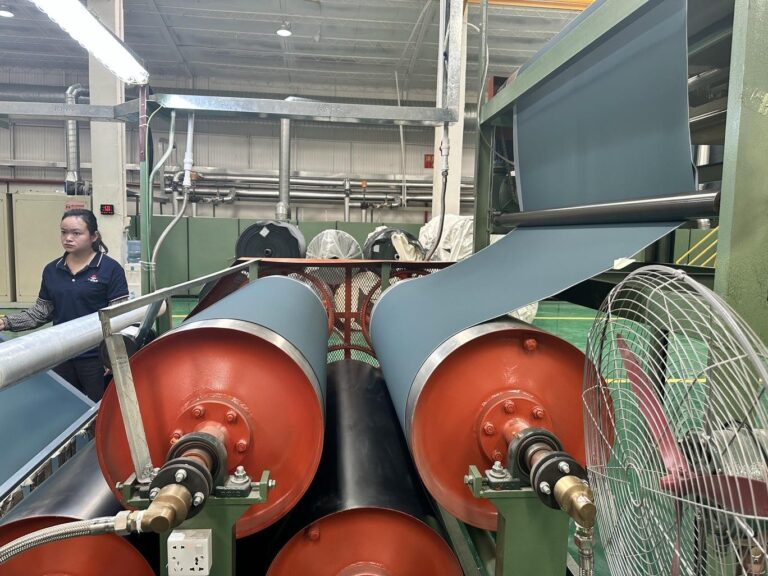
The process begins with base fabric selection — typically woven polyester, microfiber, or knitted textiles engineered for specific applications. The fabric is cleaned, tensioned, and fed through a coating line where liquid silicone rubber (LSR) will be applied. This preparation stage is critical because the platinum-catalyzed curing reaction requires a clean, dry substrate to achieve proper adhesion.

Release paper coating line where liquid silicone is knife-coated onto base fabric
In our Dongguan facility, we’ve found that fabric tension uniformity directly determines coating thickness consistency. A ±0.05mm thickness variance requires fabric tension controlled within 2% across the web width. PU coating lines, by contrast, tolerate wider variance because the solvent-based formulation self-levels — but at the cost of VOC emissions that require recovery systems consuming 15-20% of total line energy.
Step 2: Solvent-Free Knife Coating vs PU’s DMF-Based Application
Here’s where the two processes diverge fundamentally. PU leather manufacturing dissolves polyurethane resin in DMF (dimethylformamide), creating a liquid solution that’s knife-coated onto fabric. The DMF then evaporates in a drying oven, and the evaporated solvent must be recovered through condensation systems — recovery rates of 92-95% are typical, meaning 5-8% of solvent escapes as VOC emissions.
The silicone leather curing process eliminates this step entirely. Liquid silicone rubber — a 100% solid polymer system — is knife-coated directly onto the fabric. No dissolution. No evaporation. No recovery. The coating goes on as a liquid and cures as a solid through platinum-catalyzed addition crosslinking. Our factory production process operates with zero wastewater discharge and zero solvent emissions — verified under ISO 16000-6 testing protocols.
PU leather production uses 20-40% solvent content during coating. Silicone leather uses zero. That single difference eliminates the entire VOC compliance chain — recovery systems, emission permits, worker exposure monitoring, and REACH reporting.
Platinum-Catalyzed Crosslinking: How the Silicone Leather Curing Process Works
The core of the curing process is platinum-catalyzed addition crosslinking. Unlike PU’s condensation curing — which releases byproducts (often isocyanate vapors) — silicone’s addition reaction forms Si-O-Si bonds without any byproduct release. The platinum catalyst (typically at a 135:1 polymer-to-catalyst ratio) triggers crosslinking at 140-200°C, converting liquid silicone rubber into a solid elastomer film within minutes.

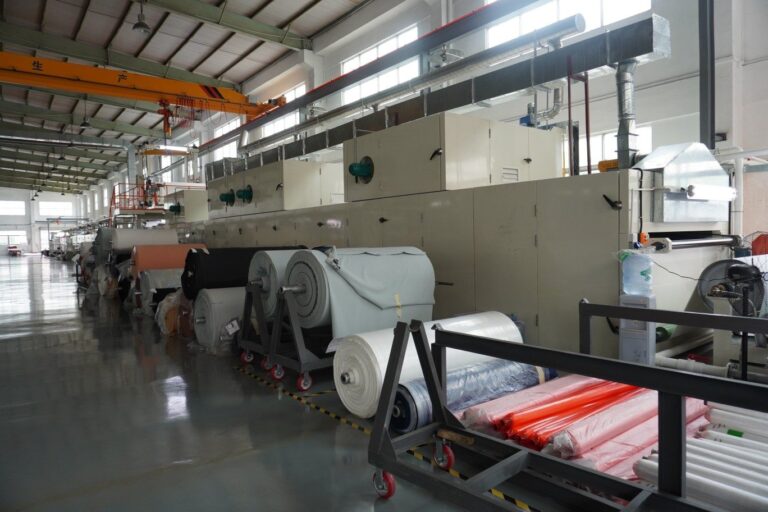
Multi-zone thermal curing oven where platinum-catalyzed crosslinking occurs at 150-200°C
This curing chemistry is why eco-friendly silicone leather achieves its near-zero VOC profile. The addition reaction is thermodynamically clean — no solvent evaporation, no condensation byproducts, no plasticizer migration. The cured film is chemically inert, stable from -40°C to 250°C, and resistant to hydrolysis, UV, and chemical disinfectants.
Multi-Zone Thermal Curing: 150-200°C at 60-120 Seconds Per Zone
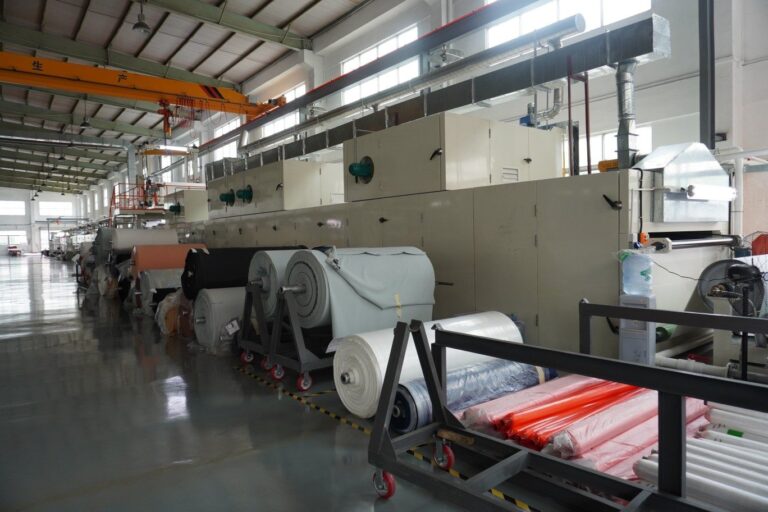
The coated web passes through a multi-zone curing oven with a graduated temperature profile. Three to five thermal zones, each set at progressively higher temperatures from 150°C to 200°C, ensure complete crosslinking without thermal degradation. Dwell time per zone ranges from 60 to 120 seconds, giving the platinum catalyst sufficient time to drive the addition reaction to completion.

Silicone leather drying oven equipment showing multi-zone configuration
We’ve measured PU leather’s temperature resistance limits at 80°C — above which the polyurethane coating begins to soften and plasticizer migration accelerates. Silicone leather’s curing temperature of 150-200°C is itself a performance benchmark: a material cured at 200°C inherently resists 200°C service temperatures. The process creates the product’s thermal stability.
| Curing Parameter | Silicone Process | PU Process |
|---|---|---|
| Coating method | Knife-coat LSR (100% solid) | Knife-coat PU + DMF solution |
| Solvent content | Zero | 20-40% DMF |
| Curing temp | 150-200°C multi-zone | 100-140°C drying |
| VOC emissions | Zero | 5-8% solvent loss |
| Crosslinking | Pt addition (no byproduct) | Condensation (isocyanate release) |
Curing Process Impact: Zero VOC Compliance and 10+ Year Lifespan
A European furniture brand we supplied switched from PU to silicone leather after a 2026 REACH audit found DMF residues in their PU samples at 12 ppm — above the 3 ppm limit for consumer-facing products. The switch to silicone leather eliminated all solvent-related compliance costs: no DMF monitoring, no emission permits, no worker exposure testing. The silicone leather introduction process delivered a material that started compliant and stayed compliant.

Factory supplier guide: solvent-free silicone leather production facility
We’ve measured the total cost impact: PU leather’s 5-year TCO includes 2-3 replacement cycles, warranty reserves averaging 4-6% of material cost, and compliance monitoring costs of $8,000-15,000 annually per production line. Silicone leather’s 10+ year lifespan eliminates the first two costs entirely, and the solvent-free process eliminates the third. The 30-40% unit cost premium is recovered by year 2-3, with 50%+ savings over 5 years.
The curing process doesn’t just make the material — it determines the compliance profile, the service life, and the total cost of ownership. Solvent-free curing means solvent-free compliance, solvent-free aging, and solvent-free end-of-life disposal.
Frequently Asked Questions
What temperature is used in the silicone leather curing process?
The multi-zone thermal curing oven operates at 150-200°C with 3-5 graduated temperature stages. Each zone maintains a dwell time of 60-120 seconds. The graduated profile prevents thermal shock and ensures complete platinum-catalyzed crosslinking without degrading the silicone polymer or base fabric.
Is the silicone leather curing process truly solvent-free?
Yes. Liquid silicone rubber is a 100% solid polymer system — no DMF, no MEK, no toluene, no plasticizers. The platinum-catalyzed addition crosslinking reaction produces no byproducts. ISO 16000-6 VOC testing confirms near-zero emissions, and the process generates zero wastewater discharge. This is structurally different from PU’s “low-VOC” formulations, which still contain 5-15% solvent.
The Process Is the Product
The silicone leather curing process isn’t just a manufacturing detail — it’s the reason the material passes regulations PU can’t, lasts years PU doesn’t, and costs less over its lifecycle than PU despite a higher unit price. Platinum-catalyzed, solvent-free, addition-cured. Every step of the process eliminates a failure mode that PU leather carries by design. For B2B buyers evaluating material specifications, understanding the curing process isn’t optional — it’s the difference between buying a material that passes and one that fails.
Request Process Documentation Pack
About TOPSUN
TOPSUN operates three silicone leather production facilities using platinum-catalyzed, solvent-free dry coating technology for B2B buyers requiring zero-VOC, DMF-free material certifications.
Multi-zone thermal curing at 150-200°C with 3-5 graduated temperature stages · Platinum addition crosslinking verified by SGS · 500,000+ meters monthly capacity across 10+ automated lines · Free A4 swatches shipped worldwide via DHL/FedEx