If you run a hospital, hotel, restaurant, or any high-traffic facility with leather upholstery, you know exactly how much time and money goes into cleaning. Coffee spills on lobby seating, makeup on guest room headboards, food stains on restaurant booths, body oils on waiting room chairs — the list never ends. Self cleaning leather promises to change that, but the technology behind the label matters more than the marketing claim.
After working with dozens of facility managers who tested various “stain-resistant” and “self-cleaning” leather products, I can tell you that not all of them deliver on the promise. Some coatings wear off after a few months of regular cleaning. Others only work on specific types of stains. And a few actually do what they say — keeping surfaces clean with nothing more than a quick wipe. In this guide, I break down the five main self-cleaning leather technologies, how they work, and which ones are worth paying for.
Request Stain-Resistant Leather Samples

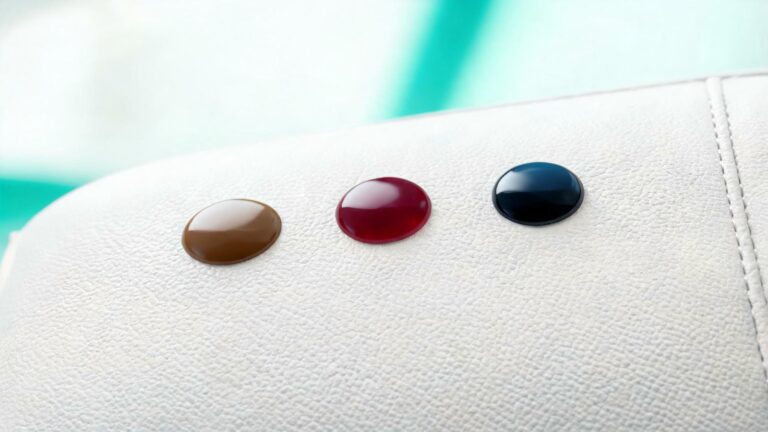
Water beading on a self-cleaning leather surface — the first sign of effective stain resistance
What Self-Cleaning Leather Actually Means
Let me start with a reality check. When a product says “self-cleaning,” it does not mean the material cleans itself while you sleep. In practical terms, self-cleaning leather means a surface that prevents stains from setting in, repels liquids, and can be wiped clean with just water — no special cleaners, scrubbing, or treatment products required. For a facility manager, that translates into less time spent cleaning, fewer cleaning chemicals to purchase, and longer material lifespan.
There are two main mechanisms at work in self-cleaning surfaces. The first is hydrophobicity — water-repellent properties that cause liquids to bead up and roll off the surface instead of soaking in. The second is oleophobicity — oil-repellent properties that prevent oil-based stains (food grease, body oils, makeup) from adhering to the surface. The best self-cleaning materials do both. Materials that are only water-repellent will still stain from coffee with cream, salad dressing, or skin oils — which is why you need to look at both properties when evaluating options.
Facility Manager Tip: Always test with real-world stains, not just water. A material that repels water but absorbs oil-based liquids is not truly self-cleaning — and oil-based stains (food, makeup, body oils) are the ones you deal with most often.
5 Self-Cleaning Leather Technologies Compared
Here are the five main technologies you will encounter when evaluating self-cleaning leather products, ranked from least to most durable in real-world commercial use.
| Technology | How It Works | Durability | Best For |
|---|---|---|---|
| Topical Spray Coatings | Silicone or fluoropolymer spray applied after manufacturing | Low — wears off in 3–6 months | Residential, low-use items |
| Photocatalytic TiO₂ | Titanium dioxide breaks down organic stains under UV light | Moderate — needs light to work | Outdoor, well-lit areas |
| Nano-Silica Coatings | Nanoparticles create micro-rough hydrophobic surface | Moderate — 1–2 years with care | Automotive interiors, furniture |
| Silver Ion Antimicrobial | Silver ions inhibit bacteria growth on surface | Moderate — antimicrobial only, not stain-proof | Healthcare, food service |
| Silicone Polymer Surface | Non-porous silicone material is inherently stain-resistant | Excellent — permanent, no coating to wear off | Healthcare, hospitality, high-traffic commercial |

The beading test — self-cleaning surfaces cause liquids to form tight beads that roll off without leaving residue
Why Coating-Based Solutions Disappoint
Here is the problem with most self-cleaning leather products on the market: they use a coating that is applied on top of the material, rather than building the self-cleaning property into the material itself. Spray-on coatings, nano-silica treatments, and even many factory-applied topcoats are sacrificial — they wear away over time with use, cleaning, and UV exposure.
I have seen this play out many times with hospitality clients. They purchase “stain-resistant” PU leather furniture, and for the first few months, everything looks great — coffee wipes right up, wine spills bead on the surface. But by month six, the protective topcoat starts to wear on the armrests and seat cushions where people make the most contact. By year one, those high-wear areas absorb stains just like regular leather. The “self-cleaning” feature is gone, and you are left with a material that looks uneven — some areas still repel water, others do not.
The pattern is predictable because the mechanism is straightforward. Any surface coating — no matter how durable — will eventually abrade away with friction from clothing, skin, and cleaning. That is why materials that are inherently non-porous, like silicone leather, outperform coated products over time. The self-cleaning property is not a layer on top — it is the material itself.
Silicone Leather: Inherent Self-Cleaning Performance
Silicone leather is different from every other self-cleaning leather option because its stain resistance is not a coating — it is a fundamental property of the silicone polymer. The silicone surface is completely non-porous, meaning there is nowhere for liquids, dirt, or bacteria to sink in. Every stain sits on top of the surface and wipes away with a damp cloth — no special cleaners, no scrubbing, no reapplication of protective sprays.
From a facility operations perspective, this changes the maintenance equation entirely. Here is what our healthcare and hospitality clients typically see after switching to silicone leather:
- 60–70% reduction in cleaning time — a quick wipe replaces deep cleaning and stain treatment
- No specialty cleaners needed — water or isopropyl alcohol works for all cleaning and disinfection
- Zero re-coating or re-treatment costs — the non-porous property does not wear off, ever
- Consistent appearance — no patchy wear patterns from uneven coating degradation
For healthcare facilities, the self-cleaning benefit goes beyond aesthetics. Silicone leather’s non-porous surface also has intrinsic antimicrobial properties — bacteria cannot penetrate or colonize the material the way they can in porous genuine leather or PU. Combined with compatibility for bleach and alcohol disinfectants, this makes it a strong choice for medical and healthcare upholstery where infection control is paramount.

In healthcare settings, self-cleaning antimicrobial leather reduces infection risk and maintenance time
Calculating the Real Cost Savings
When I talk to facility managers about self-cleaning leather, the first question is always about cost — and rightfully so. Materials with self-cleaning properties typically cost more upfront. But the question you should be asking is not “how much more does it cost?” but “how much does it save?”
Let me walk through a real example from a hotel client of ours. They had 200 guest rooms with PU leather headboards and desk chairs. The housekeeping team spent an average of 4 minutes per room treating leather surfaces — wiping, applying cleaner, buffing — during each turnover. At 80% occupancy and 365 days a year, that adds up to roughly 1,945 hours per year just on leather maintenance. At an average housekeeping wage of $18 per hour, that is about $35,000 per year in labor costs alone — not counting cleaning supplies, stain treatment products, and replacement of damaged furniture.
After switching to silicone leather, the same maintenance task takes about 45 seconds per room — a quick wipe with a damp cloth. That brings the annual labor down to around 365 hours, or about $6,570. The savings: roughly $28,000 per year just in housekeeping labor. Add in reduced replacement costs (silicone leather lasts 2–3 times longer than PU) and eliminated cleaning product expenses, and the material pays for itself quickly. For a more detailed breakdown, see our cleaning and maintenance guide with side-by-side comparison data.

Even on light-colored leather, self-cleaning surfaces prevent staining and reduce maintenance frequency
How to Evaluate Self-Cleaning Claims
Every supplier says their leather is “stain-resistant” or “easy to clean.” How do you separate the ones that actually work from marketing hype? Here is what I recommend asking for before you buy.
First, get test data — not just claims. Ask for water contact angle measurements (higher is better — 100°+ indicates good hydrophobicity), oil contact angle data, and stain resistance test results using real-world substances like coffee, wine, ketchup, and makeup. If a supplier cannot provide quantified test results, their “self-cleaning” claim is probably just marketing. Also ask about abrasion resistance — specifically, whether the stain resistance holds up after Martindale abrasion testing. A coating that works when new but fails after 10,000 rub cycles is not going to last in a commercial environment.
Second, test it yourself. Order samples and run your own stain tests with the exact substances you deal with daily — coffee, soda, makeup, food grease, whatever is relevant to your operation. Apply the stains, let them sit for 24 hours (or longer, for a worst-case test), then try to clean them with just water and a cloth. If you need special cleaners or heavy scrubbing, it is not truly self-cleaning.
Frequently Asked Questions
Does self-cleaning leather really never need cleaning?
No — no material is completely maintenance-free. Self-cleaning leather still needs regular wiping to remove dust, crumbs, and surface debris. What it eliminates is the need for deep cleaning, stain treatment, conditioning, and specialty cleaners. Instead of scrubbing stains with chemical cleaners, you just wipe the surface with a damp cloth. For most commercial facilities, this reduces cleaning time by 60–70% and eliminates the need for leather-specific treatment products entirely.
What is the difference between stain-resistant and self-cleaning?
The terms are often used interchangeably, but there is a meaningful difference. Stain-resistant means the material resists absorbing stains — you can clean them up, but you may still need cleaner and some effort. Self-cleaning implies a higher level of performance where most stains can be removed with just water and minimal wiping, because the material’s surface properties prevent the stain from adhering in the first place. In practice, the line is blurry, so always test with actual stains rather than relying on the label.
Is Self-Cleaning Leather Worth the Investment?
For high-traffic commercial environments — hospitals, hotels, restaurants, theaters, waiting rooms — the answer is almost certainly yes. The labor savings alone usually justify the price premium within the first year or two, and then you keep saving for the rest of the material’s 10+ year lifespan. But you need to choose the right technology. Coating-based self-cleaning solutions will disappoint you within a year or two. Inherent materials like silicone leather deliver consistent performance year after year.
If you are evaluating self-cleaning leather for a project, do not just take the supplier’s word for it. Ask for test data. Run your own stain tests. Calculate the labor savings for your specific operation. The numbers will tell you whether the investment makes sense — and for most commercial applications, they do.
Explore Self-Cleaning Furniture Leather
About TOPSUN
TOPSUN manufactures inherently self-cleaning silicone leather for high-traffic commercial environments — with a non-porous surface that repels stains, resists bacteria, and wipes clean with just water or disinfectant.
Non-porous stain-proof surface • Intrinsic antimicrobial • Bleach and alcohol-safe • 200,000+ Martindale cycles • 10+ year service life • ISO 22196 tested