An automotive Tier 1 supplier runs a thermal cycling test on black embossed leather dashboard panels sourced from three different material bases: PU, PVC, and silicone. After 1,500 hours of xenon arc exposure simulating 18 months of sun-load in a Phoenix parking lot, the results diverge sharply. The PU panel’s crocodile pattern has flattened — the embossing depth dropped from 0.4mm to 0.1mm as the polyurethane binder softened at 87°C surface temperature. The PVC panel shows white bloom across the embossed tiles: carbon black pigment migrating to the surface as plasticizers evaporate under thermal stress. The silicone panel? Pattern depth unchanged at 0.4mm. Black surface intact. Zero pigment migration. Surface temperature 9°C lower than PU at the same irradiance level. The test reveals a paradox that costs automotive and furniture manufacturers millions: carbon black — the pigment that makes black leather black — is simultaneously the best UV absorber and the worst heat trap in synthetic leather chemistry. Here’s why embossed black leather fails earlier than any other color, and how silicone chemistry breaks the paradox.
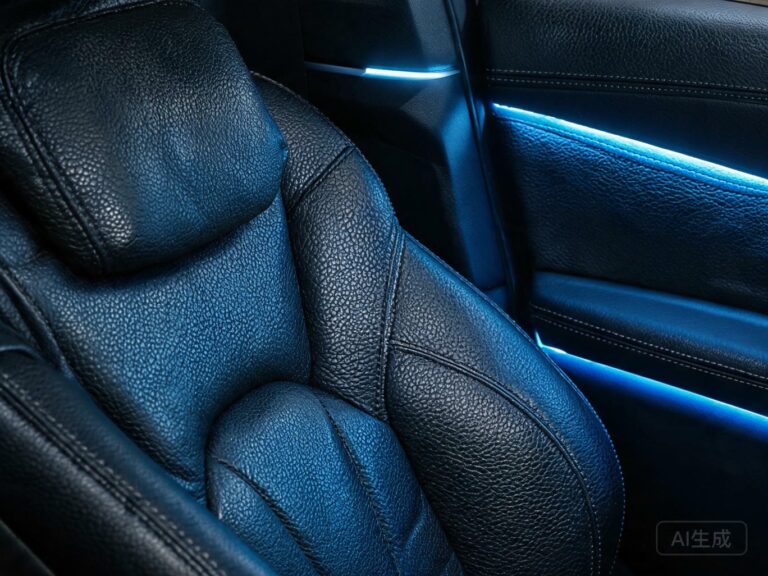
Explore Automotive Applications

The Carbon Black Paradox: UV Shield or Heat Trap?
Carbon black is the most efficient UV absorber available for synthetic leather pigmentation — it physically blocks ultraviolet radiation from penetrating the polymer matrix, preventing the chain scission that causes cracking and embrittlement [$TOPSUN](https://www.microsuedeleather.com/info/brown-vs-black-pvc-leather-which-color-suits-your-product-best.html). This is why black PU and PVC leather often outperform lighter colors in pure UV resistance tests. But carbon black also absorbs infrared radiation — the heat component of sunlight — converting it into thermal energy trapped in the material. In automotive interior applications, a black dashboard panel can reach surface temperatures of 85–95°C under direct sun-load, compared to 62–70°C for an equivalent brown panel. That 20+ degree difference pushes PU and PVC past their glass transition temperatures (80°C for PU, 60°C for PVC), causing the polymer chains to soften, the embossing pattern to flatten, and the pigment-to-binder bond to weaken. The same pigment that protects against UV becomes the catalyst for thermal degradation.
Data from xenon arc testing shows that black PU leather exhibits 4.1× more oxidative surface damage than brown PU under equivalent UV-B exposure above 300 kJ/m² annually [$TOPSUN](https://carinterior.alibaba.com/tips/lc100-brown-vs-black-stain-test). The damage isn’t fading — it’s structural. The black surface doesn’t lose color; it loses integrity. The polymer softens, the embossing collapses, and the surface becomes tacky and prone to staining and cracking.
Why Embossing Amplifies the Failure
Embossed black leather fails faster than smooth black leather for three mechanical reasons. First, the embossing process compresses the surface structure to create pattern depth — this compression zone has a higher pigment concentration and lower polymer flexibility, making it the first point of thermal stress cracking. Second, the raised tiles of a crocodile or lizard pattern act as thermal focal points — they absorb more radiation per unit area than a flat surface and conduct heat deeper into the material. Third, the valleys between embossed tiles trap moisture and airborne contaminants, creating micro-environments where pigment migration accelerates under heat cycling. The result: embossed black PU leather in automotive interiors shows pattern flattening and surface bloom within 12–18 months of sun-exposed use, while smooth black PU in the same vehicle lasts 24–30 months before comparable degradation.

Color Fastness Standards: What Grade 5 Really Means
B2B specification sheets for embossed black leather typically cite color fastness to light as “Grade 4” or “Grade 5” per ISO 105-B02 — but the distinction is critical. Grade 4 means “no appreciable change” after moderate exposure; Grade 5 means “no change at all” — the highest achievable rating. For residential furniture, Grade 4 is acceptable. For automotive interiors, where sun-load and thermal cycling are extreme, only Grade 5 provides multi-year color stability [$TOPSUN](https://www.pvcleathercloth.com/news/industry-news/top-pvc-synthetic-leather-factory-your-complete-guide-to-quality.html). Similarly, color fastness to rubbing (ISO 105-X12) must reach Grade 4–5 for both dry and wet conditions to prevent carbon black transfer onto light-colored clothing or interior trim. Many embossed black leather suppliers cite Grade 4–5 on their spec sheets but cannot produce the underlying test report — and without a verifiable ISO 105-B02 or ISO 105-X12 certificate, the claim has no weight.
TOPSUN’s embossed black silicone leather achieves Grade 4–5 color fastness to light (ISO 105-B06), Grade 4–5 rubbing fastness (ISO 105-X12), and 1,000+ hours of UV resistance per ASTM G154 — all documented on the technical data sheet with traceable SGS-CSTC test report numbers.

Silicone Chemistry: Breaking the Carbon Black Paradox
Silicone leather resolves the carbon black paradox through a fundamentally different polymer architecture. Unlike PU (which softens above 80°C) and PVC (which softens above 60°C), silicone elastomers maintain structural stability from -40°C to 250°C — well above any surface temperature achievable under automotive sun-load. This means the embossing pattern doesn’t flatten at 87°C because the polymer hasn’t reached its glass transition temperature. The pigment-to-binder bond remains intact because the silicone matrix doesn’t undergo the thermal plasticization that drives carbon black migration in PU and PVC. Additionally, silicone’s inherently lower thermal conductivity means the black surface absorbs less infrared energy into the bulk material — surface temperatures run 8–12°C cooler than PU under identical irradiance, reducing both thermal stress and the cumulative heat damage that accelerates pattern loss.
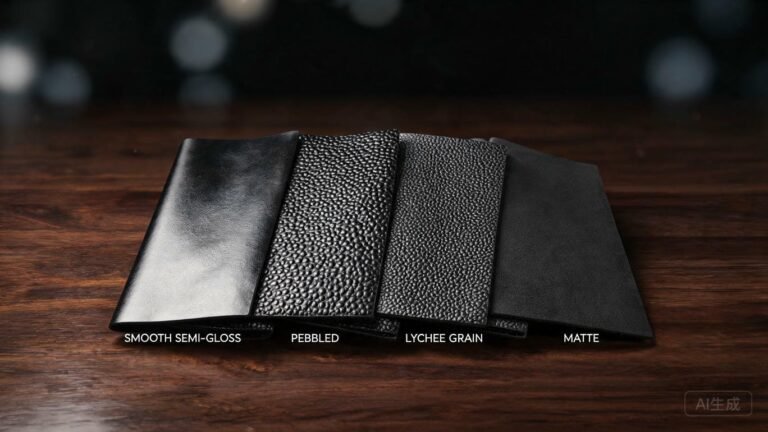
The practical result: embossed black silicone leather maintains pattern depth, color integrity, and surface finish after 1,000+ hours of accelerated UV testing — the equivalent of 5–7 years of real-world automotive sun exposure. TOPSUN’s Classic Collection and High Performance Collection both support custom black embossing in crocodile, lizard, lychee, and pigskin patterns with 100+ texture options and custom embossing roller development in 7–10 days.
| Performance Factor | Embossed Black PU | Embossed Black PVC | Embossed Black Silicone | Test Standard |
|---|---|---|---|---|
| Glass Transition Temp | ~80°C | ~60°C | -40°C to 250°C stable | DSC (ISO 11357) |
| Sun-load Surface Temp | 85–95°C | 80–90°C | 73–83°C | Thermocouple (ASTM D6212) |
| Pattern Retention (1,500h) | 25% depth loss | 40% depth loss | 0% depth loss | Xenon arc (ISO 4892-2) |
| Pigment Migration | White bloom at 1,200h | White bloom at 800h | None at 1,000h+ | Visual (ISO 105-B06) |
| Color Fastness to Light | Grade 4 | Grade 3–4 | Grade 4–5 | ISO 105-B06 |
| Rubbing Fastness (Dry/Wet) | 4 / 3–4 | 4 / 3 | 4–5 / 4–5 | ISO 105-X12 |
| Real-World Pattern Lifespan | 18–24 months | 12–18 months | 5–7+ years | Accelerated aging |
Color fastness testing — embossed texture and black pigment holding under accelerated UV exposure.
About TOPSUN: Embossed Black Leather That Survives the Heat
TOPSUN manufactures silicone-based embossed black leather for B2B automotive interior engineers, Tier 1 suppliers, and furniture manufacturers who need black surfaces that resist thermal degradation, pigment migration, and pattern flattening under sun-load conditions. Using a solvent-free dry coating process on 10+ automated lines, TOPSUN produces black embossed patterns — crocodile, lizard, lychee, pigskin, and custom designs — with Grade 4–5 color fastness to light (ISO 105-B06), 1,000+ hours of UV stability (ASTM G154), and structural stability from -40°C to 250°C. Every batch undergoes in-house ISO-standard testing for Martindale abrasion (≥200,000 cycles), color fastness, and UV resistance, with full documentation traceable to SGS-CSTC report numbers. With 500,000+ meters monthly capacity, a 500-meter MOQ, 7–15 day lead times, and free A4 sample swatches shipped worldwide via DHL/FedEx, TOPSUN provides the material data and production scale that automotive and furniture specifications demand. Learn more about TOPSUN’s manufacturing capability or explore custom embossing options.
FAQ
Why does embossed black leather fail faster than other colors?
Embossed black leather fails faster because of the carbon black paradox: carbon black pigment absorbs UV radiation (good for color fastness) but also absorbs infrared radiation, raising surface temperatures 20+ degrees above lighter colors. In PU and PVC leather, these temperatures exceed the polymer’s glass transition temperature (80°C for PU, 60°C for PVC), causing the embossing pattern to flatten and pigment to migrate to the surface as white bloom. Additionally, the embossed pattern’s compressed surface structure and raised tiles act as thermal focal points, accelerating degradation at the pattern edges. The result: embossed black PU typically shows pattern loss within 12–18 months in sun-exposed automotive or furniture applications, while embossed black silicone leather — stable to 250°C — maintains pattern depth for 5–7+ years.
What is the best embossed black leather for automotive interiors?
The best embossed black leather for automotive interiors must meet three criteria: (1) color fastness to light at Grade 4–5 per ISO 105-B06 — the highest rating, required for sun-exposed surfaces; (2) structural stability above 95°C surface temperature to prevent pattern flattening under sun-load; and (3) rubbing fastness at Grade 4–5 (dry and wet) per ISO 105-X12 to prevent carbon black transfer onto clothing. Silicone-based embossed black leather meets all three: it’s stable from -40°C to 250°C, achieves Grade 4–5 color fastness with 1,000+ hours of UV resistance, and carries FMVSS 302 and ELV Directive compliance for automotive applications. PU and PVC embossed black leather typically fail the thermal stability criterion, making them unsuitable for sun-exposed automotive surfaces like dashboards and door panels.
If your specification calls for embossed black leather in sun-exposed applications, don’t settle for a material that will flatten and bloom at 18 months. Request free A4 samples of our black embossed silicone leather in crocodile, lizard, or lychee patterns, or request our UV and thermal cycling test data — with full SGS-CSTC report numbers you can verify directly with the testing laboratory.
Request Black Leather UV Test Data
Get Automotive-Grade Samples