A restaurant operations manager walks through the dining room after the lunch rush. Booth 7 — upholstered in brown PU leather fabric 14 months ago — shows a sticky residue on the seat surface where a server wiped down a ketchup spill with the restaurant’s standard quaternary ammonium sanitizer. The brown has lightened to a mottled tan at the contact points. The armrest shows fine cracking where grease and cleaning chemicals have alternately soaked and dried the surface. Across the room, Booth 12 — upholstered in brown silicone leather fabric at the same time — shows no discoloration, no stickiness, and no cracking after the same 14 months of food spills, sanitizer wipes, and daily wear. The difference isn’t the color or the texture. It’s the chemistry. Brown leather fabric — the most popular restaurant booth material — fails not from foot traffic but from the cleaning chemicals meant to keep it sanitary. Here are the 5 sanitizer chemicals that dissolve PU leather from the inside out, and why silicone chemistry survives all five without color loss or surface degradation.
Explore Furniture Applications

Why Brown Leather Fabric Fails in Restaurant Environments
Brown leather fabric is the default choice for restaurant booth seating — caramel, cognac, and chocolate tones create warmth that drives customer dwell time and perceived value [$TRAE_REF](https://www.furnileatherfabric.com/top-7-synthetic-leather-color-trends-for-2026-in-furniture-and-upholstery-design/). But the same dining environment that makes brown leather aesthetically ideal also subjects it to the most aggressive cleaning regime in commercial interiors. A restaurant booth seat receives 4–8 sanitizer wipe-downs per day during service hours, plus a deep clean with stronger concentrations after closing. That’s 1,500–2,500 chemical exposures per year — a chemical assault that PU leather’s polyurethane binder was never designed to withstand. The failure pattern is predictable: the sanitizer first strips the topcoat, then penetrates the polyurethane matrix, extracting plasticizers and breaking polymer chains. The surface goes from smooth to sticky, from brown to mottled, and from flexible to cracked — typically within 12–18 months of commercial restaurant use.
Chemical 1: Quaternary Ammonium Compounds (QACs) — The Silent Dissolver
Quaternary ammonium compounds — the active ingredient in most food-service sanitizers like Diversex, Ecolab, and generic “quat” sprays — are the #1 cause of PU leather degradation in restaurants. QACs are cationic surfactants designed to disrupt bacterial cell membranes, but they also disrupt the polyurethane binder’s molecular structure. Repeated exposure causes the polyurethane to soften, lose adhesion to the base fabric, and release plasticizers to the surface as a sticky residue. The brown pigment, no longer securely bound in the degrading matrix, begins to migrate — creating the mottled, lightened appearance that signals terminal damage. In testing, PU leather exposed to 200ppm QAC solution (standard restaurant concentration) shows visible surface softening after 30 daily applications — approximately 4 weeks of normal restaurant cleaning.

Chemical 2: Sodium Hypochlorite (Bleach) — The Color Stripper
Bleach solutions at 200ppm (the EPA-approved concentration for food-contact surface sanitizing in restaurants) are chemically incompatible with PU and PVC leather. Sodium hypochlorite is a strong oxidizer that attacks the chromophores in brown pigments — particularly the iron oxide and organic brown dyes used in PU formulations. The result: brown leather fabric develops permanent light spots at every bleach contact point, and the oxidized polymer surface becomes brittle and prone to cracking. In restaurant environments where bleach solutions are used for deep cleaning and health inspection preparation, even incidental splash contact can cause visible color loss within minutes. Silicone leather, by contrast, is bleach-safe — the siloxane backbone is chemically inert to sodium hypochlorite at food-service concentrations, and the pigments are locked into a matrix that resists oxidative attack.
Chemical 3: Isopropyl Alcohol (70%) — The Plasticizer Extractor
Seventy-percent isopropyl alcohol — the standard surface disinfectant used in restaurants, bars, and food preparation areas — is an effective solvent for the plasticizers that keep PU leather flexible. Each alcohol wipe-down extracts a small percentage of phthalate and non-phthalate plasticizers from the polyurethane matrix, progressively stiffening the surface. After 6–8 months of daily alcohol disinfection, PU brown leather fabric loses enough plasticizer to become rigid and prone to flex cracking at seat edges and armrest curves. PVC leather suffers even more severely: alcohol accelerates the leaching of PVC’s phthalate plasticizers, causing the familiar “hardening and cracking” pattern that restaurant operators mistakenly attribute to “wear and tear” rather than chemical extraction. Silicone leather contains no extractable plasticizers — its flexibility is intrinsic to the siloxane polymer chain, not added as a secondary compound — making it fully compatible with repeated alcohol disinfection.

Chemicals 4 & 5: Hydrogen Peroxide and Chlorine Dioxide — The Oxidizers
Hydrogen peroxide (3–6% concentration) and chlorine dioxide (50–100ppm) are increasingly used in restaurant sanitizing protocols as alternatives to QACs and bleach, particularly in operations pursuing “green cleaning” certifications. Both chemicals are powerful oxidizers that accelerate polymer chain scission in PU and PVC leather. Hydrogen peroxide attacks the ether linkages in polyurethane, causing progressive embrittlement that manifests as surface cracking within 8–12 months of regular exposure. Chlorine dioxide, used for its broad-spectrum antimicrobial efficacy, is even more aggressive — it breaks both the polymer backbone and the pigment bonds simultaneously, causing accelerated color loss and surface degradation in PU formulations. Silicone leather’s siloxane (Si-O-Si) backbone is resistant to oxidative attack from both chemicals, maintaining surface integrity and color stability through repeated exposure.
| Cleaning Chemical | Effect on PU Leather | Effect on PVC | Effect on Silicone Leather | Restaurant Use |
|---|---|---|---|---|
| Quat Ammonium (200ppm) | Softens binder; pigment migration | Plasticizer extraction | No effect | Daily surface sanitizer |
| Sodium Hypochlorite (200ppm) | Color stripping; embrittlement | Color loss; hardening | Bleach-safe; no color change | Deep clean; inspection prep |
| Isopropyl Alcohol (70%) | Plasticizer extraction; stiffening | Phthalate leaching; cracking | No effect; fully compatible | Surface disinfectant |
| Hydrogen Peroxide (3–6%) | Chain scission; embrittlement | Oxidative degradation | No effect; oxidative inert | Green cleaning protocol |
| Chlorine Dioxide (50–100ppm) | Backbone + pigment breakdown | Accelerated degradation | No effect; chemically inert | Broad-spectrum antimicrobial |
| Real-World Lifespan | 12–18 months | 8–12 months | 7–10+ years | Daily restaurant cleaning |
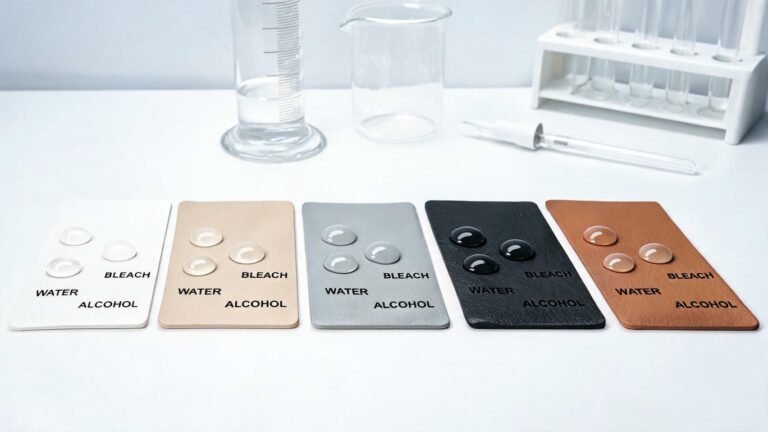
Waterproof and stain resistance test — the surface defense that lets sanitizers wipe off instead of soaking in.
About TOPSUN: Brown Leather Fabric That Survives the Wipe-Down
TOPSUN manufactures silicone-based brown leather fabric for B2B restaurant operators, food service designers, and commercial furniture manufacturers who need FDA-compliant, sanitizer-resistant brown upholstery surfaces that withstand repeated chemical cleaning without color loss, surface degradation, or cracking. Using a solvent-free dry coating process, TOPSUN produces brown leather fabric in caramel, cognac, chocolate, and custom Pantone-matched shades (Delta E ≤ 1.0) with FDA 21 CFR 177.2600 food-contact compliance, ISO 10993-5 biocompatibility certification, and inherent antimicrobial properties that inhibit bacteria, mold, and mildew without chemical additives. The non-porous silicone surface repels liquids, resists stains from food oils and sauces, and maintains surface integrity through repeated cleaning with QACs, bleach, alcohol, hydrogen peroxide, and chlorine dioxide — verified through in-house ISO-standard testing. With 500,000+ meters monthly capacity, a 500-meter MOQ, 7–15 day lead times, and free A4 sample swatches shipped worldwide, TOPSUN provides the chemical resistance data and production scale that food service specifications demand. Learn about TOPSUN’s manufacturing capability or review cleaning and maintenance protocols.
FAQ
What is the best brown leather fabric for restaurant booths?
The best brown leather fabric for restaurant booths is silicone-based leather — the only synthetic leather that withstands all 5 common restaurant sanitizers (QACs, bleach, alcohol, hydrogen peroxide, and chlorine dioxide) without color loss, surface degradation, or plasticizer extraction. PU leather — the most common booth material — fails within 12–18 months due to chemical attack from daily sanitizer wipe-downs, while PVC fails even faster at 8–12 months. Silicone leather is FDA 21 CFR 177.2600 food-contact compliant, inherently antimicrobial (inhibits bacteria and mold without chemical additives), bleach-safe, and cleanable with water alone — making it the only material that maintains both its brown color and surface integrity through multi-year restaurant use. Additionally, silicone leather achieves a 200,000+ Martindale abrasion rating, meaning it survives both the chemical assault and the physical wear of high-traffic restaurant seating.
Can brown leather fabric withstand restaurant sanitizers?
Only silicone-based brown leather fabric can withstand restaurant sanitizers long-term. PU leather degrades when exposed to quaternary ammonium compounds (the active ingredient in most food-service sanitizers), which soften the polyurethane binder and cause pigment migration. Bleach strips brown pigments through oxidation. Isopropyl alcohol extracts plasticizers, causing stiffening and cracking. Hydrogen peroxide and chlorine dioxide break polymer chains through oxidation. Silicone leather survives all five because its siloxane (Si-O-Si) backbone is chemically inert to these cleaning chemicals — it contains no extractable plasticizers, no ester bonds to hydrolyze, and no oxidizable chromophores. The material is bleach-safe, alcohol-compatible, and maintains its brown color and surface flexibility through years of daily restaurant sanitizing protocols.
If you’re specifying brown leather fabric for restaurant booths, bar stools, or food service furniture and need material that survives daily sanitizing — not just the first month — request free A4 samples of our brown silicone leather, or request our chemical compatibility test data showing performance against all 5 restaurant sanitizer classes.
Request Restaurant Material Samples
Get Cleaning Compatibility Data