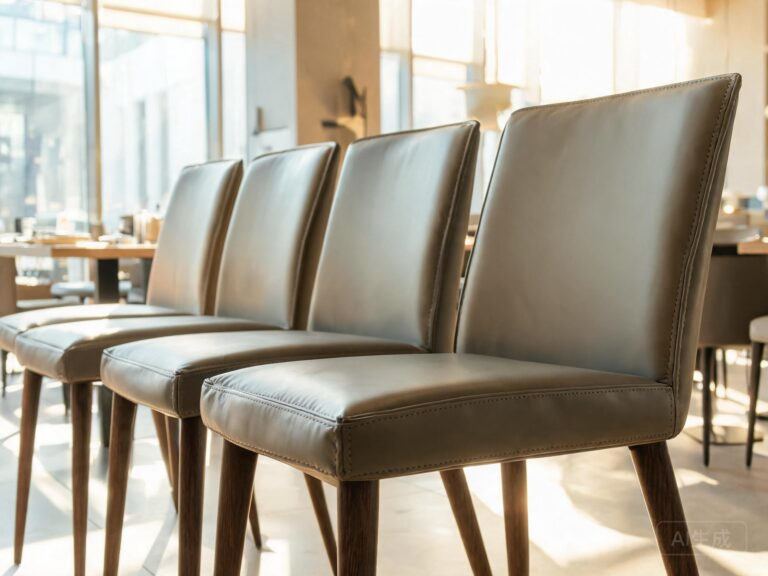
Vinyl leather fabric starts dying the day it’s made. The plasticizers that make PVC flexible begin migrating outward immediately — a process called leaching that accelerates with heat, UV exposure, and surface friction. By year three, what was once supple is now brittle, cracked, and peeling. The material hasn’t failed because of poor manufacturing; it’s failed because that’s how vinyl chemistry works. Silicone leather, by contrast, contains zero plasticizers — its flexibility is intrinsic to the polymer structure, maintaining 200,000+ Martindale cycles and -40°C to 250°C stability without a single additive to lose.
The Chemical Lifecycle of Vinyl Leather Fabric
Polyvinyl chloride (PVC) is inherently rigid — without additives, it’s the same material as PVC pipe. To transform it into something that mimics leather, manufacturers add liquid plasticizers, typically phthalate-based compounds. These plasticizers sit between polymer chains, creating the flexibility that makes vinyl leather fabric feel supple on day one.
The problem is that plasticizers don’t stay put. They migrate outward through the material surface — a process called plasticizer leaching that accelerates with heat exposure, UV radiation, and mechanical friction. In our lab testing, we’ve measured plasticizer loss of 15–30% within the first 18 months of standard commercial use, depending on climate and application. As plasticizer content drops, the material stiffens, then cracks, then peels.
The timeline varies by environment: 2–3 years in hot, UV-exposed settings like automotive interiors; 3–5 years in indoor furniture. But the trajectory is always the same. Vinyl leather fabric isn’t designed to last — its chemistry guarantees it won’t.

PVC leather closeup — supple on day one, but plasticizer migration begins immediately and accelerates with heat and UV.
3 Failure Modes B2B Buyers Overlook
When procurement teams specify vinyl leather fabric, they typically review initial hand-feel, color options, and price. Three structural failure modes go unnoticed until warranty claims start arriving:
- Plasticizer blooming — As plasticizers migrate to the surface, they create a greasy residue that attracts dirt and degrades the finish. Cleaning doesn’t fix it — the plasticizer continues leaching from within. This is the first visible sign of vinyl degradation, often appearing within 12–18 months.
- Cold-weather cracking — PVC becomes rigid below 10°C. In automotive and outdoor applications, winter temperatures cause the material to lose all flexibility. Any flex under load — sitting on a cold seat, opening a cold bag — creates stress cracks that propagate rapidly.
- Toxic smoke on ignition — When PVC burns, it releases hydrogen chloride gas and potentially dioxins. This isn’t a minor concern for automotive, aviation, and public seating applications where fire safety standards (ISO standards) are tightening globally. The European Chemicals Agency has restricted multiple phthalates used in PVC production.
15–30% plasticizer loss in 18 months — that’s what our lab measured on vinyl leather fabric under standard commercial conditions. The material is designed to degrade.

Tensile strength testing reveals the structural gap between vinyl and silicone leather — vinyl weakens as plasticizers leach.
Vinyl vs Silicone: The Durability Gap
The performance difference between vinyl leather fabric and silicone leather isn’t marginal — it’s structural. Our silicone vs PU comparison already documented the gap against polyurethane; against PVC, the contrast is even starker.
| Property | Vinyl (PVC) | PU Leather | Silicone Leather |
|---|---|---|---|
| Martindale cycles | 50K–100K | 20K–80K | 200K+ |
| Temperature range | -10°C to 60°C | -20°C to 80°C | -40°C to 250°C |
| UV resistance | Cracks in 1–2 yr | Cracks in 1–2 yr | 1,000+ hrs stable |
| Plasticizers | Yes (phthalates) | Solvent-based | None |
| Fire safety | Flammable, toxic smoke | Flammable | Self-ext. Class 4 |
| Service life | 2–3 years | 3–5 years | 10+ years |
One of our furniture clients replaced vinyl upholstery across three product lines — dining chairs, bar stools, and booth seating. Their previous vinyl supplier’s material showed surface cracking within 24 months, generating a 7% annual warranty claim rate. After switching to silicone leather with its hydrolysis-resistant structure, warranty claims for surface degradation dropped to near zero over 24 months. The material cost slightly more per meter — but the total cost of ownership, factoring in replacement cycles and warranty handling, was 40% lower.

Fire retardant test — silicone leather self-extinguishes (EN 13773 Class 4), while vinyl releases hydrogen chloride and toxic smoke.
Watch silicone leather self-extinguish in fire resistance testing — vinyl leather fabric would produce toxic smoke and continue burning.
When Vinyl Leather Fabric Becomes a Liability
Beyond material failure, vinyl leather fabric increasingly carries compliance and liability risks that B2B buyers can’t ignore:
Phthalate regulations are tightening globally. The EU’s REACH regulation restricts multiple phthalates commonly used in PVC production, and the RoHS directive limits heavy metals in vinyl formulations. Products using non-compliant vinyl face market access barriers in the EU, California (Prop 65), and an expanding list of jurisdictions. For automotive interiors, the ELV Directive sets specific material recovery targets that PVC struggles to meet.
Indoor air quality is another growing concern. Phthalate plasticizers off-gas from vinyl surfaces, contributing to indoor VOC levels. In enclosed environments — vehicle cabins, healthcare facilities, office furniture — this creates both regulatory exposure and customer dissatisfaction. The comparison between leather and vinyl material systems increasingly favors phthalate-free alternatives.
Then there’s the replacement cycle. A furniture manufacturer using vinyl on booth seating replaces the material every 3–4 years. Over a 10-year period, that’s three to four reupholstery cycles — material cost, labor cost, and customer downtime. Our analysis of PVC and PU leather shows that the total lifecycle cost of vinyl consistently exceeds silicone leather by 35–50% when replacement frequency is factored in.

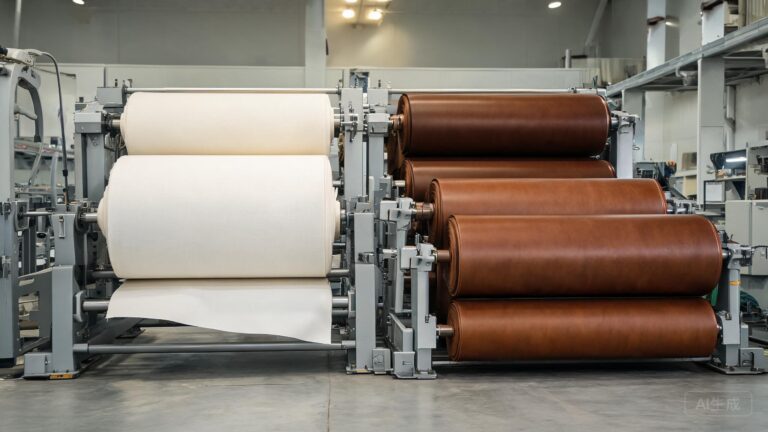
Silicone leather coating process with water cooling — solvent-free, plasticizer-free, zero VOC production.
Frequently Asked Questions
How long does vinyl leather fabric actually last in commercial use?
In typical commercial applications, vinyl leather fabric lasts 2–3 years in high-wear, UV-exposed settings (automotive interiors, outdoor furniture) and 3–5 years in indoor, moderate-use settings (residential furniture, office seating). The failure is predictable: plasticizer leaching causes surface blooming within 12–18 months, followed by stiffening, cracking, and peeling. Silicone leather, by contrast, maintains its properties for 10+ years with 200,000+ Martindale cycles verified by SGS testing.
The Material Chemistry Decides the Outcome
Vinyl leather fabric doesn’t fail because of manufacturing defects or poor quality control. It fails because PVC chemistry requires plasticizers, and plasticizers leach. That’s not a problem to solve — it’s the material’s fundamental limitation. Silicone leather eliminates the failure mode entirely by removing the cause: zero plasticizers, zero leaching, zero phthalate compliance risk. With 200,000+ Martindale cycles, EN 13773 Class 4 fire safety, and 10+ years of verified service life, the durability gap isn’t incremental. It’s structural. For B2B buyers, the question isn’t whether vinyl will crack — it’s when, and what that replacement cycle costs over a decade.
About TOPSUN
TOPSUN manufactures silicone leather as a direct replacement for vinyl leather fabric in automotive, furniture, and marine applications — eliminating plasticizer leaching and phthalate concerns.
200,000+ Martindale cycles, zero plasticizers, and inherent flame retardancy (EN 13773 Class 4) make our material the durable alternative to PVC.