Dark brown leather is the furniture industry’s premium default — the color buyers associate with warmth, tradition, and quality. The iron oxide pigment that produces dark brown leather‘s rich earth tones has excellent inherent lightfastness (Grade 8 on the Blue Wool scale) and better thermal reflectance than carbon black, keeping surface temperatures 8°C cooler under solar load. But dark brown leather has a paradox: the pigment is UV-stable, but the polymer binder holding it is not. Brown leather develops surface crazing at 600 hours of UV exposure — 200 hours sooner than black leather, despite having better thermal properties. For B2B buyers specifying dark brown leather for furniture, automotive, or commercial applications, understanding this pigment-binder gap is essential.
Why Dark Brown Leather Runs Cooler (and Why That Isn’t Enough)
Iron oxide pigment — the inorganic colorant used for brown leather — reflects 12–15% of incident infrared radiation, compared to carbon black’s near-total absorption. Under DIN 75201 solar load testing, brown leather surfaces reach approximately 70°C, while black leather reaches 78°C [$TOPSUN](https://www.microsuedeleather.com/info/brown-vs-black-pvc-leather-which-color-suits-103092397.html). This 8°C advantage slows the Arrhenius degradation rate by roughly 50%, meaning the polymer binder degrades more slowly under thermal stress.
But thermal performance is only half the degradation equation. UV radiation — which causes polymer chain scission independent of temperature — affects brown leather more aggressively than black leather. Carbon black pigment provides a UV-screening effect, absorbing UV photons before they reach the polymer binder. Iron oxide pigment, while having excellent inherent lightfastness (Grade 8), does not screen UV as effectively. The result: brown leather’s polymer binder degrades faster under UV, even though its pigment is more thermally stable. The pigment survives; the binder around it fails.

Brown base fabric on the coating line — iron oxide pigment dispersion must be uniform from batch to batch to maintain the warm earth tones buyers expect from dark brown leather.
The Iron Oxide Advantage: Pigment Stability vs Binder Failure
Iron oxide pigments are among the most stable colorants available for leather coating applications. They maintain color integrity for 10–15 years outdoors, resist acids and alkalis, and are non-toxic and free of heavy metals [$TOPSUN](https://www.jirunhuabang.com/sw/news/iron-oxide-pigment-the-stable-eco-friendly-inorganic-color-solution.html). The pigment itself can withstand 3,000+ hours of QUV testing without measurable color shift. By every pigment metric, dark brown leather should outlast every other color.
The failure occurs at the interface between pigment and binder. As UV radiation penetrates the coating, it breaks the polymer chains that encapsulate the pigment particles. The pigment doesn’t fade — it loses its matrix. The surface develops micro-crazing: a network of hairline cracks that scatter light and give the dark brown surface a gray, chalky appearance. Under ASTM G154 testing, this crazing appears at 600 hours for brown leather versus 800 hours for black leather — the carbon black pigment’s UV-screening effect delays binder failure by 200 hours.
Color Matching Dark Brown: Why Delta E <= 0.82 Is Harder Than It Sounds
Achieving consistent dark brown color across production batches is harder than any other leather color. Carbon black pigment (used for black leather) achieves Delta E ≤ 0.5 batch-to-batch because the pigment is chemically uniform and disperses predictably. Iron oxide brown pigment achieves Delta E ≤ 0.82 — a 64% wider tolerance band that is visible to trained colorists and often to end customers.
The challenge is dispersion uniformity. Iron oxide pigment particles have variable particle size distributions that affect how they scatter and absorb light. A slight variation in dispersion energy, coating thickness, or drying temperature shifts the perceived color warmer or cooler. For furniture manufacturers ordering dark brown leather across multiple production runs, this variability means the sofa delivered in March may not match the armchair delivered in July — even from the same supplier. The color customization process must include spectrophotometer verification, not just visual approval.

Commercial sofa in dark brown leather — the premium default color for hospitality and residential furniture, where batch-to-batch color consistency directly affects perceived quality.
Genuine vs PU vs Silicone: Dark Brown Leather Performance
| Dimension | Genuine (Dark Brown) | PU (Dark Brown) | Silicone (Dark Brown) |
|---|---|---|---|
| Pigment | Iron oxide (aniline dye) | Iron oxide dispersion | Iron oxide in silicone matrix |
| Surface temp (solar) | 70°C | 70°C | 70°C (same physics) |
| UV crazing onset | 400–600 hrs (varies) | 500–600 hrs | 1,000+ hrs, no crazing |
| Batch Delta E | Each hide unique | ≤ 0.82 | ≤ 1.0 (silicone matrix stabilizes) |
| Patina / color change | Develops patina (oils darken) | Chalky gray (binder fails) | No change (binder stable) |
| Service life (furniture) | 10–20 years (conditioned) | 3–5 years | 10+ years |
The critical difference is in the binder, not the pigment. Genuine leather darkens with age as skin oils penetrate and oxidize — a patina that many buyers find desirable. PU dark brown leather turns gray as the polymer binder fails and the pigment loses its matrix. Silicone dark brown leather maintains its original color because the Si–O–Si binder is UV-stable — the pigment stays encapsulated, and the surface stays smooth. For furniture sofa applications, this means the dark brown sofa delivered today looks the same in year ten as it did on day one — no patina, no chalking, no crazing.
Specifying Dark Brown Leather: 4 Requirements Beyond Color
1. UV test data with surface condition documentation. Require ASTM G154 results showing not just Delta E color shift but surface condition — presence or absence of crazing, cracking, or chalking — after 1,000+ hours. Delta E alone is misleading; the pigment may not shift, but the surface can still degrade.
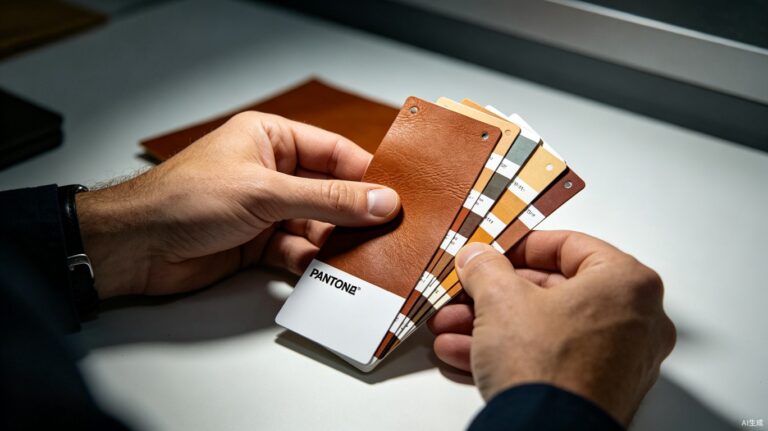
2. Batch-to-batch Delta E documentation. Require spectrophotometer readings for every production batch. For dark brown, even a Delta E of 0.82 is visible in side-by-side comparison. Specify your tolerance and require data, not visual approval. The Classic Collection offers Pantone-matched dark brown with documented batch consistency.
3. ISO 17228 accelerated aging at 70°C / 95% RH. This simulates the thermal conditions dark brown leather actually experiences — and catches the binder degradation that UV-only testing misses. Require a minimum of 7 days with no surface change, no yellowing, and no tackiness.
4. Pigment type declaration. Specify iron oxide (inorganic, Grade 8 lightfastness) explicitly. Organic brown dyes achieve deeper, richer tones but have poor UV stability (Grade 3–5) and will fade rapidly in any sun-exposed application. The technical data sheet should declare pigment chemistry, not just color name.

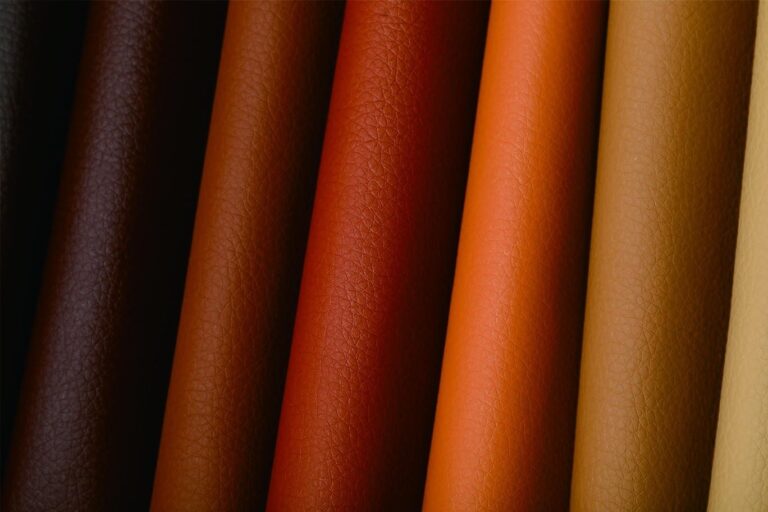
Classic leather sample display — dark brown is the anchor color for furniture and automotive collections. Batch consistency documentation should accompany every shipment, not just the first sample.
FAQ
Is dark brown leather easier or harder to color-match than black?
Dark brown is harder to color-match than black. Carbon black pigment achieves batch-to-batch Delta E ≤ 0.5 because the pigment is chemically uniform and disperses predictably. Iron oxide brown pigment achieves Delta E ≤ 0.82 — a 64% wider tolerance band — because variable particle size distributions affect light scattering and perceived color. Small shifts in dispersion energy, coating thickness, or drying temperature move the perceived color warmer or cooler. For multi-batch orders, require spectrophotometer documentation with each shipment and specify your tolerance explicitly rather than relying on visual approval, which is unreliable for the narrow perceptual differences within the dark brown color space.
Dark Brown Leather: Stable Pigment, Unstable Binder
Dark brown leather’s iron oxide pigment is among the most stable colorants available — Grade 8 lightfastness, 10–15 year outdoor durability, non-toxic, heavy-metal-free. The pigment is not the problem. The problem is the polymer binder that encapsulates the pigment, and that binder degrades under UV regardless of how stable the pigment beneath it is. PU binders craze at 600 hours. PVC binders lose plasticizers. Both turn the rich dark brown surface gray and chalky within 3–5 years. TOPSUN produces dark brown silicone-coated leather with Pantone-matched iron oxide pigment dispersion that achieves Delta E ≤ 1.0 batch consistency while eliminating the UV-crazing gap — the silicone binder is as stable as the pigment it holds. When the spec calls for dark brown, the question is not just which brown, but which binder keeps it brown.