The Q2 warranty file landed on my bench with three photos of the same sofa SKU. One armrest carried a crescent gouge from a key ring. One bolster was laddered with parallel claw marks from a dog using it as a launch pad. One seat edge had gone silver where denim rivets had dragged across it for two summers. Every spec sheet in that program promised scratch resistant leather, and the promise was useless — because those three failures are three different physical events, and “scratch resistance” is four different problems wearing one name. Here is how to tell them apart, how each one is actually tested, and which defense stops which attack.
Order Free Scratch-Test Swatches
Four Ways Seating Actually Gets Scratched
Before you can buy your way out of scratches, you have to know which attack your product will absorb. Sorting thousands of damage claims by cause, four vectors cover almost everything we see in the field.
The first is point-load gouging: keys, belt buckles, jewelry, luggage hardware pressing a sharp profile into the surface with concentrated force. The second is repeated sliding scuff — denim rivets and back-pocket seams dragging across a seat front edge until the coating wears through and the surface reads gray. The third is claw damage, the parallel lacerations and puncture marks left by dogs and cats; pet exposure is why an entire “cat scratch proof leather” product category now exists on wholesale marketplaces, mostly 1.1 mm pebble-grain synthetics. The fourth is micro-abrasion: grit and sand ground into the surface by everyday sliding, which shows up as an overall dull haze rather than any single mark. Pet-heavy programs face the harshest mix of vectors at once — our notes on selecting leather for pet products break down which constructions hold up under claws.
| Damage vector | Typical object | Damage signature | Defense that works |
|---|---|---|---|
| Point-load gouge | Keys, key rings, buckles | Single crescent or linear groove, coating displaced | High surface hardness or elastic recovery that closes the mark |
| Sliding scuff | Denim rivets, seams, zippers | Matte gray haze lines on seat edges, coating transfer | High abrasion cycles (Taber / Martindale) plus a broken texture |
| Claw damage | Dog claws, cat kneading | Parallel lacerations with puncture entry points | Puncture resistance, elastic surface, pebbled grain to hide residue |
| Micro-abrasion | Grit, sand, sliding trays | Uniform dulling and haze across touch zones | Abrasion resistance plus easy cleaning that removes grit fast |

Pets combine three damage vectors in one household — gouge, claw, and abrasion at the same time.
How Scratch Resistant Leather Is Really Tested
There is no single instrument called a “scratch test” that covers all four vectors, and that gap is where weak claims hide. The workhorse for abrasion is the rotary-platform Taber method. Leather got its own dedicated version in 2006 — ASTM D7255, which fixed the reliability problems that came from testing hides on textile methods. The international equivalent is ISO 17076-1:2020. A Taber claim is only meaningful when the wheel grade, load, and cycle count ride along with it: 1,000 g on CS-10 wheels to a defined endpoint is a spec; “abrasion resistant” alone is a brochure.
For the sliding-scuff vector, Martindale cycles under ISO 12947-2 measure flat rubbing endurance — the closest lab proxy for a rivet dragging across a seat edge two thousand times. For point-load gouging, pencil hardness under ASTM D3363 ranks how hard a tip the surface resists. And for claw puncture, only a puncture or lacing test with a defined stylus tells you anything at all. When we release a construction, every one of those numbers is generated in our own lab on the exact recipe being shipped — the production and testing workflow runs per-construction, not per marketing line.
The headline number for sliding wear on our silicone constructions is 200,000+ Martindale cycles, and the full method behind that figure is traced in the abrasion test breakdown.

Rotary-platform abrasion testing: the numbers only count when wheel grade, load, and cycles are stated together.
Texture as Engineering: Why Pebbled Grain Hides What Smooth Shows
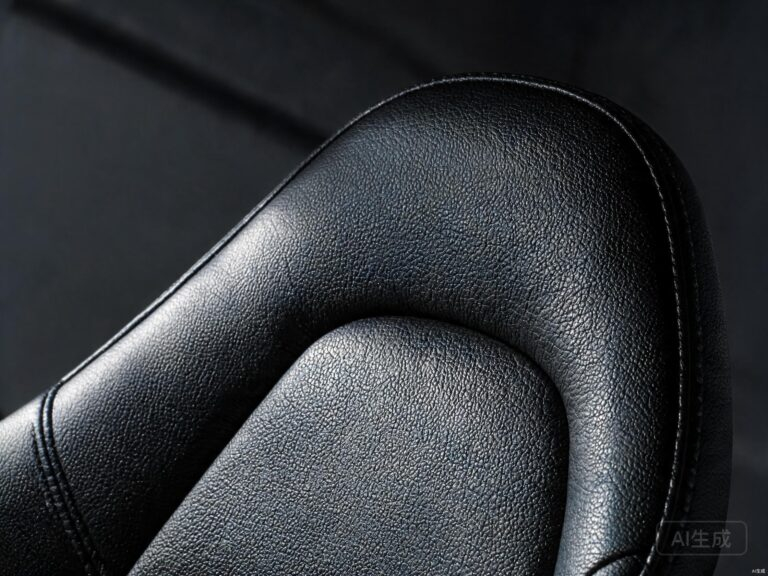
The cheapest scratch defense is not a coating — it is geometry. On a pebbled or lychee grain, raised domes take the contact while the valleys below never meet the offending object, so light abrasion lands on high ground and micro-marks disappear into the pattern’s shadow. A smooth, flat surface behaves like a mirror: it has nowhere to hide, and every scuff reflects light straight at the customer. That optical camouflage is why pebble grain dominates the pet-resistant product listings on wholesale marketplaces. Texture also breaks up the contact area of a sliding object, spreading a scuff that would otherwise cut one bright line across flat grain. The practical takeaway for specifiers: in scratch-heavy environments, a well-engineered embossed grain buys you visible-damage headroom that no chemistry alone provides, and pattern depth can be specified like any other parameter.

Pebbled grain in macro: raised domes absorb contact, valleys hide what gets through.
Choosing Scratch Resistant Leather by Defense Mechanism
Materials fight scratches with one of three mechanisms, and each one maps to a different vector. Pigmented finishes on genuine leather rely on a replaceable surface: light marks buff out under finger pressure and deeper ones blend into patina, which reads as character in residential settings but as damage in a hotel lobby. PU and painted synthetics rely on a hard topcoat film — excellent against gouging in year one, but the film is a fixed layer that ages, embrittles, and eventually cracks at flex zones. Silicone leather works differently: the elastic polymer network recoils after a shallow indent, so many marks that would scar a rigid film simply close again.
If the mechanism is new to your sourcing team, a plain-language overview of how silicone leather is built and behaves is worth five minutes before the material meeting.
Then match the mechanism to your dominant vector: hard films for gouge-light interiors, elastic surfaces plus pebbled grain for pets and public seating. The full set of abrasion, hardness, and flex numbers for our constructions sits in the technical data sheet.
A scratch-resistance run on silicone leather: watch shallow marks close instead of staying.
Frequently Asked Questions
Can scratches be removed from leather?
Light surface marks on pigmented or coated finishes often buff out with a finger or a little conditioner, because the color layer is intact underneath. Deeper cuts need binder and filler kits, and on textured surfaces the repair rarely disappears completely. Elastic surfaces change the question: a mark that closes on its own never needs repairing.
What is the most scratch resistant leather?
No single type wins, because the title depends on the attack. Against gouging, a hard finish or high pencil hardness leads. Against claws and scuffs, an elastic surface under a pebbled grain outperforms both, since it recovers from shallow marks and hides the rest. The honest answer is a defense stack matched to your damage vector, backed by test numbers.
Do cat and dog claws ruin leather furniture?
Woven upholstery snags and ladders; solid leather surfaces do not snag, but claws can puncture and score any coating. Pebbled grain plus an elastic substrate keeps most claw contact from reading as damage, which is why pet-facing programs specify exactly that combination. A determined scratcher will eventually mark any material — the goal is damage that disappears, not damage that never happens.
Specifying Scratch Resistant Leather: Ask for the Test, Not the Adjective
Scratch resistant leather is not a material grade — it is a claim, and it only means something when the damage vector and the test method are named together. Start by identifying which of the four attacks your product will actually absorb. Then demand the matching evidence: Taber cycles under ASTM D7255 or ISO 17076-1 with wheel and load stated, Martindale cycles for sliding wear, pencil hardness for gouging, puncture data for pets. Put texture on your side as free insurance. The suppliers who can answer that question in numbers, per construction, are the ones whose warranty files stay thin.
Request the Scratch Test Data Pack
About TOPSUN
TOPSUN manufactures silicone leather for scratch-heavy seating programs, with abrasion and surface-hardness testing run in-house on every construction before it ships.
200,000+ Martindale cycles under ISO 12947-2, Taber abrasion and ASTM D3363 pencil hardness data per construction, 100+ embossed textures including pebbled grains specified by pattern depth, and free A4 swatches shipped worldwide.